

In This Article
Your dashboard says your AI share of voice is 23%, and nobody in the meeting can tell you 23% of what.
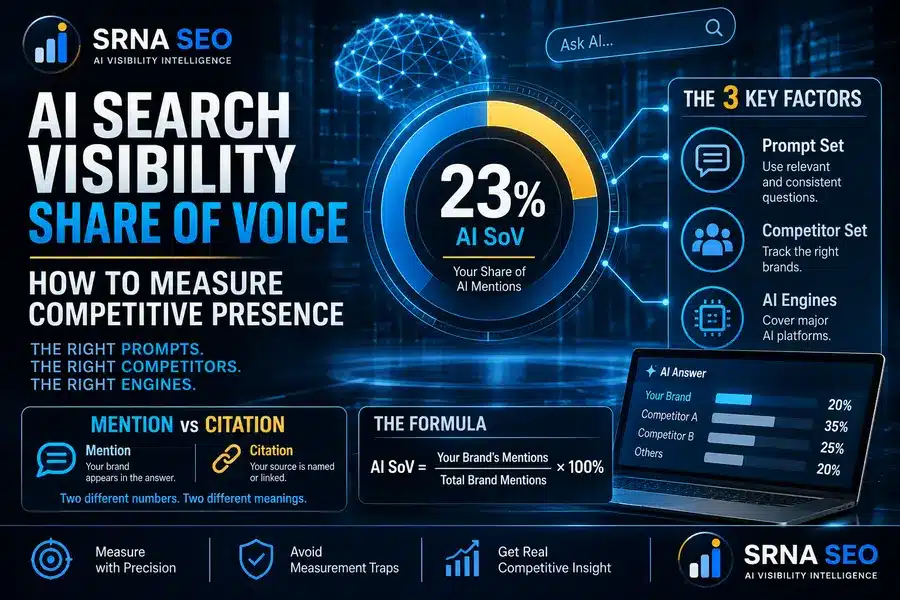
That is the problem. AI search visibility share of voice only becomes a real number when you fix three things before you measure: the prompt set, the competitor set and the AI engines. Change any one of them and the percentage moves while nothing real has changed. And mention share and citation share are two different numbers, so do not merge them into one score and call it visibility.
What AI Search Visibility Share of Voice Actually Is
AI search visibility share of voice (AI SoV) is your brand’s share of all tracked brand appearances in AI-generated answers, counted over the same fixed set of prompts, engines and competitors.
The formula is simple: AI SoV = your brand’s mentions ÷ mentions of all tracked brands, counted over the same set of AI answers
An illustrative example, not real data: you are mentioned 40 times, all tracked brands together are mentioned 200 times, so your AI SoV is 20%. Simple. And almost every dashboard stops right there, which is where the trouble starts.
Two terms I will use throughout. A mention is your brand name appearing in the answer text. A citation is a source the AI engine names or links to support the answer (your page, a review site, a Wikipedia entry, a competitor’s blog). You can be mentioned without being cited, and cited without being mentioned. Different events, different business meaning.
What is in This Series
This article is part of cluster How to Measure Your Presence in AI Search Engines, the series hub containing the: How to Optimize Your Website for ChatGPT, How to Measure Your Presence in ChatGPT, How to Optimize Your Website for Perplexity, How to Measure Your Presence in Perplexit, How to Optimize Your Website for Claude, How to Measure Your Presence in Claude.
Also read AI Search Visibility Share of Voice, for turning mentions into a competitive number
Why Classic Share of Voice Logic Breaks in AI Search
In classic SEO, share of voice was built on rankings. Position one gets more clicks than position three, you multiply by search volume, you get a share. It was never perfect, but it worked as a trend line.
AI answers do not work like that. There is no page one with ten slots. The engine writes one answer, names a handful of brands, and the rest of the market is simply absent. One study of a million keywords, as reported by Topify, found only 38% overlap between AI citations and the top ten search results. So your rank tracker can look healthy while your AI presence is thin. I see this pattern constantly, and I wrote about the structural reason in Why SEO Tools Cannot Audit AI Visibility.
And there is a second break. The same question asked five different ways can give you five different sets of brands (this is often called prompt-variation volatility). So a single run tells you almost nothing. A share of voice number from one run of one prompt is an anecdote, not a measurement.
The Four Numbers I Would Put on One Page
Most competitors in this space sell you one percentage. In-house, I never got one question from a VP that a single percentage could answer. They asked: are we winning, where are we losing, and who is taking it. That needs four numbers.
| Number | What it counts | What it answers | The trap |
|---|---|---|---|
| Mention share | Your brand name in answers vs all tracked brands | Does the AI know you exist in this category? | Rewards being named in a bad context too |
| Citation share | Your URLs and domains cited vs all cited sources | Does the AI trust your content as a source? | Ignores that third-party pages may be doing the work for you |
| Weighted share | Mention share with prompts weighted by commercial intent | Are you winning where money is decided? | Weights are a judgment call, document them |
| Prominence | Where in the answer you appear (first recommendation or buried) | Are you the answer or an afterthought? | Position is unstable between runs, report ranges |
If you can only afford one cut, split everything by engine. Strong presence in one chatbot does not guarantee the same in another, so averaging across engines hides exactly the gap you need to see. Report each engine on its own line.
How to Set It Up (Five Steps, Fixed Before You Collect Anything)
1. Build the prompt set from buyer questions, not from keywords or your corporate language. Group prompts in four buckets: category (“best X for Y”), comparison (“A vs B”), problem-aware (“how do I fix Z”) and branded. A smaller, clean set beats a huge noisy one. My working range is 30 to 60 prompts per topic cluster to start, but that is my rule of thumb, not a statistical standard. Version the set and keep a change log, because the day you edit prompts, your history breaks.
2. Define the competitor set honestly. Include the competitors your sales team names. Then add the one nobody in your CRM names but the AI keeps recommending. And write down every alias and spelling of each brand, otherwise the count is wrong. Ambiguous names are a real failure here, I explained how to fix them in Entity Ambiguity Resolution.
3. Choose the engines and keep them fixed. Pick the ones your buyers use. Do not add a new engine mid-quarter and then compare the quarters.
4. Sample more than once. Run each prompt several times per cycle and report a range, not a point. Three to five runs is my practical minimum. It costs more. It is also the only way to separate real movement from noise.
5. Lock a baseline and a cadence. Weekly for the operating team, monthly for executives. The first run is your baseline, and nothing before it counts.
If you want a quick first read before building any of this, the AI Visibility Inspector (my diagnostic tool for checking how AI systems see a brand) is the fastest starting point. For a full competitive baseline across your prompt set, this is exactly the work I do in Enterprise Search Advisory, so you can talk to me directly here.
This is not a ranking. Share of voice in AI does not tell you your “position” the way a SERP did. It is not a traffic metric either, and I would not let anyone present it as one (I wrote why in The AI Dark Funnel). It is not proof of causation. If your citations rise after you publish something, that is correlation, treat it that way. And it is not a vanity score to put on a slide with a green arrow. If you want a number to feel good about, this is the wrong exercise.
Competitor Presence and Citation Distribution
Share of voice tells you the score. Citation distribution tells you why.
For each competitor, I ask three questions:
- Prompt gap: which prompts mention them and leave you out?
- Source gap: which pages and domains get cited for them? Their own site, or third parties like review sites and industry publications?
- Engine gap: which engines favor them?
The source gap is the most useful one, and the most ignored. If a competitor wins because a respected third-party page keeps naming them, you will not fix that by rewriting your homepage. You fix it by getting into that third-party source. That is a PR and entity job, not a content calendar job.
The competitor who wins the AI answer is often not the one who outranks you, it is the one the AI’s trusted sources keep naming. I explained that mechanism in AI Competitive Displacement, and the retrieval side in Retrieval Layer Diagnostics.
Competitor Citation Alerts: How I Would Design Them
Many GEO platforms (tools that track and optimize AI answer visibility) now offer alerts when a competitor gains ground. Good. But an alert is only as useful as the rule behind it. Mine would be:
- A competitor appears for the first time in a prompt cluster you currently hold.
- Your citation share on a prompt drops past a set threshold for two consecutive cycles (not one, one is noise).
- A new third-party source starts being cited for a competitor.
And every alert needs an owner and an action. An alert with no owner is just another email. As for how accurate the alerting is across vendors, I have not tested it yet, and don’t have enough data to give you exact numbers.
Historical AI Search Data: The Part Buyers Forget to Check
A single score is a snapshot. A snapshot cannot tell you momentum, and it cannot tell you whether a model update changed the picture. History can.
Here is the mistake I see: teams pick a tool, run for six months, and only then find out the tool stored 90 days. Omnia describes exactly this in its comparison of historical AI search data platforms, and it scores platforms on five axes: lookback depth, backfill before signup, snapshot cadence, raw response archiving and export portability. Retention also varies by plan within one vendor. Searchable’s documentation lists 3 months, 12 months and unlimited depending on the tier, which is a good example of why you read the plan, not the homepage.
Raw response archiving matters more than the dashboard chart. If you only keep the percentage, you cannot go back and see what the engine actually said when your share dropped. Keep the answers. Keep an annotation log of your own launches, PR pushes and content updates beside the trend line, so that later you can ask what changed.
Choosing a Provider or Platform
When you evaluate AI share of voice optimization service providers or platforms, I would ask these questions before looking at any demo:
- – Can I fix and version my own prompt set, or is it chosen for me?
- – Are results reported per engine, with ranges across repeated runs?
- – How long is history kept on my plan, and can I export raw answers?
- – Do alerts have configurable thresholds, and who gets notified?
- – Does it separate mention share from citation share?
If a vendor cannot answer these in plain words, that tells you something. For a side-by-side view of the tools themselves, see Best AI Visibility Tools. My own platform, NovaX (AI Visibility Intelligence Platform), is built around this kind of measurement, and I say so openly, so weigh my opinion accordingly.
Reporting It Upward Without Embarrassing Yourself
Executives do not need twelve metrics. They need to know whether you are gaining or losing against named competitors on the prompts that matter, and what you want to do about it. Lead with weighted share and the gap list. Put the methodology in an appendix, including prompt count, engines, runs per prompt and the competitor list.
And be careful connecting this to revenue. The link is real in my experience but hard to prove, and I covered how to handle that honestly in AI Visibility Is Breaking Revenue Attribution and AI Visibility and Executive Reporting.
Estimated Gain After Implementation
I will not give you a percentage, because I would be inventing it. Not enough available data exists to promise one honest range across companies, and anyone who gives you one number is selling.
What I can say is directional. Measurement itself does not raise your share of voice. It shows you where you are absent and a competitor is present, and the first gains usually come from fixing those specific gaps, one prompt cluster at a time. Expect the first reliable read after the baseline plus two or three cycles, because less than that is mostly noise. Treat any early swing, up or down, with suspicion.
The Uncomfortable Part
A higher share of voice is not always better. Winning 40% of prompts nobody buys from is worse than winning 15% of the prompts where deals are decided. And a trend line built on one run per prompt is decoration. If your provider is showing you a smooth curve, ask how many runs are behind each point.
FAQ
It is your brand’s share of all tracked brand appearances in AI-generated answers, counted over a fixed prompt set, a fixed competitor set and fixed engines. The formula is your mentions divided by all tracked brand mentions.
Mention share counts how often your brand name appears in the answer. Citation share counts how often your pages or domains are used as sources. You can have one without the other, so I report them separately.
Because the same question phrased differently, or simply run again, can return different brands. That is why I run each prompt several times per cycle (three to five is my practical minimum) and report a range.
I start with 30 to 60 per topic cluster. That is my working rule, not a statistical standard. A smaller, clean, versioned set is better than a large noisy one.
I would alert on a competitor entering a prompt cluster you hold, a citation share drop sustained for two consecutive cycles, and a new third-party source being cited for a competitor. Each alert needs an owner and an action. Alert accuracy across vendors: Not enough available data.
A snapshot cannot show momentum or the effect of model updates. Retention differs by vendor and plan (one documented example ranges from 3 months to unlimited), so check lookback depth, backfill, snapshot cadence, raw response archiving and export before you buy.
No. I do not have enough data for an honest cross-company range. Promise a baseline, a gap list and a cadence, and report gains with the methodology attached.
No. It is a correlation at best. Citations rising after you publish is not proof the publishing caused it.
Where to Go From Here?
If you want to know where you stand before you build a measurement program, start with the AI Assessment Center or the Search Visibility Diagnostic. If you already know you have gaps and need a competitive baseline your CFO will accept, contact me and we will scope it together.
This article was researched and drafted with the assistance of AI tools and reviewed and edited by author prior to publication.
