

In This Article
You searched for a free AI humanizer and every result offered the same thing: paste your text, get it rewritten, hope the detector stops complaining. We built a free AI humanizer that works on the other end of the problem.
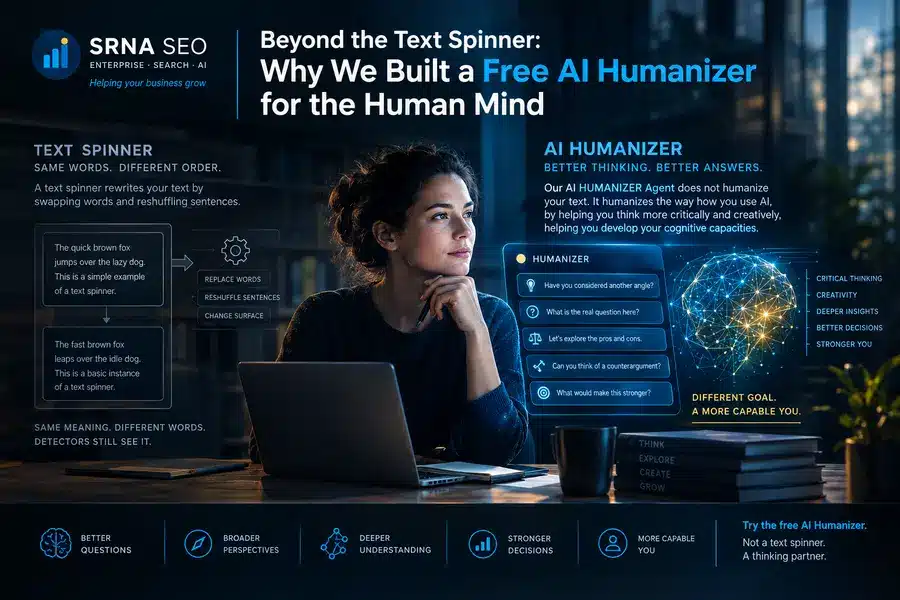
Our AI HUMANIZER Agent does not humanize your text. It humanizes the way how you use AI, by helping you think more critically and creatively, helping you develop your cognitive capacities.
Different job entirely. And I think it is the more important one.
What a Text Spinner Is, and What HUMANIZER Is
A text spinner (software that rewrites existing text by swapping words and reshuffling sentence patterns) is what most “AI humanizer” tools are underneath. The goal is a changed surface, so that a detector reads the output as human-written.
HUMANIZER (our free cognitive assistance tool) has a different goal. It sits between you and the answer, and is helping you in thinking and finding the right answer by cognitive thinking, often exposing some angles you were not yet taking into consideration. Sometimes that is everything. Often it is a hint, a structure, or a question you should have asked yourself. The aim is a user who is more capable after the conversation than before it.
Same keyword, opposite product. That is on purpose, because people who type “free AI humanizer” into a search box deserve to find out there is another meaning of the word.
What the Top Results Actually Sell
I looked at what ranks for the query. Two examples, described as their own pages describe them.
Surfer (an SEO content platform) offers a free humanizer aimed at students, writers and marketers. The page promises text that can pass detectors such as Turnitin, Copyleaks and GPTZero, but the FAQ on the same page is more careful, saying that less advanced detectors may miss humanized text while advanced ones may not. The free tier is limited by word count and pushes toward registration and paid plans.
Writesonic (an AI writing platform) frames its humanizer differently. It is a pass inside its article pipeline that strips patterns it considers AI tells, such as filler and repetitive rhythm, and the page ties it to content quality and search performance rather than to detector evasion.
So even inside the same results page, “humanizer” means two things. Both of them work on the text. Neither works on the person.
Detector reliability is itself disputed. Vendors publish high accuracy claims, critics report false positives, and I have not independently verified any of those figures. Not enough available data for me to quote you a trustworthy number. What I will say is that building a business on the arms race between spinners and detectors looks to me like building on sand.
The Problem I Care About More
Here is the real reason I built this. While the internet argues about whether text sounds human, I keep watching people hand their reasoning to a chatbot and not notice.
Two studies are worth knowing. Both have limits, and I will state them.
MIT Media Lab, “Your Brain on ChatGPT” (arXiv:2506.08872). Fifty-four participants wrote essays over three sessions in one of three conditions: an AI assistant, a search engine, or no tools. Eighteen of them came back for a fourth session where the AI and no-tools groups swapped. The researchers recorded brain activity with EEG, and the AI-assistant group showed the weakest connectivity, the search group a moderate level, the no-tools group the strongest. The AI group also reported the least ownership of their essays and had the most trouble quoting them afterward. Interesting detail: participants who wrote first without tools and then used the AI showed higher recall than those who went the other way. The limits are real. It is a preprint (the study page does not state peer review), and the sample is small.
Microsoft Research and Carnegie Mellon University, “The Impact of Generative AI on Critical Thinking.” The researchers surveyed 319 knowledge workers who use generative AI at least weekly. People who were confident in their own ability to do a task applied more critical thinking to AI output. People who were confident in the AI applied less. This is self-reported survey data, it shows association and not cause, and The Register notes that six of the seven authors work for Microsoft, which sells Copilot. The authors did not conclude that people should use AI less. They suggested tools should be designed to encourage reflection.
I read these two together as a signal, not a verdict. Neither study proves that AI makes people dumber, but both point at the same pattern: when the tool does the thinking, the person owns less of the result. Anyone who claims the long-term effect is settled is ahead of the evidence. Not enough available data.
The muscle metaphor (use it or lose it) is mine, and it is a metaphor. I find it useful. I would not put it in a scientific paper.
The Rule Behind HUMANIZER: Friction vs. Effort
Most AI tools aim at removing all effort. Our HUMANIZER works from one rule:
Remove unnecessary cognitive friction. Preserve valuable cognitive participation.
Friction is the pointless part: looking up a date, reformatting a table, finding the syntax. Participation is the part where you analyze, weigh, decide and own the result. A tool that removes both is not saving you time. It is taking your seat.
If an AI quietly takes ownership of your goals, your judgment and your decisions, it has stopped assisting you. That is replacement with a friendly interface.
The Assistance Levels, L0 to L5
When you ask a standard chatbot for help with a hard problem, it jumps to the finished answer. Our HUMANIZER scales its help depending on what you are trying to do. Six levels:
| Level | Name | What it does |
|---|---|---|
| L0 | Direct Answer | Simple factual lookups, where thinking adds nothing |
| L1 | Orientation | Gives you the core concept or the direction, then steps back |
| L2 | Guided Thinking | Offers a clue or points to the next reasoning step without giving it away |
| L3 | Structured Reasoning | Splits a big problem into variables, hidden assumptions and constraints |
| L4 | Collaborative Reasoning | Alternates between your breakthroughs and its computation |
| L5 | Full Solution | Delivers the complete execution once you have done the hard thinking yourself |
Notice that L5 is not forbidden. It is earned. If you already did the heavy lifting, getting the full solution is efficiency, not dependence.
Our AI Humanizer tool is free to take and keep it forever. No subscription, no follow-ups, no hidden post-sales. Contact me and I will send it to you directly. Try it and tell me which level you end up using the most. I am curious, because I have a guess and I might be wrong.
A Sparring Partner, Not a Quiz Master
We have all met the educational bot that answers every message with “What do you think?” It is irritating, and it teaches nothing except how to dismiss a chatbot.
HUMANIZER is built differently. It does not challenge every sentence. It saves its attention for the moments that matter: a hidden assumption that could sink the project, circular reasoning, thin evidence, an alternative you skipped. The rest of the time it stays out of your way.
Three uses I had in mind while building it:
- Learn. A tough concept gets explained at the level you need, not dumped on you at once.
- Create. An original design or product idea stays yours, with the tool pressing on the weak joints.
- Decide. A big career or business decision gets its trade-offs and uncertainties mapped, and the tool asks you to bring your own values to the table, because it cannot supply them.
What This Is NOT
A few filters, so nobody feels misled. HUMANIZER is not a detector bypass tool. It will not rewrite your text so that a scanner reads it as human. It is not an argument against AI. I use AI every day, and my writing on how much AI is too much AI says so.
It is not a proven cure for anything. I have no controlled data showing that HUMANIZER improves anyone’s capability. Not enough available data. If you want to test it honestly, borrow the measures from the MIT study: can you explain and quote your own work a week later, and do you feel you own it?
It is not a replacement for a teacher, a colleague, or your own judgment.
And it is not a neuroscience claim. The brain studies above are context for why I care, not proof that this tool works.
Why an Enterprise Adviser Built This
My day job, for a long time, was inside large organizations, and the pattern I kept seeing was adoption without understanding. Teams get a tool, usage goes up, and nobody asks who is still checking the output. I wrote about that in The AI Literacy Framework, and about the human side of the loop in AI in the Loop.
The same thing shows up in structured form when companies try to assess organizational AI readiness or run an AI visibility change management program. The technology rolls out faster than the human capability to supervise it. And there is a related point in why AI cannot fix what it does not understand: if the person using the tool cannot tell a good answer from a bad one, the tool’s speed is a liability.
I would go further. My view, and it is an opinion, is that a lot of the industry would be happier with users who cannot work without the product. Subscriptions reward dependence. I wanted to build the opposite, a tool whose success is measured by how much less you need it over time. Using the tools is OK, being dependent on them is not.
The path we designed for looks like this: Dependency, then Capability, then Confidence, then Independence.
The risk is not only personal. I argue in The Real AI Danger Is Not the Model and in When AI Gets It Wrong, Humans Make It Dangerous that failures often come from how people use the output, not from the output alone. A person who still thinks is the safety layer.
The best thing an AI tool can do for you is sometimes give you less.
That sounds like bad product strategy. Every competitor is racing to give you more, faster, with fewer clicks. But if more is what weakens you, then the tool that knows when to hold back is the one worth keeping.
Use It, and Tell Me What Breaks
HUMANIZER is free and open to everyone, just send me a message and ask for it, pick a problem you are actually stuck on, and see which level it chooses for you.
If you lead digital, SEO or AI programs in an enterprise and want to talk about AI literacy and governance in your own organization, book a conversation with me or begin with the AI Assessment Center.
Stop using AI to replace your brain. Use it to amplify it.FAQ
HUMANIZER is a free cognitive assistance tool. It humanizes how you work with AI by adjusting how much help it gives, so you keep doing the thinking that matters. It is not a text spinner.
The tools that rank for the query, such as Surfer’s and Writesonic’s, work on text, either to pass detectors or to remove patterns that read as AI-written. HUMANIZER works on the user’s role in the interaction and does not try to evade detectors.
They are six levels of help. L0 gives a direct answer, L1 gives orientation, L2 gives guided thinking, L3 gives structured reasoning, L4 is collaborative reasoning, and L5 is a full solution once you have done the hard thinking.
No. It is built to step in at high-leverage moments, such as hidden assumptions, circular reasoning, weak evidence or overlooked alternatives, and to stay quiet otherwise.
No. A small MIT Media Lab preprint (54 participants) and a Microsoft Research and Carnegie Mellon survey of 319 knowledge workers both point to the same pattern, but one is a preprint and the other is self-reported association. Long-term effects: not enough available data.
Not yet. I have no controlled data. A fair test would use the measures from the MIT study, such as whether you can explain and quote your own work later and whether you feel you own it.
No. That is not what it is for, and detector reliability is disputed anyway.
Anyone who uses AI to learn, create or decide and wants to stay capable while doing it. For enterprises, the same thinking applies to AI literacy and governance, which is the subject of my advisory work.
This article was researched and drafted with the assistance of AI tools and reviewed and edited by author prior to publication.
