

In This Article
Every tool on this list measures something real. Semrush tracks your brand citations in AI answers. Ahrefs Brand Radar tells you how often your name appears across six AI platforms. Conductor monitors your AI share of voice across enterprise domains. BrightEdge just launched AI Hyper Cube to map where you appear, and where you don’t, in generative AI search results.
All of them measure outcomes. None of them tells you why. That is the gap. And it is the gap that NovaX was built to close.
We are giving the honest review of AI Visibility Inspector and NovaX, with all strengths and weaknesses, and compare them against competitors in articles like: NovaX vs Semrush, Ahrefs, Conductor & BrightEdge, Which AI Visibility Tool Is Best for SEO, Best AI Visibility Tools: What They Do and Who They’re For, Which AI Visibility Tool Is Best for SME, Which AI Optimization and Visibility Tools Are Actually Built for Agencies, AI Visibility Inspector and NovaX vs BrightEdge, AI Visibility Inspector and NovaX vs Conductor, NovaX vs Ahrefs, Best Tool to Optimize and Track ChatGPT Citations, AI Visibility Inspector vs Ahrefs, NovaX vs Semrush, AI Visibility Inspector vs Semrush, and when competitor is better than us, we say it clearly and loudly.
What Is an AI Visibility Diagnostics Tool?
An AI visibility diagnostics tool is a platform that analyzes the content-level signals inside your pages to determine retrieval eligibility, the degree to which an AI system can parse, trust, extract, and cite your content in a generated response. It operates upstream of citation tracking, examining the structural, semantic, and entity-level properties of your content before any AI engine makes its decision.
This is a fundamentally different category from AI visibility monitoring, which measures whether your brand appeared in an AI answer after the fact. Diagnostics explain the causes. Monitoring reports the symptoms.
The Market Has Already Moved – But in One Direction
Since 2025, the SEO industry has shifted fast. Semrush launched its AI Visibility Toolkit as a $99/month add-on for brand citation monitoring. Ahrefs released Brand Radar, tracking your presence across ChatGPT, Perplexity, Claude, Gemini, and more, at an additional $199 to $699 per month, depending on the number of AI indexes. Conductor positioned itself as the only end-to-end enterprise AEO platform, earning Forrester Wave Leader status and adding 50-plus enterprise logos in a single quarter. BrightEdge launched AI Hyper Cube in March 2026, promising to show brands exactly where they appear, and why they don’t, across ChatGPT, Gemini, and other generative engines.
The movement is real. The investment is significant. But every one of these platforms shares the same architectural assumption: if you can see where you get cited, you can figure out what to fix.
Twenty-five years in SEO, seven of them inside global enterprises, taught me something different. Knowing you lost the race does not tell you why your legs gave out at kilometre three.
How These Platforms Actually Work
Before comparing them against NovaX, it is worth being precise about what each tool does. I have used three of these four extensively. The picture is clear, and I will not exaggerate their weaknesses; they are strong platforms doing what they were designed to do.
Semrush
SEMrush is a 55-tool marketing platform with AI visibility added as a focused layer. The AI Visibility Toolkit, launched in September 2025, tracks how often your brand appears in AI-generated answers across ChatGPT, Perplexity, Gemini, and Google AI Overviews. The Enterprise AIO tier connects citation data to the wider SEO signals: backlinks, authority, and content structure, which likely drove the outcome. Pricing starts at $99 per month per domain, on top of a base SEMrush subscription.
The strength here is breadth and context. Semrush lets you trace a competitive AI citation gap back to the SEO signals that created it. That is genuinely valuable. The limitation is that its architecture remains keyword-centric and Google-first. As one independent review put it, the AI Visibility Toolkit focuses on “keyword-focused reporting versus prompt-level analysis.”
Ahrefs
Ahrefs expanded from backlink intelligence into AI visibility with Brand Radar, which monitors brand mentions across six AI platforms using a database of over 110 billion real queries and associated search results, not synthetic prompts. This is a methodologically stronger approach than most competitors. Brand Radar adds $199 per month per AI index, or $699 per month for the full six-platform bundle, on top of existing plan costs that range from $129 to $449 per month.
The backlink infrastructure remains Ahrefs’ defining capability, refreshing every 15 to 30 minutes. Brand Radar is the right tool for understanding competitive AI mention gaps and discovering which cited pages your competitors own that you do not. Its limitation is the same as Semrush’s: it tells you what happened, not what to change inside your pages to make it happen differently.
Conductor
Conductor is the most direct enterprise AEO competitor in this group. It describes itself as the only end-to-end enterprise AEO platform, and it earns that positioning. The unified suite combines AI search performance tracking, scaled content generation, 24/7 technical monitoring, and now a native app inside ChatGPT. Conductor analyses 3.3 billion sessions across 13,000-plus enterprise domains and has expanded into agent-based workflows through its AgentStack launch in April 2026.
Pricing reflects the enterprise positioning: documented contracts range from $26,800 to over $500,000 per year, with a median closer to $49,000 for mid-market deployments. Conductor was named a Forrester Wave Leader in 2025. Clients include Citi, Mastercard, FedEx, and BlackRock’s Aladdin. The platform is outstanding at what it does. Its limitation is not capability, it is scope. Conductor tracks and reports AI visibility at scale. It does not diagnose the content-level causes at the page level.
BrightEdge
BrightEdge is the most established enterprise SEO platform in this group, built on a proprietary data architecture (Data Cube X) that now includes AI footprint intelligence, competitive benchmarking, and content optimization signals. The March 2026 launch of AI Hyper Cube specifically targets the prompt-level visibility question: which prompts trigger your brand to appear, and which sources drive those citations. BrightEdge also introduced AI Agent Insights alongside Hyper Cube, giving brands visibility into how AI agents interact with their content.
Like Conductor, BrightEdge requires a custom quote and targets mid-to-large enterprise deployments. Also like Conductor, its analytical layer is output-focused: it tells you that your brand is appearing in certain AI answers and not others. It does not analyze the internal structure of your pages to explain why a specific URL is or is not retrieval-eligible.
The Comparison Table
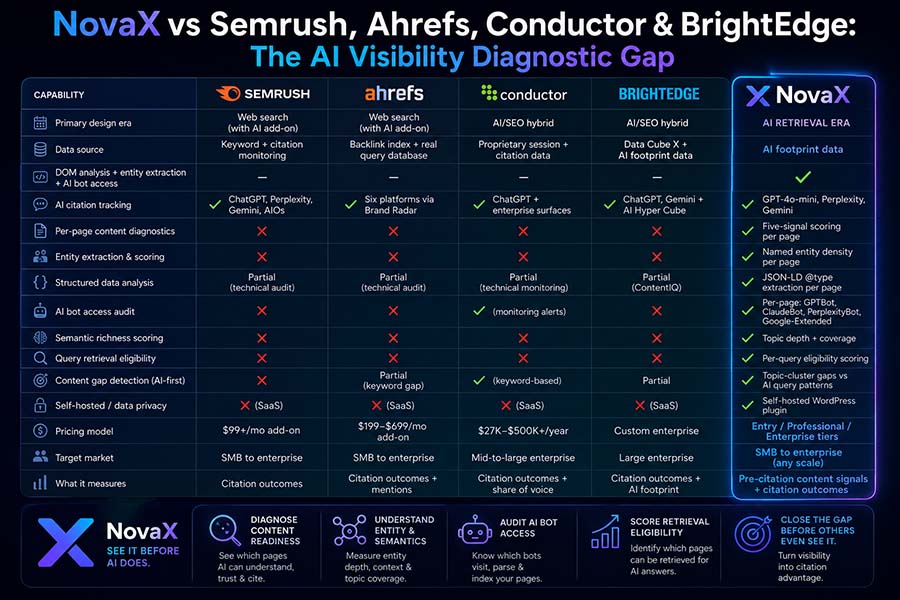
The table below maps each platform against the dimensions that matter most for understanding AI visibility, not just measuring it.
| Capability | Semrush | Ahrefs | Conductor | BrightEdge | NovaX |
|---|---|---|---|---|---|
| Primary design era | Web search (with AI add-on) | Web search (with AI add-on) | AI/SEO hybrid | AI/SEO hybrid | AI retrieval era |
| Data source | Keyword + citation monitoring | Backlink index + real query database | Proprietary session + citation data | Data Cube X + AI footprint data | DOM analysis + entity extraction + AI bot access |
| AI citation tracking | ✅ ChatGPT, Perplexity, Gemini, AIOs | ✅ Six platforms via Brand Radar | ✅ ChatGPT + enterprise surfaces | ✅ ChatGPT, Gemini + AI Hyper Cube | ✅ GPT-4o, Perplexity, Gemini |
| Per-page content diagnostics | ❌ | ❌ | ❌ | ❌ | ✅ Five-signal scoring per page |
| Entity extraction & scoring | ❌ | ❌ | ❌ | ❌ | ✅ Named entity density per page |
| Structured data analysis | Partial (technical audit) | Partial (technical audit) | Partial (technical monitoring) | Partial (ContentIQ) | ✅ JSON-LD @type extraction per page |
| AI bot access audit | ❌ | ❌ | ✅ (monitoring alerts) | ❌ | ✅ Per-page: GPTBot, ClaudeBot, PerplexityBot, Google-Extended |
| Semantic richness scoring | ❌ | ❌ | ❌ | ❌ | ✅ Topic depth + coverage |
| Query retrieval eligibility | ❌ | ❌ | ❌ | ❌ | ✅ Per-query eligibility scoring |
| Content gap detection (AI-first) | ❌ | Partial (keyword gap) | ✅ (keyword-based) | Partial | ✅ Topic-cluster gaps vs AI query patterns |
| Self-hosted / data privacy | ❌ (SaaS) | ❌ (SaaS) | ❌ (SaaS) | ❌ (SaaS) | ✅ Self-hosted Full data privacy |
| Pricing model | $99+/mo add-on | $199–$699/mo add-on | $27K–$500K+/year | Custom enterprise | Entry / Professional / Enterprise tiers |
| Target market | SMB to enterprise | SMB to enterprise | Mid-to-large enterprise | Large enterprise | SMB to enterprise (any scale) |
| What it measures | Citation outcomes | Citation outcomes + mentions | Citation outcomes + share of voice | Citation outcomes + AI footprint | Pre-citation content signals + citation outcomes |
What the Table Does Not Show
The table captures the functional gaps, but the architectural gap runs deeper.
Every platform in the left four columns starts at the same point: a query goes into an AI engine, a response comes out, and the tool measures whether your brand appeared in it. The optimization logic that follows is inferred backwards – if you appeared, what did you do right? If you did not, what might be missing?
NovaX starts before the query. The AI Visibility Inspector loads your page, parses the live deep page, extracts entities, scores structured data completeness, evaluates semantic richness, checks AI bot access rules from your robots.txt, and assigns a five-signal score. That happens before any AI engine sees your content. It happens at the page level, not the domain level or the keyword level.
The site-wide NovaX layer then aggregates those per-page scores across your entire crawled inventory, up to 25,000 active pages at the enterprise tier, and surfaces a signal heatmap: every page as a row, every signal category as a column. You can see, at a glance, which pages are retrieval-eligible and which are not, and exactly which signal is responsible.
That is forensic diagnostics. Not monitoring. Not reporting. Diagnostics.
What These Platforms Do Better Than NovaX
I said at the start that I would be accurate, so I will say this plainly: if your primary objective is tracking brand citations across AI engines at scale, monitoring competitive AI share of voice, or connecting AI visibility outcomes to revenue reporting for enterprise stakeholders, Conductor and BrightEdge are stronger for that job today. They have years of investment in data infrastructure at a scale that a WordPress-based platform built on diagnostic logic cannot yet match.
If you need keyword research, backlink intelligence, and content gap analysis alongside AI citation monitoring, Semrush and Ahrefs remain indispensable. I still use them. Many clients I advise still use them. They fill their lane well.
What they do not fill is the diagnostic lane. And for enterprise platforms where content volume is large, AI citation rates are inconsistent, and the team cannot understand why certain pages get retrieved, and others do not, that lane is the one that costs the most when it stays empty.
You can visit my Enterprise Search Advisory to see how I structure that diagnostic layer into a full AI visibility programme.
The Real Question for Enterprise Teams
Here is the question I ask every enterprise SEO lead I work with: Do you know which of your pages are currently retrieval-eligible for AI systems, not which ones got cited last month, but which ones could be cited if the right query came in?
If you cannot answer that, you have a diagnostic gap. Citation monitoring will not close it. Keyword tracking will not close it. Share-of-voice reporting will not close it.
Understanding AI visibility signals at the page level closes it. That is what the AI Visibility Inspector does for individual pages, and what the site-wide NovaX platform does across your full content inventory.
The platforms I have described above tell you the score at full time. NovaX tells you what happened during the match, and more importantly, what to change before the next one.
Strategic Implications: The 18–36 Month Horizon
The current market position of Semrush, Ahrefs, Conductor, and BrightEdge reflects a logical adaptation to a fast-moving shift. They saw AI search growing and added citation tracking. That was the right move for 2025.
The next move, which several of these platforms are already beginning to develop, is page-level diagnostic intelligence. Conductor’s 24/7 monitoring already flags technical blockers. BrightEdge’s AI Hyper Cube is moving toward source-level analysis. The direction is clear.
What is not yet present in any of them is the content-signal logic layer: the per-page evaluation of entity density, semantic coherence, structured data completeness, and retrieval eligibility scoring that explains why an AI system would or would not use a specific URL as a citation source.
Enterprise platforms that invest in that layer now will have compounding advantages. Those who wait until the monitoring tools add it will be operating on borrowed time. The Search Visibility Diagnostic I offer is designed to give your team a clear starting point for understanding where that gap exists on your own site.
Key Takeaways
- Semrush, Ahrefs, Conductor, and BrightEdge all measure AI citation outcomes, they tell you whether your brand appeared in AI answers.
- None of them diagnoses the content-level signals that determine why a page is or is not retrieval-eligible before any citation decision happens.
- NovaX operates upstream: it scores pages across five signal dimensions (entity extraction, structured data, semantic richness, AI bot access, query eligibility) before any AI engine is queried.
- The comparison table above is accurate as of May 2026; capabilities in this category are evolving rapidly.
- These platforms are not mutually exclusive. The highest-performing enterprise programmes will combine citation monitoring (Conductor, BrightEdge, or Semrush) with content-level diagnostic intelligence (NovaX) as complementary layers.
- The diagnostic layer is the one currently missing from every major platform. That gap will close, the question is whether your team fills it proactively or reactively.
Ready to Know What AI Systems Actually See in Your Pages?
If you are running an enterprise content programme and want to understand your retrieval eligibility, not just your citation rate, the AI Visibility Inspector is the right starting point. It loads your page, parses every signal, and scores it in under two seconds.
You can access the AI Visibility Inspector here, explore the NovaX platform for site-wide diagnostic intelligence, or contact me directly through the Enterprise Search Advisory if you want to discuss how this fits into your existing SEO stack.
The tools above will tell you where you stand. NovaX will tell you why.
You May Also Ask
No, and it is not designed to. Semrush and Ahrefs remain the strongest platforms for keyword research, backlink intelligence, and competitive AI citation monitoring. NovaX fills the diagnostic gap that sits upstream of those functions: it analyzes the content-level signals that determine retrieval eligibility before an AI engine is queried. The highest-performing programmes use both layers together.
Retrieval eligibility is the degree to which a specific page contains the signals that make it likely to be selected as a citation source by an AI retrieval system. Those signals include entity density and clarity, structured data completeness, semantic coherence, topic depth, and AI bot access permissions. A page can rank well in Google and still score poorly on retrieval eligibility, because Google’s ranking signals and AI retrieval signals are not the same thing.
For pure enterprise-scale AI citation monitoring and share-of-voice reporting, Conductor and BrightEdge are the most mature platforms in the market. Conductor earned Forrester Wave Leader status in 2025 and has 10-plus years of proprietary web data. The limitation is that neither platform currently offers content-level diagnostic scoring at the page level; they measure outcomes, not the upstream causes.
AI Hyper Cube, launched in March 2026, maps the prompts that trigger AI answers in your category and identifies which sources are being cited. This moves closer to source-level analysis than pure brand monitoring. However, it does not evaluate the internal content signals of your pages, entity structure, structured data, and semantic depth, which explain why a specific URL was or was not selected. That is where NovaX operates.
The self-hosted model serves enterprise data privacy requirements. When content-level diagnostic intelligence runs inside your own infrastructure, no page content, entity data, or structured data signals leave your environment. For regulated industries, financial services, healthcare, and legal, that distinction matters significantly.
Content quality (including word count, heading structure, and semantic completeness), structured data (JSON-LD presence, @type coverage, and completeness), semantic richness (entity density, topic depth, and coverage of related concepts), authority signals (internal linking structure and canonical accuracy), and AI bot access (per-bot permissions from robots.txt for GPTBot, ClaudeBot, PerplexityBot, and Google-Extended).
All three send real queries to AI engines and check whether your domain appears in the response. The key difference is what surrounds that tracking. Semrush and Ahrefs connect citation data to keyword and backlink intelligence. NovaX connects citation results to per-page content diagnostic scores, so when a page fails to get cited, you can immediately cross-reference its entity score, structured data completeness, and AI bot access status to understand the probable cause.
