

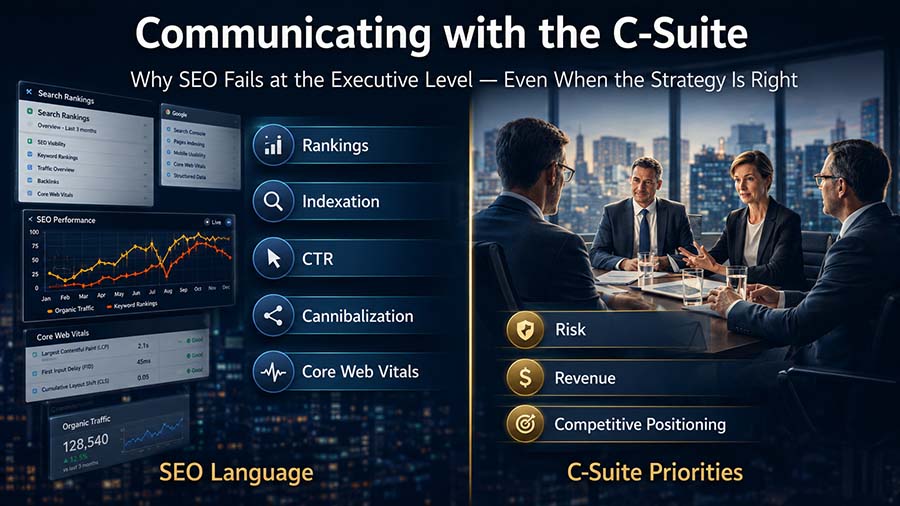
Most SEO strategies don’t fail because they are technically incorrect. They fail because they are communicated at the wrong altitude.
In my 25 years leading search strategy for global enterprises like Adecco and Atlas Copco, I’ve seen a recurring pattern: a brilliant architectural diagnostic is dismissed, or a critical indexing fix is deprioritized, simply because it was presented in a language the C-suite doesn’t speak.
If you are an SEO lead, you are likely reporting on mechanics. But your executives are evaluating strategic exposure.
The Core Misalignment
There is a fundamental “translation layer” missing in most organic search reporting. While SEO teams are focused on the process, executives are focused on the portfolio.
| SEO Teams Speak In: | Executives Think In: |
| Indexation & Crawl Budget | Operational Efficiency & Waste |
| CTR & Core Web Vitals | Market Share & User Trust |
| Cannibalization | Portfolio Risk & Internal Conflict |
| Algorithm Updates | Competitive Positioning |
| Keyword Rankings | Revenue & Defensibility |
When you present mechanics to someone evaluating risk, you don’t just lose their attention, you lose your budget.
What the C-Suite Actually Needs (The 3-Pillar Framework)
Executives don’t need a bigger dashboard; they need a clearer lens. In 2026, a strategic SEO conversation must answer three specific questions:
- Exposure: Where are we structurally vulnerable? If a technical debt is left unpaid, how much market share are we handing to a competitor?
- Opportunity: What competitive advantage can we secure? If we dominate this category, what is the downstream impact on our Customer Acquisition Cost (CAC)?
- Timeline: How fast does this become a crisis? SEO is a lagging indicator. Executives need to know when a “silent” decline today becomes a “visible” revenue drop next quarter.
The Shift: From Traffic to Infrastructure
To bridge this gap, I had to stop explaining how Google works. I had to start framing SEO as Digital Defensibility Infrastructure.
In the era of AI Search and the “Dark Funnel,” search visibility is no longer just about clicks. It is about:
- Brand Equity: Does the market see us as the definitive answer to their problem?
- Demand Capture Infrastructure: Are we present at the exact micro-moment a B2B buyer begins their research?
- AI Retrieval Positioning: How do LLMs perceive our brand authority when a user asks for a recommendation?
When you frame SEO this way, it stops being a “marketing tactic” and starts being a “structural moat.” It moves from the “marketing budget” to the “infrastructure budget.”
Where Most Teams Break
The breakdown usually happens in the Translation Layer.
- Reporting Symptoms, Not Causes: Telling an executive that “traffic is down 10%” is a symptom. Telling them that “competitor X has outpaced our content governance in the UK market, leading to a 10% drop in lead intent” is a structural cause.
- Speaking in Tasks: Executives don’t care that you “optimized 50 meta descriptions.” They care that you “improved the conversion path for high-margin service categories.”
- Ignoring Uncertainty: Executives make decisions under uncertainty. If you don’t frame the risk of inaction clearly, they will choose the safest-looking option: doing nothing.
The Strategic Advantage of Alignment
When SEO is communicated properly at the executive level, it fundamentally changes the organization. It is no longer an “SEO project” – it influences:
- Product Strategy: Identifying new market needs before the sales team does.
- International Expansion: Mapping the “Search Maturity” of new territories.
- Content Governance: Ensuring every piece of company intellectual property is machine-readable and AI-ready.
The Bottom Line for 2026
The higher you go in an organization, the less people care about tactics. They care about trajectory.
If you want SEO to matter at the top, stop explaining what you are doing. Start explaining what happens if you don’t.
In the 2026 Buyer Journey, executives no longer rely solely on search results; they rely on RAG-driven retrieval. When a C-Suite leader asks an LLM to evaluate vendor risk, the engine performs a semantic scan of the brand’s digital defensibility infrastructure. If your SEO isn’t structured for these retrieval layers, you are effectively absent from the decision-making table.
FAQ: SEO Strategic Governance for Executives
We shift from tracking “clicks” to tracking “Market Share” and “AI Visibility.” In 2026, the “Dark Funnel” means 70% of the buyer journey happens in untrackable spaces like private Slack groups or AI chats. We measure success by our brand’s “Citation Rate” in AI-generated search results and our defensibility against competitor market-share encroachment.
Yes, but the definition has changed. SEO is now “Digital Defensibility.” It is about ensuring your brand is the primary entity cited by AI models. Without a strategic search foundation, your company becomes “invisible” to the LLMs that B2B buyers now use for their initial vendor shortlisting.
The risk is “Strategic Misalignment.” When SEO is treated as a task rather than infrastructure, it is ignored during product launches or international expansions. This creates massive technical debt that eventually requires a costly “rescue” operation. Strategic governance ensures SEO is a stakeholder at the start of the decision-making process.
