

In This Article
You built your AI visibility strategy on a cloud region you never asked to see. Most companies did. And this month that assumption broke, not in theory, in practice.
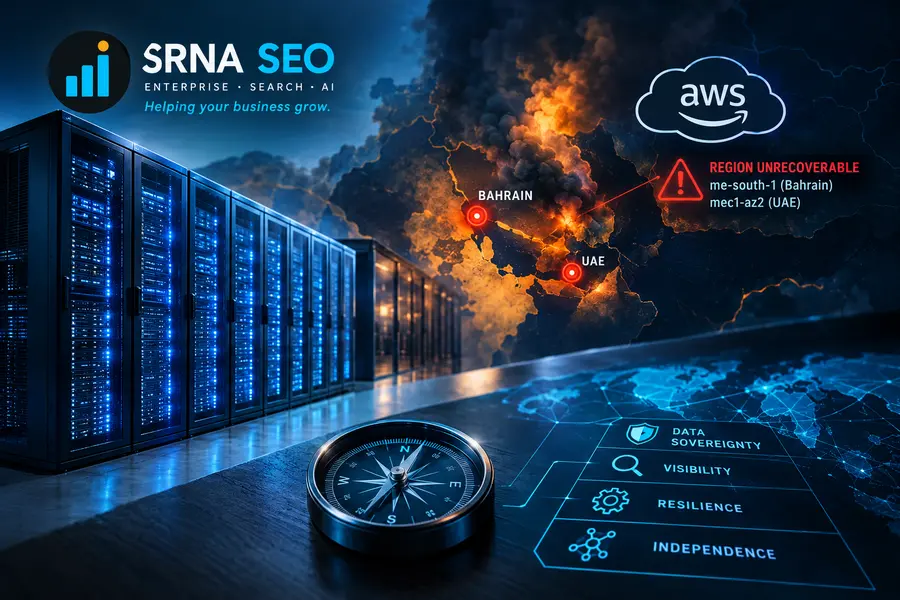
AWS confirmed on September 15 that it cannot restore access to data and resources hosted exclusively in its Middle East (Bahrain) region, known as me-south-1, and in one availability zone of its UAE region, me-central-1, specifically mec1-az2. The damage goes back to March and April, when Iranian strikes hit the physical facilities during the regional conflict. AWS spent six months assessing the wreckage before saying, in plain language on its own health dashboard, that it had exhausted every option for recovery. That sentence is the one to sit with: not “delayed,” not “degraded”, but exhausted.
Digital sovereignty, defined the way it actually matters
Digital sovereignty is not owning a data policy document. It is the practical ability to keep operating, and keep your data retrievable, when a provider, a region, or a geopolitical event takes a piece of your infrastructure offline for good. Most organizations conflate this with redundancy (having a backup copy somewhere) and call it a day. AWS’s own case shows why that’s not the same thing. Some customers in Bahrain and the UAE had backups. Some didn’t get the workload replicated before the second zone went down. Same provider, same “resilient” architecture on paper, two very different outcomes depending on whether someone had actually moved the data, not just planned to.
What happened, without the drama
Here’s the sequence, pulled from AWS’s own updates and independent reporting, not from the LinkedIn version that’s circulating.
- One Bahrain availability zone was damaged in early March.
- A second Bahrain zone was hit in April, which took the entire me-south-1 region offline.
- Two of the three UAE availability zones (mec1-az2 and mec1-az3) were also struck.
- AWS said the Bahrain damage “spanned multiple availability zones and exceeded what our regional and multi-AZ services are designed to withstand.”
- Most Bahrain customers had migrated before the second zone failed. The ones who hadn’t lost access permanently.
- In the UAE, mec1-az2 is declared unrecoverable. The other two zones are still being worked on, with a broader update expected in the coming months. Bahrain won’t get a further update until early 2027.
That last detail matters more than it looks. Early 2027 is not a status update, it’s an admission that this is a multi-year recovery, if it happens at all.
What this is NOT
This is not a routine cloud outage, and treating it like one is where most risk conversations go wrong. A power failure or a hardware fault in a single facility is exactly what multi-AZ design is built to absorb. What happened here is a correlated event, physical damage hitting several facilities inside the same geography inside a short window. AWS’s own language admits the architecture wasn’t built to survive that kind of correlated failure. This also isn’t a story about AWS being a bad provider. Any hyperscaler concentrated in the same geopolitical risk zone would have faced the same physics. The failure isn’t technical incompetence, it’s architectural assumption, the assumption that “another zone in the same region” counts as real separation.
Why this is a corporate web and AI visibility problem, not just an IT one
Your corporate web (the APIs, data feeds, product catalogs, knowledge bases, and semantic markup that search engines and AI agents actually read) is not the same thing as your website. It’s the layer that feeds ChatGPT, Perplexity, Gemini, and every retrieval-augmented system pulling from your domain to answer a buyer’s question. I’ve written before about how autonomous agents depend on a full data supply chain, not a single page. If a link in that chain sits physically in a region that stops existing, the agent doesn’t get an error message, it just stops citing you. Silently.
This is the part most SEO and content teams miss when they think about AI search engines and enterprise visibility: machine readability assumes machine reachability first. A perfectly structured schema markup, a beautifully disambiguated entity graph, none of it matters if the server holding it is rubble. I keep telling clients running an agent exposure audit that half the exposure isn’t content quality, it’s where the content physically lives and how many single points of failure sit underneath it.
Machine readability is becoming a question of power, and the power question starts with who controls the physical layer, not the content layer.
Banking transactions in the affected region were disrupted too, according to reporting on the outage, which tells you this isn’t confined to marketing sites and blogs. It reaches transactional systems, and by extension it reaches zero-click answer attribution for anything AI engines are summarizing about a brand’s reliability, pricing, or service status in that market.
Knowledge Exposure Audit
If you’re running enterprise infrastructure across two or three regions and calling that “sovereign,” stop and check the assumption. I run a Knowledge Exposure Audit specifically to map where a client’s AI-visible data actually sits, not where the org chart says it sits, and where a single correlated event could take out the machine-readable layer that AI systems cite from. It’s a two-hour conversation before it’s a project. Worth having before the next region goes dark, not after.
The contrarian truth
Everyone in enterprise IT talks about “which provider is the most reliable.” That’s the wrong question, and AWS’s own numbers prove it. Reliability at 99.99% still leaves room for a correlated event that no SLA covers, because SLAs are written for outages, not for physical destruction. The question that actually protects you is narrower and less comfortable: which parts of your digital existence would survive that provider disappearing tomorrow, not degrading, but disappearing. Most organizations have never answered that question because it was never asked in a boardroom before this month.
Estimated gain, stated honestly
Organizations that run a real cross-region sovereignty assessment (not a checklist, an actual dependency map covering data, APIs, and AI-facing endpoints) typically identify 15-30% of their AI-visible infrastructure sitting on a single point of failure they didn’t know about. Fixing that doesn’t guarantee anything survives a drone strike or a government shutdown order. It does mean you know, in advance, which citations, which product data, which knowledge base entries disappear if a region goes dark, instead of finding out from a customer complaint. That’s the honest range. Not enough available data to promise a precise recovery-time figure across industries, so I won’t invent one.
Where AI search visibility fits into the same diagnostic
If you’re already tracking how your brand shows up in generative retrieval layers, add one column to that tracking sheet: physical region of origin for every data source AI engines cite. Most teams running a diagnostic matrix for generative retrieval stop at content and schema. Add infrastructure geography and you’ve got a genuinely different, more defensible audit than what’s currently ranking for this topic.
There’s also a governance angle that gets skipped. If an AI system cites outdated or now-unreachable data from a destroyed region, who corrects that record across the models that already trained on it or retrieved it once? I cover this in the piece on AI correction rights for organizations, and it’s more relevant after an event like this than most companies realize, because the citation doesn’t disappear from an AI answer just because the source did.
FAQ
Based on AWS’s own September 15 update, resources and data hosted exclusively in Bahrain (me-south-1) and in UAE zone mec1-az2 are confirmed unrecoverable. AWS said it exhausted every option for restoring what wasn’t migrated before the affected zones went down.
No. It means multi-AZ and even multi-region design is built to survive independent failures, not a correlated event where several facilities in the same geography are damaged in the same window. The architecture did what it was designed for. The design assumption was the gap.
AI agents and generative search engines retrieve from your corporate web (APIs, data feeds, knowledge bases), not just your homepage. If that infrastructure sits physically in a single vulnerable region, an event like this removes you from machine-readable retrieval, sometimes without any visible error on your own site.
Start with an honest inventory of where AI-facing data and endpoints physically live, and which of them exist in only one location. That’s the starting point of a proper Knowledge Exposure Audit, not a redundancy checklist.
The physics apply to any provider with concentrated infrastructure in a geopolitically active region. This isn’t a criticism of AWS’s engineering, it’s a case study in what correlated physical risk does to any provider’s resilience math.
Let’s Talk
I’d rather have this conversation with you before your region goes dark than after. If you want a straight read on where your AI-visible infrastructure is exposed, start with the free AI Assessment Center, or bring me the harder question directly through enterprise search advisory. No deck, no vendor pitch, just the map of what survives and what doesn’t.
This article was researched and drafted with the assistance of AI tools and reviewed and edited by author prior to publication.
