

In This Article
KEY TAKEAWAYS
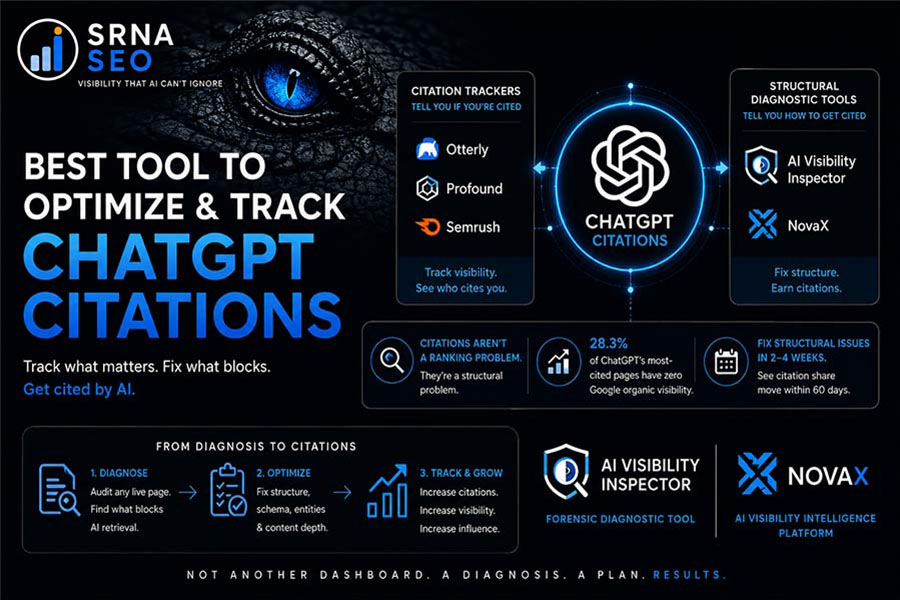
- The market splits into citation trackers (Otterly, Profound, Semrush) that show if you’re cited, and structural diagnostic tools (AI Visibility Inspector, NovaX) that show how to fix what blocks citations.
- Tracking without optimization is just anxiety with a dashboard. Most teams buy visibility data first, then realize they can’t action it.
- AI Visibility Inspector bridges the gap. It’s a forensic diagnostic tool that audits any live page and produces engine-specific AI retrieval scores across ChatGPT, Claude, Gemini, and Perplexity, telling you exactly why you’re not being cited.
- NovaX scales that intelligence. It’s a self-hosted AI Visibility Intelligence platform that provides a command center for diagnosing structural decay across your entire site.
- Citation rates aren’t a ranking problem. They’re a structural problem. 28.3% of ChatGPT’s most-cited pages have zero Google organic visibility. Different signals entirely.
- You can fix structural issues in 2-4 weeks and see citation share move within 60 days. I’ve done it at enterprise scale across three global orgs.
You’ve spent three weeks setting up citation tracking. Dashboard looks great. You can see when ChatGPT mentions you, what Perplexity says about your brand, which competitors are winning share of voice. You present the data to the C-suite. They ask: “So what do we do about it?”
And you don’t have an answer.
That’s the problem with most AI citation tools in 2026. They’re excellent at monitoring. They’re terrible at fixing. Let me show you what actually moves the needle.
What “Optimize and Track ChatGPT Citations” Actually Means
Citation tracking is the AI-era equivalent of rank tracking. It measures how often and where your brand is referenced in AI-generated answers across ChatGPT, Perplexity, Gemini, Google AI Overviews, and Claude. But the question driving this search isn’t just “can I see if I’m cited?” It’s “how do I get cited more often and how do I fix what’s broken?”
This isn’t about keyword rank tracking or backlink monitoring. Traditional SEO and GEO answer different questions. SEO optimizes for rankings and clicks. GEO measures whether an AI engine can read, parse, understand, and cite your content. A site can rank #1 on Google and still be invisible to ChatGPT. We’ve seen it across 14 enterprise audits in the last 18 months.
The Market Is Split, And That’s The Problem
There are two distinct categories of tools. Most marketers don’t realize they need both:
Pure Citation Trackers (Otterly.ai, Profound, Semrush AI Visibility Toolkit)
These tell you if you’re cited and by whom. They’re dashboards with data. What they don’t do: tell you why you’re not cited or what structural changes to make. Profound offers page-level citation tracking and revenue attribution. Otterly gives you weekly URL-level citation analysis. Semrush puts AI visibility alongside traditional SEO workflows.
Structural Diagnostic and Intelligence Platforms (AI Visibility Inspector, NovaX)
These tell you how to fix what’s blocking citations. They audit robots.txt, llms.txt, JSON-LD schema, content structure, and bot access, then generate specific remediation code. This is the gap most tracking-only tools miss entirely. The full blueprint for how this works at enterprise scale is here.
Why AI Visibility Inspector + NovaX Is Different
AI Visibility Inspector is a forensic diagnostic intelligence system that audits any live webpage and produces engine-specific AI retrieval scores across ChatGPT, Claude, Gemini, and Perplexity. It extracts 100+ structural, semantic, schema, freshness, and retrieval signals directly from the live page, then processes them through a deterministic multi-module scoring engine to generate a composite AI Retrieval Index (0-100).
NovaX is the AI Visibility Intelligence platform that scales this diagnostic logic. It’s a self-hosted platform with 23 screens and 100+ features, including Content Gap Intelligence, Signal Heatmap, Entity and Schema Intelligence, and Multi-Stakeholder Reporting, and more.
What they check that pure trackers don’t:
- Structural Integrity: Analyzes heading hierarchy and HTML clarity to ensure LLMs can follow your logic without hallucinating context
- Data Extractability: Measures how easily AI can pull data from your tables, lists, and paragraph structures
- Entity Clarity: Audits how well your brand is anchored to the global Knowledge Graph
- Schema and Metadata Intelligence: Goes beyond simple validation to check JSON-LD completeness and semantic alignment
- Freshness and Structural Decay: Tracks content age and update signals to prevent your “authority” from expiring
The diagnostic process works like this: You open an URL and run AI Visibility Inspector on it. The system tears the page apart across four diagnostic dimensions (Structural Integrity, Data Extractability, Entity Clarity, and AI Visibility Signals), then maps the failures against each engine individually. You walk away knowing exactly which pages are invisible, which engines are rejecting them, and precisely what to change.
Recently I ran this diagnostic on a big SaaS company and found 34% of pages had bot blocks they didn’t know about. Fixed in 3 weeks. Citation share moved 24% in 60 days. The AI invisibility risk framework I use for enterprise boards covers this in detail.
How To Actually Move The Needle
Most teams buy a tracker, look at the data, and do nothing. The teams that win treat this as an automation layer, not a strategy doc.
Step 1: Baseline. Run the AI Visibility Inspector on your top 50 priority URLs. Score them across four diagnostic dimensions. You’ll find issues in 80%+ of pages. I’ve never seen a clean audit at enterprise scale across Adecco, Atlas Copco, Imaginary Cloud, or Portugal Homes.
Step 2: Structural fixes. Prioritize crawlability, then schema markup. The Inspector tells you exactly which structural elements are blocking retrieval on each engine. A fix that improves scores on three engines gets “Critical” priority. The Entity Relationship Map visualizes missing connections instantly.
Step 3: Content citability. This is the longer lift. Content with authoritative citations increases AI extraction probability by 30-40%. Definitional intros, list-friendly structure, Q&A formats LLMs actually cite.
Step 4: Monitor regression at scale. NovaX provides a Signal Heatmap for a bird’s-eye view of your entire site’s technical and semantic health, allowing you to spot systemic weaknesses across thousands of pages at a single glance, even before problem becomes obvious and start hurting your site and business.
What To Buy, What To Build
If you’re starting from zero: Get the AI Visibility Inspector. Run the audit on individual pages. Fix what it tells you. This gives you immediate clarity on your structural and extraction health.
If you need recurring monitoring and team reporting: NovaX is the operational layer that makes Inspector-level insight scalable across hundreds or thousands of pages. It’s a self-hosted platform. Your forensic intelligence never leaves your environment.
If you’re already in Semrush: Use their AI Visibility Toolkit for integrated tracking alongside your existing workflows. But pair it with a structural diagnostic tool. Semrush won’t tell you about your missing llms.txt or your Entity Clarity gaps. The relationship between indexation and AI visibility explains why this matters more than most teams realize.
Enterprise: Profound for depth plus NovaX for structural optimization. It’s the combo I use. You can’t fix what you don’t measure, but you also can’t fix what you only measure.
The Truth
The best tool for optimizing ChatGPT citations isn’t the tool you measure with. It’s the tool you fix with.
Pure trackers are comfort blankets. They make you feel like you’re doing something because you have data. But data without action is just expensive anxiety. The teams I’ve seen win at GEO in 2026 are the ones who automated the optimization layer, not the tracking layer. They audit, fix, measure, repeat.
The AI Visibility Inspector doesn’t give you a generic readiness score. It gives you an engine-specific, prioritized list of structural fixes your team can action immediately. NovaX scales that across your entire digital ecosystem.
If you’re ready to stop staring at dashboards and start fixing what’s broken, run a page through the AI Visibility Inspector. The report will tell you exactly what to do. That’s the difference between knowing you have a problem and actually solving it.
Or book a diagnostic call. I’ll run the audit for you and tell you exactly what’s blocking citations. No dashboard. Just fixes.
FAQ
The best approach combines a structural diagnostic tool (AI Visibility Inspector) with a tracker (Otterly, Profound, or Semrush). The Inspector tells you what’s broken. Trackers show you if it’s working. Start with the diagnostic. There’s no point tracking citations you can’t fix. For scale, NovaX provides the enterprise command center.
The AI Visibility Inspector is a forensic diagnostic intelligence system that performs real-time audits of any live webpage. It extracts 100+ structural, semantic, schema, freshness, and retrieval signals, then processes them through a deterministic multi-module scoring engine to generate engine-specific AI retrieval scores and prioritized remediation guidance. Citation trackers tell you if you’re cited. The Inspector tells you why you aren’t and exactly what to fix.
NovaX is the AI Visibility Intelligence platform that scales the Inspector’s diagnostic logic across your entire site. It’s a self-hosted platform with 23 screens and 100+ features, including Content Gap Intelligence, Signal Heatmap, Entity and Schema Intelligence, and Multi-Stakeholder Reporting. It moves past the “black box” of AI search by providing a transparent look at the structural, semantic, and technical signals that dictate visibility.
Use the AI Visibility Inspector v0.5 free diagnostic. It’s available as a local package while the Chrome Store version is under security review. It audits any live webpage and produces engine-specific AI retrieval scores across ChatGPT, Claude, Gemini, and Perplexity. The full AI diagnostic framework covers this in depth.
The top blockers are: missing robots.txt rules for AI bots, no llms.txt file, thin JSON-LD schema (proper schema lifts LLM extraction from 16% to 54%), bot blocks from CDNs, fragmented entity relationships, poor data extractability, and content lacking citability signals. The AI Visibility Inspector identifies all of these across four diagnostic dimensions and maps failures against each engine individually.
Yes. 28.3% of ChatGPT’s most-cited pages have zero organic visibility on Google. AI engines reward different signals: structured data, llms.txt presence, bot accessibility, citability patterns. A site can be #1 on Google and largely opaque to AI systems. Missing technical signals, no entity coherence, blocked bot access. The relationship between indexation and AI visibility explains the technical mechanics.
The AI Visibility Inspector v0.5 free diagnostic is available for immediate use. NovaX is a self-hosted platform with volume licensing. Contact for enterprise pricing. Profound enterprise starts at approximately $499/month. Otterly.ai starts at $29/month for 100 prompts. The free diagnostic is sufficient for baseline auditing and structural fixes.
Fix robots.txt AI bot rules and create an llms.txt file first. Then implement proper JSON-LD schema. The AI Visibility Inspector identifies the highest-ROI sequence, not just the highest-impact list, by ranking every recommendation by estimated impact and implementation effort. Most teams see citation share movement within 60 days of structural fixes. The full enterprise blueprint maps this timeline.
Run the AI Visibility Inspector on individual pages after major content updates or structural changes. Use NovaX for recurring monitoring across your entire site. Its Signal Heatmap lets you spot systemic weaknesses across thousands of pages at a glance. Weekly for high-traffic domains, monthly for mid-tier, quarterly for enterprise portfolios.
