

SEO governance Definition
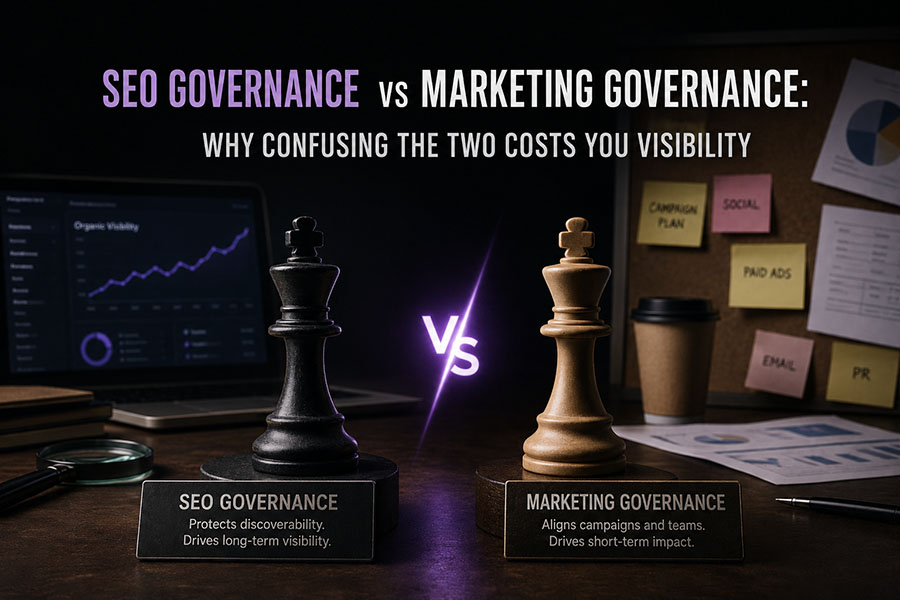
SEO governance is the organizational system of enforceable standards, defined ownership, and structural controls that protect and scale search visibility across an enterprise. Marketing governance is the framework that ensures brand consistency, campaign compliance, and messaging alignment across channels. They overlap, but they are not the same discipline; they do not serve the same masters, and treating them as interchangeable is one of the most expensive structural mistakes a large organization can make.
I’ve worked inside organizations where SEO sat comfortably under the marketing umbrella, attended the same planning meetings, followed the same approval chains, and reported to the same VP. It looked organized. It felt aligned. And it consistently underdelivered, because the governance model being applied to search visibility was designed for something fundamentally different.
Marketing governance manages brand expression. SEO governance manages system eligibility. This article is about that distinction. Not theory, operational reality.
What Marketing Governance Actually Controls
Marketing governance exists to protect brand integrity and campaign effectiveness at scale. Its primary concerns are message consistency, legal compliance, approval workflows for outbound communications, and channel coordination. It answers questions like: Does this asset match brand guidelines? Has a lawyer reviewed this claim? Is this campaign aligned with the quarterly plan?
These are legitimate and necessary functions. At a global organization, ungoverned marketing creates reputational risk, regulatory exposure, and brand fragmentation across markets. Marketing governance exists to prevent all of that, and it does that job well.
But notice what it doesn’t govern: URL structure. Crawl budget allocation. Structured data schema standards. Internal linking architecture. Canonical tag enforcement. Entity representation across thousands of pages. Indexation eligibility for AI retrieval systems.
Those outcomes are determined by a completely different set of decisions, made earlier, by different teams, with different accountability structures. And yet, in most enterprises, the people responsible for those outcomes are sitting inside the marketing governance framework, working within approval chains and planning cycles designed for campaigns, not infrastructure.
That mismatch is structural. And it produces structural consequences.
Where the Confusion Originates
The confusion between SEO governance and marketing governance has a clear historical origin: SEO was born inside marketing. It arrived as a channel, a way to generate traffic and leads, measured alongside paid search, social, and email. Governance followed function. If SEO lived in marketing, marketing governance applied to SEO.
That model worked tolerably well when the search was simpler. On-page optimization, link building, and keyword targeting were largely content and campaign decisions. Marketing governance frameworks could accommodate them without much friction.
Modern search has fundamentally changed that calculus. Today’s search systems, including Google’s AI-driven retrieval and answer engines like ChatGPT and Perplexity, evaluate organizations as coherent systems, not individual pages. They assess entity consistency, structural clarity, topical authority depth, and machine-readable signal quality across an entire digital estate. These outcomes are not produced by content teams following brand guidelines. They are produced by engineering decisions, platform architecture, taxonomy design, and technical standards that predate any individual piece of content.
When SEO governance sits inside a marketing framework, it loses the organizational authority to govern those upstream decisions. It can recommend. It can advise. It cannot enforce. And in enterprise organizations, the difference between advisory and enforceable is the difference between compounding visibility and chronic structural decay.
The Four Critical Differences
1. Who They Govern
Marketing governance governs people: content creators, campaign managers, agency partners, and regional marketing teams. It sets standards for human behaviour in the production and distribution of brand communications.
SEO governance governs systems: CMS templates, URL patterns, crawl directives, structured data schemas, hreflang implementations, canonical policies, redirect logic, and internal linking architecture. It sets standards for how digital infrastructure produces machine-readable signals.
This distinction matters because the enforcement mechanisms are entirely different. You enforce marketing governance through approvals, training, and review workflows. You enforce SEO governance through platform controls, release checkpoints, template standards, and pre-deployment audits. One is a people problem. The other is a systems problem. Applying people-management governance to a systems problem produces guidelines that no one enforces, because there is no system to enforce them. At enterprise scale, optional guidelines are not governance. They are noise.
2. Who They Report To
Marketing governance typically reports into a Chief Marketing Officer or VP of Marketing. Its accountability sits within the marketing function because its primary risk, brand inconsistency and campaign non-compliance, is a marketing risk.
SEO governance, at maturity, reports to a combination of digital leadership, product, and technology ownership, with executive sponsorship at the C-suite level. Its primary risks, structural decay, indexation failure, and authority fragmentation across markets, are infrastructure risks, not campaign risks. They affect revenue at a scale that campaigns rarely do, and they compound over time in ways that campaign failures typically don’t.
Placing SEO governance under marketing leadership creates an accountability structure where the person responsible for search visibility doesn’t control the engineering, product, or platform decisions that determine it. That accountability gap is the structural root cause of most enterprise SEO underperformance I’ve seen from the inside.
3. Their Time Horizons
Marketing governance operates on campaign cycles: quarterly planning, launch timelines, creative reviews, and post-campaign analysis. It is inherently short-to-medium term in its orientation. Campaigns launch, run, and close. Governance resets with the next cycle.
SEO governance operates on infrastructure time horizons. A decision made today about URL architecture, site taxonomy, or CMS template standards will affect organic visibility for years. A migration executed without SEO governance input can produce traffic losses that take 12–18 months to recover from, long after the campaign team that approved it has moved on to the next project. I covered this directly in website migration SEO recovery: the organizations that suffer the most severe post-migration collapses are almost always the ones where the rebuild was treated as a marketing project rather than an infrastructure project, with marketing governance applied instead of SEO governance.
4. What Compliance Looks Like
Marketing governance compliance means an asset has been reviewed, approved, and published according to brand standards. The asset exists. The campaign launched. The review happened. The box is checked.
SEO governance compliance means a page or template meets structural eligibility standards before it goes live, and continues to meet them as the platform evolves. It means structured data validates. Canonical tags point to the correct URLs. Internal links distribute authority according to the architectural design. Entity representation matches the centralized taxonomy. These aren’t creative checks. They are technical audits with binary outcomes: eligible or not eligible for retrieval. Partial compliance is not compliance.
Marketing governance frameworks are not built to run binary technical audits at scale. That is not a criticism; it is a description of what they were designed to do. But it does mean that organizations applying marketing governance to SEO will consistently produce content that passes the creative review and fails the technical eligibility check.
The Real Cost of Conflating the Two
When SEO governance and marketing governance are conflated, specific and predictable failures emerge. I’ve encountered all of them directly.
Content teams publish at volume without structured data enforcement, because the content review process checks message and tone, not schema validity. The result is a large content estate that passes every editorial standard and fails AI retrieval on the queries that matter most.
Engineering teams deploy platform updates without SEO pre-launch review, because the approval chain runs through marketing governance, which doesn’t include a technical SEO checkpoint. The result is indexation losses that take quarters to diagnose and months to recover from.
International markets launch localized content without canonical governance, because the regional marketing team followed the approved localization process, which was designed to ensure brand consistency, not signal clarity. The result is multilingual cannibalization that erodes authority in every market simultaneously.
Each of these failures looks different on the surface. At the root, they share the same cause: an SEO governance requirement being managed through a marketing governance framework that wasn’t designed to meet it.
The compounding cost is high. Organizations that operate without structurally independent SEO governance typically see 25–40% of recoverable organic performance lost to structural inefficiency, authority fragmentation, indexation failures, and technical debt accumulating through ungoverned platform decisions. That gap doesn’t recover through better campaigns or more content. It requires structural intervention, which is significantly more expensive than building the governance model correctly in the first place.
What Separation Actually Looks Like in Practice
The clearest practical test is this: can the SEO function block a deployment, a template change, or a content launch that fails structural eligibility standards? Not recommend. Not flag. Block.
Under marketing governance, the answer is almost always no. SEO is advisory. It can raise concerns in a meeting. It cannot stop a launch.
Under SEO governance, the answer should be yes, with a defined escalation path for exceptions that require executive authorization. That authority is what makes governance enforceable rather than aspirational. Without it, SEO teams spend their time auditing damage rather than preventing it. And at enterprise scale, auditing damage is dramatically more expensive than building the checkpoint that prevents it.
Building that separation requires executive sponsorship. It requires a RACI that explicitly assigns SEO governance ownership outside the marketing approval chain for infrastructure decisions. And it requires leadership that understands the difference between managing a channel and managing an organizational capability, a distinction I explore in detail in the context of the broader enterprise SEO operating model.
The organizations that get this right don’t just rank better. They stop losing ground every time a platform decision is made without SEO input, every time a new market launches without canonical coordination, and every time a sprint delivers a template change that bypasses the structural standards the SEO team built. They build compounding authority instead of constantly recovering from fragmentation.
If your SEO maturity model still places governance fully inside marketing, you are operating a campaign review process for an infrastructure problem. The gap between those two things is exactly where your organic performance is leaking, quietly, predictably, and at compounding cost.
Key Takeaways
- SEO governance and marketing governance are distinct disciplines with different objects, time horizons, enforcement mechanisms, and accountability structures. Treating them as the same function produces structural SEO underperformance.
- Marketing governance governs people and brand expression. SEO governance governs systems and structural eligibility. Applying a people-management framework to a systems problem produces optional guidelines, not enforceable standards.
- The most expensive symptom of conflated governance is the advisory gap: SEO functions that can recommend but cannot block. Advisory SEO governance cannot prevent the structural failures that compound over time.
- Separating SEO governance from marketing governance requires executive sponsorship and a RACI that explicitly assigns infrastructure ownership outside the standard marketing approval chain.
- The recoverable organic performance gap between organizations with mature, structurally independent SEO governance and those without is typically 25–40%. That is a structural efficiency problem, not a tactics problem.
Ready to Separate the Two?
If your SEO function operates inside your marketing governance framework, following campaign approval chains, reporting into marketing leadership, and managing visibility as a channel rather than as infrastructure, the gap between your current performance and your potential is almost certainly structural.
I work with SEO Managers, Heads of Digital, VPs, and C-suite leaders at enterprise organizations to build SEO governance frameworks that carry actual organizational authority, separate from, and integrated with, marketing governance where it matters.
Frequently Asked Questions
SEO governance is the system of enforceable standards, defined ownership, and structural controls that protect and scale search visibility. It governs systems, URL architecture, structured data, crawl directives, canonical logic, and internal linking. Marketing governance governs people and brand expression, ensuring message consistency, campaign compliance, and creative approval. They overlap where SEO intersects with content production, but they operate on different time horizons, report into different organizational structures, and require fundamentally different enforcement mechanisms.
When SEO governance sits inside marketing, the SEO function becomes advisory: it can recommend structural decisions but cannot enforce them. Engineering, product, and platform decisions that directly affect search visibility get made without SEO governance input, because those decisions don’t flow through the marketing approval chain. The result is structural SEO failures that accumulate quietly over time and compound into significant organic performance losses.
Marketing governance frameworks handle what they were designed for: brand consistency, legal compliance, and campaign review. They are not built to run technical SEO eligibility checks, enforce structured data schema standards, manage canonical tag policies, or audit deployment changes for crawl impact. Applying marketing governance to SEO infrastructure requirements produces guidelines rather than controls, and guidelines at enterprise scale are routinely overridden under delivery pressure.
It looks like a defined RACI that assigns SEO governance ownership for infrastructure decisions outside the standard marketing approval chain. It includes pre-deployment SEO review checkpoints integrated into engineering release workflows. It includes template standards enforced at the platform level, not reviewed after launch. And it includes an executive sponsor, typically at the CMO or CTO level, who treats organic visibility as an organizational asset, not a marketing deliverable.
The clearest indicators are: SEO recommendations that get deprioritized in sprint planning because they don’t fit the marketing roadmap; post-launch indexation or crawl issues that weren’t caught in the approval process; content that passes brand review but fails structured data validation; and international market launches that create cannibalization because the localization workflow checked brand consistency but not signal clarity.
The cost is structural. Organizations operating without independent SEO governance typically see 25–40% of recoverable organic performance lost to structural inefficiency, authority fragmentation, indexation failures, and technical debt accumulating through ungoverned platform decisions. That gap doesn’t recover through better campaigns or more content. It requires structural intervention, which is significantly more expensive than building the governance model correctly in the first place.
No. Separation means SEO governance carries enforceable authority over infrastructure decisions that marketing governance was never designed to handle. Collaboration between SEO and marketing teams remains essential for content strategy, campaign alignment, and channel coordination. The separation is about authority structures, not working relationships. High-performing enterprise organizations integrate both governance frameworks at the workflow level while keeping their accountability structures distinct.
