

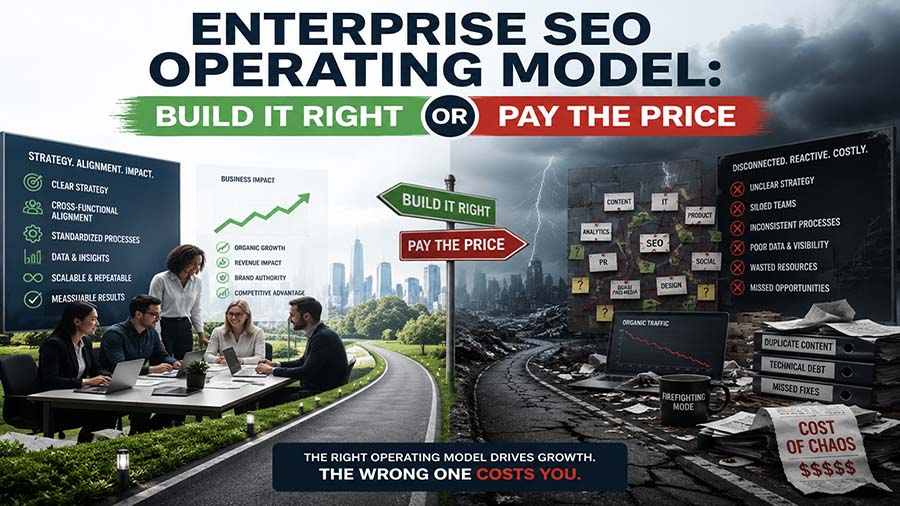
Definition: An enterprise SEO operating model is the organizational system that governs how search visibility is planned, executed, owned, and scaled across a large, complex organization. It defines roles, standards, workflows, governance structures, and measurement frameworks – not as a set of best practices, but as enforceable operational infrastructure.
Most large organizations don’t have an enterprise SEO operating model. They have a team, a tool stack, and a quarterly reporting deck.
I know the difference because I’ve sat inside both. At Adecco Group and Atlas Copco, I didn’t inherit a functioning operating model; I inherited the wreckage of organizations that had treated SEO as a marketing task rather than an organizational capability. Fragmented ownership. Templates no one enforced. Technical debt that compounded across market after market. Measurement that tracked activity, not business outcomes.
The cost of that misalignment wasn’t theoretical. It was real revenue, real visibility loss, and real organizational friction that slowed everything down.
Here’s what I’ve learned: an enterprise SEO operating model isn’t built by the SEO team. It’s built by leadership that understands what SEO has become. And in 2026, that distinction matters more than it ever has.
Why the Old Model Is Broken
For most of the last decade, enterprise SEO operated as a downstream marketing function. The team optimized what the product and engineering teams had already built. They advised. They requested. They waited.
That model was never efficient, but it was survivable – search engines were forgiving enough that you could compensate for structural gaps with enough content, enough links, and enough activity.
That era is over.
Modern search systems – including Google’s AI-driven retrieval and answer engines like ChatGPT, Perplexity, and Gemini – don’t reward isolated optimizations. They reward coherence. They reward structural clarity. They reward organizations where entities are defined consistently, intent is modeled deliberately, and content governance enforces quality at scale. If your organization lacks those foundations, your content may never enter the retrieval set at all – regardless of how technically correct individual pages appear.
The question is no longer “Are we doing SEO well?” The question is: “Is our organization structurally capable of being discovered, understood, and selected by modern search systems?”
If you can’t answer yes to that question with evidence, you have an operating model problem – not a tactics problem.
The Five Components of a Functioning Enterprise SEO Operating Model
1. Structural Ownership – Not Guidelines, Governance
The single most common failure I’ve seen in enterprise SEO is the confusion between guidelines and governance. Guidelines are optional. Governance is enforceable.
A functioning operating model defines who owns what – not aspirationally, but operationally. That means a RACI that reflects how decisions actually get made, not how they should ideally be made. It means escalation paths that work without political friction. It means an executive sponsor who treats organic visibility as a business performance metric, not a marketing deliverable.
Without this, SEO remains a negotiation at every stage: with engineering over deployment windows, with content teams over briefs, with legal over claims. Every optimization requires persuasion. That’s not an operating model. That’s chronic inefficiency.
If your SEO governance framework doesn’t define consequences for non-compliance, it isn’t a governance framework. It’s a wish list.
2. SEO as Infrastructure – Embedded Upstream, Not Applied Downstream
The organizations that consistently outperform in organic search share one structural characteristic: SEO requirements are embedded into the systems that produce digital assets, not applied to them afterward.
That means taxonomy decisions include SEO input at the design phase. Template standards include structured data requirements from the start. URL structures, metadata schemas, hreflang logic for international markets – all of it is enforced through the platform, not retrofitted by an SEO team working against an already-deployed system.
At Atlas Copco, one of the most complex challenges I encountered was international website cannibalization – market sites competing against each other for the same queries because the architecture had never been designed with signal clarity in mind. By the time the SEO team identified the problem, the structural debt was already deep.
Infrastructure decisions are leadership decisions. If your organization still treats SEO as something applied after the build, you’re creating structural debt that compounds with every deployment.
3. Cross-Functional Accountability – SEO Is a Team Sport
In most enterprises, SEO is measured on outcomes while other teams control the systems that produce those outcomes. Engineering controls deployability. Content teams control publishing calendars. Product controls information architecture. Legal controls what you can say. Procurement controls tools.
This accountability gap is the structural root cause of most enterprise SEO underperformance. The SEO function carries the KPI but doesn’t control the inputs.
A functioning operating model closes that gap. It defines shared visibility ownership, establishes cross-functional review cadences, and creates mechanisms for SEO requirements to be integrated into engineering sprints, content workflows, and product roadmaps – not bolted on at the end.
This connects directly to what I’ve written about organizational friction in SEO: the biggest performance barriers aren’t technical. They’re structural. And structural problems require structural solutions, not more reporting.
4. Content Governance at Scale
Publishing volume is not a strategy. I’ve seen organizations producing hundreds of pieces of content per month with almost no visibility gain – because the content lacked structural coherence, intent alignment, and topical depth.
At scale, content governance means standardized production frameworks: brief templates that enforce intent clarity, editorial workflows that include structured data requirements, quality thresholds that are enforced rather than recommended, and consolidation logic that prevents internal cannibalization before it starts.
It also means understanding that semantic cluster architecture is not a content calendar exercise. It’s an organizational system for mapping topical authority across a domain – one that requires upfront design, ongoing governance, and cross-functional enforcement.
The cost of ungoverned content at enterprise scale isn’t just wasted budget. It’s active visibility harm: thin pages that dilute domain authority, duplicate content that confuses retrieval systems, and structural gaps that prevent AI systems from understanding what your organization actually stands for.
5. Measurement That Reflects Business Reality
Most enterprise SEO measurement tracks the wrong things. Rankings, impressions, and organic traffic are useful signals – but they don’t tell leadership what they actually need to know: what is organic search worth, what is it costing us, and where is the return on investment?
A mature operating model connects SEO performance to business outcomes. That means organic-attributed pipeline and revenue, not just sessions. It means SEO revenue accountability as a core reporting discipline. It means measurement frameworks that capture AI search visibility alongside traditional SERP performance – because in 2026, a significant portion of brand discovery happens in environments that don’t generate a click at all.
If your SEO reporting makes leadership ask “so what?” – that’s a measurement model failure, not a communication failure.
The Cost of Getting This Wrong
Let me be direct about what the absence of an operating model actually costs.
Organizations without structured SEO governance accumulate structural decay across their digital estate. Pages compete internally. Templates drift. Technical debt prevents indexation of high-value content. Authority signals fragment across market sites. And because no one owns the outcome end-to-end, no one is accountable for fixing it.
The compounding effect of that decay is not recoverable through increased content production or a new tool. It requires structural intervention, which is significantly more expensive and time-consuming than building the operating model correctly in the first place.
In quantitative terms, organizations with mature SEO operating models typically see 30–50% higher organic-attributed revenue efficiency compared to organizations managing SEO reactively. The gap isn’t from doing more. It’s from doing it systematically.
Conversely, the cost of not building this model – in lost visibility, wasted content investment, and missed AI retrieval opportunities – compounds every quarter. It’s not a slow bleed. In competitive markets, it’s a structural disadvantage that widens over time.
Governance failures rarely appear as a single incident. They typically emerge through disconnected ownership, inconsistent decision-making, and fragmented execution patterns that accumulate over time. The most common warning signals are outlined in Broken Cluster Governance Signs.
What Implementation Actually Looks Like
Building a functioning enterprise SEO operating model doesn’t happen in a quarter. But it can be sequenced effectively across a 12-month horizon.
The first phase focuses on governance design: defining ownership, establishing the RACI, identifying the executive sponsor, and auditing where current accountability gaps are costing performance. This phase typically surfaces $200K–$500K in annual efficiency losses that can be directly attributed to missing governance.
The second phase focuses on infrastructure integration: embedding SEO requirements into CMS templates, development release standards, and content production workflows. The returns here are compounding – every piece of content produced through a governed workflow generates stronger signals than ungoverned content ever could.
The third phase focuses on measurement transformation: shifting from activity-based reporting to outcome-based reporting, integrating AI visibility tracking, and building the executive dashboard that connects organic performance to business results.
The organizations that complete all three phases don’t just rank better. They stop losing ground every time the algorithm shifts, every time a team makes an infrastructure change without SEO input, and every time a new market launches without coordination.
Key Takeaways
- An enterprise SEO operating model is not a team or a process. It is an organizational capability, and building it is a leadership decision.
- The shift from guidelines to governance is the most important structural change most enterprise organizations need to make in 2026.
- Cross-functional accountability must be designed into the model, not assumed. If SEO carries the KPI without controlling the inputs, the accountability gap will always limit performance.
- Content governance at scale requires enforced standards, not recommendations. Volume without governance generates structural debt.
- Measurement must connect to business outcomes. Rankings and traffic are inputs, not outputs.
- The cost of not building this model compounds. Structural SEO debt is significantly more expensive to recover from than to prevent.
Ready to Audit Your Operating Model?
If your organization is producing content, running SEO programs, and still struggling to generate consistent, predictable organic performance – the problem is almost certainly structural, not tactical.
I work with SEO Managers, Heads of Digital, and C-suite leaders at enterprise organizations to diagnose operating model gaps and build the governance frameworks, accountability structures, and measurement systems that create durable visibility at scale.
Frequently Asked Questions
An enterprise SEO operating model is the organizational system that defines how search visibility is governed, executed, and scaled across a large organization. It encompasses role ownership, governance frameworks, content production standards, technical infrastructure requirements, and measurement systems, not as optional guidelines, but as enforceable operational standards.
An SEO strategy defines what you want to achieve and which areas to prioritize. An operating model defines how the organization is structured to execute that strategy at scale, including who owns what, how decisions get made, what standards are enforced, and how performance is measured and reported. Without an operating model, even a well-designed strategy will fail at the execution level.
The most common root cause is the accountability gap: SEO functions carry visibility KPIs without controlling the organizational inputs that determine those outcomes. Engineering, content, product, and legal teams all make decisions that directly affect SEO performance, without SEO governance built into their workflows. The result is reactive SEO work that cannot generate consistent, compounding returns.
Governance means enforceable standards, not optional guidelines. In practice, it means a RACI that defines who owns decisions and who must be consulted, escalation paths that resolve cross-functional conflicts, mandatory compliance requirements built into CMS templates and production workflows, and an executive sponsor who holds the organization accountable to shared visibility outcomes.
A realistic implementation timeline runs 9–18 months for a large enterprise, depending on organizational complexity and current governance maturity. The first 90 days typically focus on diagnostic work and governance design. Infrastructure integration and measurement transformation follow in subsequent phases. The returns are compounding; organizations that complete this work stop losing ground every time a new market launches or an infrastructure change is made without SEO input.
Organizations with mature operating models typically generate 30–50% higher organic-attributed revenue efficiency compared to organizations managing SEO reactively. The return comes not from doing more SEO, but from doing it systematically, with governance that prevents structural debt, content standards that enforce quality at scale, and measurement that connects visibility to business outcomes.
Modern AI-driven search systems, including Google’s AI Overviews and answer engines like ChatGPT and Perplexity, reward structural clarity, entity consistency, and content coherence. These are outputs of a well-governed operating model. Organizations that lack operating model infrastructure are not just underperforming in traditional search – they’re increasingly invisible in AI-mediated discovery environments.
