

Author: Ivica Srncevic | Updated: May 28, 2026
AI Visibility Inspector: Find Out Exactly Why AI Engines Are Ignoring Your Pages
SEE HOW AI SEES THE WORLD
In This Article
The AI Visibility Inspector, an Innovative intelligence field scout that audits any live webpage and produces engine-specific AI retrieval scores across ChatGPT, Claude, Gemini, and Perplexity, is a premium diagnostic intelligence system designed for organizations that need precise, engine-level visibility insights. Licensing is issued per machine and tied to a verified corporate email. Data residency guaranteed.
AI Visibility Inspector is the first diagnostic engine that exposes the semantic graph the way modern AI systems interpret it.The AI Visibility Inspector is a forensic AI Intelligence solution that performs real-time, client-side audits of any active web page – your own or your competitors’, no difference. The system extracts 100+ structural, semantic, schema, freshness, and retrieval signals directly from the live DOM, then processes them through a deterministic multi-module scoring engine to generate a composite AI Retrieval Index (0–100), engine-specific citation probability models, and prioritized remediation guidance.
Why the AI Visibility Inspector Exists
The AI Visibility Inspector is the first diagnostic system built specifically for the AI‑era retrieval landscape. Traditional SEO tools measure rankings, keywords, and crawlability. Still, none of them can tell you how ChatGPT, Claude, Gemini, or Perplexity interpret your content, which entities they extract, or why your pages fail to appear in AI‑generated answers. The AI Visibility Inspector fills this gap by providing engine‑level visibility diagnostics that no other tool on the market offers.
The AI Visibility Inspector is the first diagnostic tool built to answer the question every SEO Manager, Head of Digital, and VP of Marketing is asking in 2026 – not “do I appear in AI?” but “why don’t I, and what do I fix first?“
Built for Agencies, Enterprises & Professional SEO Teams
| Business Owners & CEOs Benefits | Marketing Manager Benefits |
|---|---|
| – A competitive advantage no one else has | – Stop producing content AI will never retrieve |
| – Faster, more accurate decision‑making | – Precision competitive intelligence |
| – Protect your brand from AI reasure | – Higher ROI on every content Euro |
| – Recover lost revenue from Dark Funnel | – Faster and more accurate decision making |
| – Strengthen your topical authority | – Blueprint for AI-ready content |
| – Get insights into the competitors strategies | – Know what your competitors are doing better |
We are giving the honest review of AI Visibility Inspector and NovaX, with all strengths and weaknesses, and compare them against competitors in articles like: NovaX vs Semrush, Ahrefs, Conductor & BrightEdge, Which AI Visibility Tool Is Best for SEO, Best AI Visibility Tools: What They Do and Who They’re For, Which AI Visibility Tool Is Best for SME, Which AI Optimization and Visibility Tools Are Actually Built for Agencies, AI Visibility Inspector and NovaX vs BrightEdge, AI Visibility Inspector and NovaX vs Conductor, NovaX vs Ahrefs, Best Tool to Optimize and Track ChatGPT Citations, AI Visibility Inspector vs Ahrefs, NovaX vs Semrush, AI Visibility Inspector vs Semrush, and when competitor is better than us, we say it clearly and loudly.
What does AI AI Visibility Inspector actually do?
The Problem No Monitoring Tool Can Solve
Every major platform, like Semrush, Peec AI, Profound, and Surfer, now offers AI visibility tracking. They tell you your share of voice. They show you where competitors appear. They confirm what you already suspect: your AI citation rate is lower than it should be.
What they cannot tell you is WHY.
Because the answer is not in the monitoring layer. It lives inside the page itself, in the heading hierarchy, the entity markup, the data extractability architecture, the schema signals, and the retrieval logic that your content either satisfies or doesn’t. Across four different AI engines that evaluate pages by four completely different standards.
That is the gap the AI Visibility Inspector closes.
You enter a URL. The AI Visibility Inspector tears the page apart across four diagnostic dimensions: Structural Integrity, Data Extractability, Entity Clarity, and AI Visibility Signals, then maps the failures against each engine individually. You walk away knowing exactly which pages are invisible, which engines are rejecting them, and precisely what to change.
No dashboards to maintain. No subscriptions to manage. No waiting for a platform crawl to refresh. One URL. One pass. Complete structural clarity.

Free AI Visibility Diagnostic (v0.5)
Audit Your Site’s LLM Retrieval Probability
Traditional SEO tools are blind to how AI models like Gemini, Perplexity, and ChatGPT actually “see” and cite your content. The AI Visibility Inspector v0.5 is a forensic “lite” tool designed to give you instant clarity on your structural and extraction health.
Note: The Chrome Store version is currently under a 6-week security review. Get early access by downloading the local package below.
1. Download & Unzip: Save the v0.5 folder to your computer.
2. Extensions Page: Open Chrome and go to chrome://extensions/.
3. Developer Mode: Toggle the switch in the top right corner.
4. Load Unpacked: Click the button and select your unzipped v0.5 folder.
What Changes When You Have This Clarity
Before the AI Visibility Inspector, your team operates on assumptions. You’ve optimized for Google. You’ve added the FAQ schema. You’ve increased word counts. Some of it moved the needle. Most of it didn’t, because you were solving for one engine while four were evaluating your pages by entirely different logic.
After the AI Visibility Inspector, you know which exact structural elements are blocking retrieval on each engine. You know whether your Entity Knowledge Graph is green, yellow, or red, and what that means for how AI models describe your brand when a buyer asks. You know which query intent types your page satisfies and which it fails – and what a single structural change would do to your Logic Retrieval and Actionable match scores.

See how AI sees the web
The Audit Intelligence module
The Audit Intelligence module is the AI Visibility Inspector’s central diagnostic and decision-making layer. It consolidates all structural, semantic, schema, freshness, entity, and retrieval signals into a unified AI Retrieval Index score while generating a prioritized action framework designed to improve AI citation eligibility and machine-readable trust signals.
Unlike traditional SEO auditing systems that focus primarily on rankings or technical compliance, the Audit module evaluates how effectively a page functions as a retrievable, understandable, and trustworthy source within modern AI-driven discovery systems such as ChatGPT, Perplexity, Claude, Google Gemini, and Copilot.
The system analyzes more than 100 live signals extracted directly from the rendered DOM, then processes them through a deterministic multi-module scoring engine to evaluate five core dimensions: Structural Integrity, Data Extractability, Entity Clarity, Schema & Metadata, and Freshness & Decay. Each dimension contributes to the overall AI Retrieval Index and helps identify which weaknesses are most likely reducing citation probability.
At the center of the Audit tab is the AI Assessment layer – an AI-generated interpretation of the page’s current retrieval posture, semantic quality, structural health, and overall trust profile. This provides a high-level summary of how AI systems are likely to perceive the page before users begin reviewing individual diagnostic modules.
The module also generates a prioritized remediation framework through Critical Actions – ranked recommendations classified by estimated impact level (Critical, High, Medium, or Low). These recommendations are designed to help users focus first on the structural and semantic weaknesses that most strongly affect retrieval visibility and AI citation confidence.
The 100-Signal Scoring Engine Explained: Most diagnostic tools rely on crawl data or API samples. The AI Visibility Inspector works differently. It renders the page as a real user would, then extracts 60+ live signals directly from the executed DOM. This includes visible heading hierarchy, JSON-LD schema presence and connectivity, entity co-occurrence patterns, semantic bolding density, table and list extractability, machine-readable date signals, FAQ schema completeness, internal link entity flow, image alt entity reinforcement, paragraph-level topical clustering, code-to-content ratio, and more than 45 additional structural markers. Each signal is weighted differently per engine – what matters for Claude (heading precision) matters less for Perplexity (citation density).
Why “Aggregate Scores” Hide Your Real Problems: An aggregate AI Retrieval Index of 67 sounds average. But the Audit module reveals what that average conceals: Structural Integrity at 91, Data Extractability at 44, Entity Clarity at 82, Schema at 38, Freshness at 80. The page is being destroyed by extractability and schema – two dimensions that share a common root cause (missing structured data for key facts). A generic SEO audit would suggest “improve content quality.” The Audit module tells you to convert three paragraphs into a definition list and add Product or FAQ schema. Two fixes. One hour.
The Critical Actions Hierarchy and ROI Sequencing: Not all Critical Actions are equal. The Audit module ranks every recommendation by estimated impact, but it also adds a second dimension: implementation effort. A Critical fix requiring five minutes of work (adding a schema tag) appears above a Critical fix requiring two hours (restructuring heading hierarchy) – even if the two-hour fix has slightly higher potential impact. This effort-weighting is unique to the AI Visibility Inspector. It prevents the common failure mode where teams receive a 50-item report, tackle the easiest tasks first, see no improvement, and abandon the process. The Audit module guides you to the highest-ROI sequence, not just the highest-impact list.

See how AI sees the web
The Engines Intelligence module
This is the insight that makes the AI Visibility Inspector genuinely different from everything else available.
Perplexity, ChatGPT, Claude, and Google Gemini do not use the same retrieval logic. They are not interchangeable. A page optimized for one will frequently fail on another – and that failure is invisible until you look at the engine-level diagnostic.
Perplexity runs real-time retrieval-augmented generation. It prioritizes high-authority citations and verifiable structured data. Your page’s ability to appear in Perplexity answers depends heavily on whether it contains citable external references, semantic FAQ schema, and accessible Key Facts structures.
ChatGPT evaluates semantic weight and topical depth. It responds to clear intent, conversational NLP structure, and content that reads like genuine expertise rather than marketing copy. Enterprise pages are particularly vulnerable to this; years of brand-safe copy have trained teams to write in exactly the register ChatGPT penalizes.
Claude is the most demanding engine for content hierarchy. It analyzes document structure with unusual precision, which means your H1-through-H4 logic, expertise-signal identifiers, and contextual disambiguation quality directly determine whether your content gets cited or ignored.
Google Gemini bridges the Search Graph with LLM output, applying strict E-E-A-T principles on top of JSON-LD evaluation. A Gemini score in the 50s, which is common even on well-maintained enterprise sites, means your structured data layer and authority signals are misaligned.
The Cross-Engine Priority Matrix: After analyzing all four engines, the AI Visibility Inspector generates a unified action plan ranked by cross-engine impact. A fix that improves scores on three engines gets “Critical” priority. A fix that helps only one engine but addresses a severe gap (like missing Person schema causing Gemini failure) gets “High” priority. A fix that only affects ChatGPT’s marketing register penalties gets “Medium.” This prevents the common mistake of optimizing for ChatGPT at the expense of Claude, or fixing Perplexity citations while ignoring Gemini’s E-E-A-T requirements. You see exactly which structural changes deliver the highest return across the entire AI retrieval ecosystem.
See how AI sees the web
The Schema Intelligence module
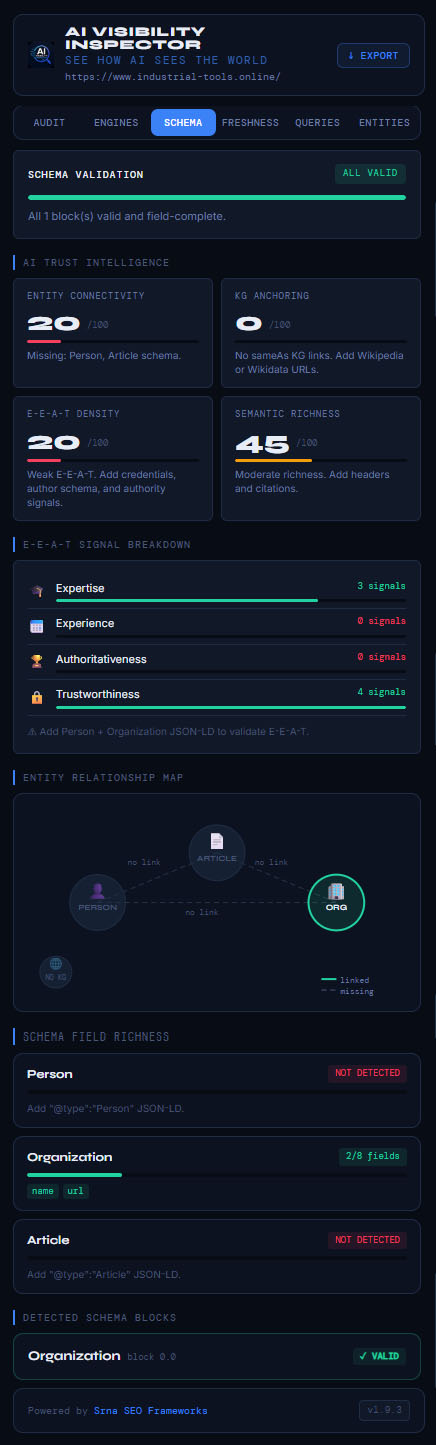
The Schema Intelligence module is the AI Visibility Inspector’s advanced trust and entity validation layer. While most SEO tools simply check whether schema exists, the AI Visibility Inspector analyzes how effectively your structured data helps AI systems understand, verify, and trust your content.
The system evaluates the quality, completeness, and interconnectivity of your JSON-LD schema graph across core entity types such as Article, Person, Organization, Product, FAQ, WebPage, and more. It validates whether critical machine-readable signals are present, properly linked, and aligned with the visible page content.
Beyond simple schema detection, the module measures deeper AI trust factors including Entity Connectivity, Knowledge Graph Anchoring, E-E-A-T Density, and Semantic Richness. These signals help determine whether AI engines can confidently associate your content with real authors, organizations, expertise, and topical authority.
The Schema tab also introduces a visual Entity Relationship Map, allowing you to see how your Person, Article, and Organization entities connect together inside your trust graph. Missing or weak relationships are highlighted automatically, helping identify structural gaps that reduce citation probability across AI systems such as ChatGPT, Perplexity, Claude, and Google Gemini.
The Schema Gap That Destroys AI Trust: Most enterprise pages have schema – often valid JSON-LD. But validity is not the same as connectivity. The AI Visibility Inspector routinely finds pages with separate Person, Organization, and Article blocks that share no references between them. To an AI engine, this looks like three unrelated claims rather than one trusted source. A Person entity without an affiliation link to your Organization, or an Article without an author reference to a verified Person profile, breaks the trust graph Gemini requires for E-E-A-T validation. The Entity Relationship Map visualizes these missing connections instantly. Adding three lines of JSON-LD to connect existing schema blocks is often a 15-minute fix that raises Gemini scores by 15–20 points—one of the highest-ROI interventions the AI Visibility Inspector identifies.
Why Schema Completeness Is Not Schema Confidence: A page can have perfect schema completeness – every required field populated, every type correctly declared – yet still fail AI trust evaluation. The reason is confidence. Gemini and ChatGPT don’t just check if schema exists; they evaluate whether the schema aligns with visible page content. A Product schema declaring a price of 49 while the visible price says 59, which creates a conflict signal that reduces citation confidence more than missing the schema entirely. The Schema Intelligence module performs alignment verification between every schema field and its visible DOM equivalent. Mismatches are flagged as Critical Actions because they actively damage trust rather than simply failing to build it. Fixing alignment is usually a 30-second edit – and typically recovers 10–15 points on Gemini’s E-E-A-T evaluation.
See how AI sees the web
The Freshness Intelligence module
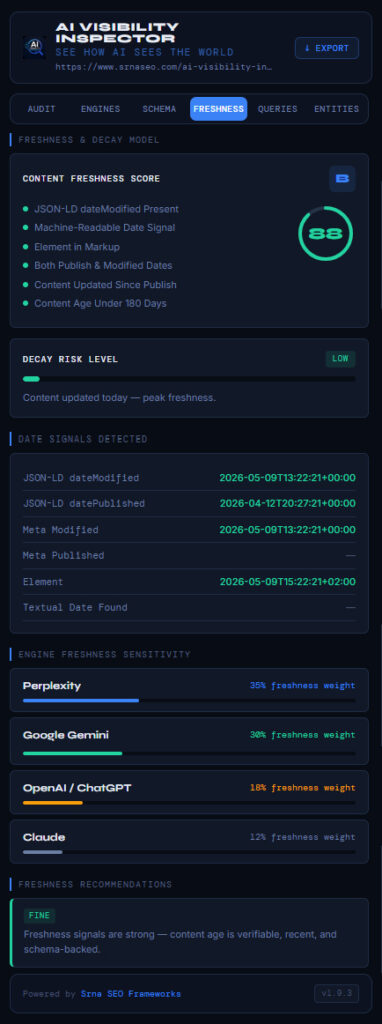
The Freshness Intelligence module evaluates how recent, maintained, and time-relevant your content appears to AI systems. Modern engines such as Perplexity and Google Gemini heavily prioritize freshness signals when selecting sources for citations, especially for evolving topics and informational queries.
The AI Visibility Inspector analyzes machine-readable date signals including datePublished, dateModified, Open Graph timestamps, HTML time elements, and visible on-page update indicators. It also measures content age, update consistency, and freshness decay risk.
Pages with strong freshness signals are more likely to be trusted, retrieved, and cited by AI systems, while outdated or poorly maintained content often experiences reduced visibility regardless of content quality. The module highlights missing or weak date signals and provides prioritized recommendations to improve retrieval freshness and citation confidence.
The Freshness Paradox That Most Tools Miss: A page updated yesterday can appear “fresher” to AI engines than a page updated today—if the machine-readable signals are misaligned. The AI Visibility Inspector regularly finds pages where the visible footer says “Updated May 2026” but the dateModified schema tag still shows January 2024. Perplexity and Gemini read the machine date, not the human text. The result? An engine-assigned freshness score equivalent to an 18-month-old page despite recent edits. Even worse: pages with no machine-readable date signals at all are often treated as “unknown freshness” and systematically deprioritized in favor of any competitor with a verifiable timestamp. The Freshness Intelligence module scans for all six machine-readable date locations simultaneously, flags every inconsistency, and tells you exactly which three lines of code to add or correct—typically a 10-minute fix that moves a page from “freshness penalty” to “citation eligible.”

See how AI sees the web
The Queries Intelligence module
The Queries Intelligence module analyzes how AI engines may interpret your page as a potential source for answering real user questions. Instead of relying on traditional keyword databases, the system extracts and generates contextual query opportunities directly from the page itself – including headings, semantic patterns, informational structures, FAQs, definitions, comparisons, and instructional content.
The module evaluates how well your content aligns with retrieval-oriented search behavior used by systems such as ChatGPT, Perplexity, Claude, and Google Gemini. Each generated query is assigned an eligibility score representing the estimated likelihood that AI systems could retrieve, trust, and cite your page when responding to that specific question or intent.
The Query Intent Gap That Kills Citations: Most pages answer the questions the author wanted to answer, not the questions AI engines are being asked. The AI Visibility Inspector reverses this. It extracts 20–40 potential queries directly from your content structure, then scores each on two dimensions: Intent Match (does your page actually answer this question?) and Structural Retrieval Probability (can an AI engine find and extract that answer within 3–5 seconds?). A page might score 95% on Intent Match for “what is enterprise SEO” but only 30% on Retrieval Probability because the answer is buried in paragraph 12. The Queries module surfaces every high-intent, low-retrieval gap and tells you exactly which structural change would move each query from invisible to citation-ready.

See how AI sees the web
The Entities Intelligence module
The Entities Intelligence module analyzes the semantic ecosystem of your page – the people, organizations, technologies, products, concepts, locations, and topical relationships that AI systems use to build contextual understanding. Rather than evaluating isolated keywords, the system measures how effectively your content establishes a coherent and machine-readable entity graph.
The module identifies primary entities, supporting secondary entities, topical clusters, and semantic co-occurrence patterns directly from the live page content and structured data. These signals help determine whether AI engines can clearly understand what the page is about, which entities are most important, and how they relate to one another within a broader knowledge context.
At the center of the module is the Entity Graph Stability model – a composite evaluation measuring semantic consistency, entity reinforcement, schema backing, query alignment, contextual clarity, and topical cohesion. Strong entity graphs help AI systems confidently associate your content with specific topics and retrieval pathways, increasing citation eligibility and topical authority signals.
The AI Visibility Inspector also evaluates whether important entities are missing, weakly reinforced, or disconnected from the surrounding semantic structure. Missing entities frequently indicate content gaps, incomplete topical coverage, or insufficient contextual depth – especially when high-priority concepts appear in generated queries but are absent from the actual content.
Unlike traditional SEO systems focused primarily on keywords and density, the Entities Intelligence module evaluates pages as interconnected semantic environments – helping determine how effectively your content functions as a recognizable, context-rich knowledge source inside modern AI retrieval systems.
The Entity Tax That No One Talks About: Every AI engine pays a computational “tax” when interpreting ambiguous entity relationships. A page that mentions “Apple” ten times forces the engine to decide each time: fruit or technology company? A page that mentions “Apple Inc.” twice and “MacBook” eight times eliminates the ambiguity entirely. The AI Visibility Inspector quantifies this tax through its Entity Clarity Index. Pages with high entity ambiguity (same term pointing to multiple possible meanings without disambiguation) lose 15–30% of their potential citation probability before any other diagnostic even runs. The Entities module flags every ambiguous entity, measures the clarity gap, and recommends specific disambiguation signals – a brand prefix, a schema sameAs reference, or a contextual anchor phrase – that close the gap in minutes, not hours.
The Difference Between Entity Density and Entity Stability: Most entity tools measure density – how many times a concept appears. The AI Visibility Inspector measures stability – how consistently entities are defined, reinforced, and connected across the entire page. A competitor page might mention “zero-party data” twelve times (high density) but never define it, never link it to a schema type, and never connect it to related entities like “first-party data” or “consent management.” Your page mentions it six times (lower density) but includes a definition, a DefinedTerm schema block, and explicit relationship links. The AI Visibility Inspector will score your page higher on every engine because stability beats density. This is why keyword-focused optimization fails in AI retrieval – and why the Entities module reveals competitive advantages invisible to traditional tools.
The Entities Intelligence module analyzes the semantic ecosystem of your page – the people, organizations, technologies, products, concepts, locations, and topical relationships that AI systems use to build contextual understanding. Rather than evaluating isolated keywords, the system measures how effectively your content establishes a coherent and machine-readable entity graph.
The module identifies primary entities, supporting secondary entities, topical clusters, and semantic co-occurrence patterns directly from the live page content and structured data. These signals help determine whether AI engines can clearly understand what the page is about, which entities are most important, and how they relate to one another within a broader knowledge context.
At the center of the module is the Entity Graph Stability model – a composite evaluation measuring semantic consistency, entity reinforcement, schema backing, query alignment, contextual clarity, and topical cohesion. Strong entity graphs help AI systems confidently associate your content with specific topics and retrieval pathways, increasing citation eligibility and topical authority signals.
The AI Visibility Inspector also evaluates whether important entities are missing, weakly reinforced, or disconnected from the surrounding semantic structure. Missing entities frequently indicate content gaps, incomplete topical coverage, or insufficient contextual depth – especially when high-priority concepts appear in generated queries but are absent from the actual content.
Unlike traditional SEO systems focused primarily on keywords and density, the Entities Intelligence module evaluates pages as interconnected semantic environments – helping determine how effectively your content functions as a recognizable, context-rich knowledge source inside modern AI retrieval systems.
The Structural Layers That Determine Whether AI Cites You
Underneath the engine-specific scores, the AI Visibility Inspector evaluates four foundational layers that govern AI retrieval across all engines simultaneously.
Structural Integrity determines whether AI models can parse and trust your page’s architecture. This is the baseline. A page with perfect Structural Integrity gives every AI engine a clean map to follow – logical heading hierarchy, stable knowledge graph signals, correct heading-to-text ratio, and coherent intent throughout. Without this foundation, extractability improvements deliver nothing.
Data Extractability is where most enterprise pages quietly fail, and where the AI Visibility Inspector delivers its most commercially valuable diagnostic. This measures whether AI systems can pull usable structured information from your page. An Extractability score in the high 40s or low 50s, typical even for content-rich enterprise pages, means AI models can see your content but cannot extract a clean signal from it. The practical consequence: they cite your competitors instead. The fix is structural, not creative. Scrapeable bullet structures, table data availability, LLM word density, and elimination of code/script interference are the levers. The AI Visibility Inspector tells you exactly which ones are pulling you down.
Entity Clarity reveals how AI models categorize your page, and whether those categories align with how you want to be found. The AI Visibility Inspector maps four entity types: your core topic entity (Concept), your organizational brand (Organization), your expert persona (Person), and your regional positioning (Location). Green signals mean AI has confidently identified and structured that entity. Yellow means it’s detected but dependent on external references, a latent E-E-A-T risk. Red means the entity is absent, which is particularly damaging for internationally targeted content and for any page where expert authority is a conversion signal.
This models the same semantic structures Google, OpenAI, and Anthropic rely on internally – entity graphs, schema anchors, co‑occurrence patterns, and clarity signals.
Over time, repeated retrieval consistency and citation confidence contribute directly to AI visibility and brand trust formation across generative search ecosystems.
AI Visibility Signals – the fourth layer, measures the meta-level readiness of your page: intent clarity, RAG retrieval readiness, Schema.org integration, cross-reference strength, and metadata alignment. This is the layer that determines whether a structurally sound page actually gets retrieved in practice.
This layered evaluation model reflects the contextual ranking layers increasingly used by modern AI retrieval systems to assess meaning, trust, extractability, and semantic relevance progressively rather than simultaneously.
How This Investment Translates Into Revenue
The AI Visibility Inspector directly impacts revenue by improving your visibility in the channels where customers now discover information: AI assistants, AI search layers, and multi‑modal retrieval systems.
With AI Visibility Inspector, you become visible where others are still invisible.
| Strategic Advantage in a New Visibility Layer | Sharpen your competitive edge |
|---|---|
| Most companies are blind to AI retrieval. You’re not. This gives you a multi‑year competitive edge. | Reveal your competitors’ semantic weaknesses by exposing exactly where their AI visibility breaks, and where you can overtake them. |
Why Companies Choose the AI Visibility Inspector
1. Built for enterprise workflows
2. Zero data sharing
3. Zero API cost
4. Zero operational overhead
5. Proprietary metrics
6. Category‑defining methodology
7. Immediate ROI
8. No comparable product on the market
| How Licensing Works? | Volume Discounts |
|---|---|
| Contact us with the number of seats and the corporate emails to register. | – 3–5 seats → 10% off |
| – We issue an invoice. | – 6–10 seats → 15% off |
| – After payment, you receive an email with the Intelligence software, licence keys, and activation instructions | – 11–20 seats → 20% off |
| – Each license activates one machine. | – 20+ seats → custom enterprise pricing |
| Licenses can be reassigned upon request. |
AI Visibility Inspector – Core Diagnostic Components
The AI Visibility Inspector is built on top of twelve proprietary frameworks that define how modern search engines and AI systems interpret meaning, entities, and intent. If you want to understand the methodology behind the AI Visibility Inspector’s diagnostics, you can explore the full Frameworks collection, including the SEO Maturity Model, Semantic Cluster Blueprint, Visibility Strategy System Design, AI Search Readiness Audit, International SEO GEO Optimization, and Indexation & Crawl Diagnostic, as well as the six semantic metrics: Entity Graph Stability Score™, Semantic Coverage Index™, Query Intent Alignment Score™, Entity Clarity Index™, Schema Confidence Score™, and Topical Authority Density™. These frameworks form the foundation of the AI Visibility Inspector’s semantic analysis engine.
What Makes This Different From SEO Tools
Traditional SEO tools measure keywords, links, and on‑page signals, but they cannot see what AI systems actually interpret. The AI Visibility Inspector intelligence system analyzes your pages the way LLMs do, exposing semantic gaps, entity instability, and even your competitors’ weaknesses, revealing exactly where their AI visibility breaks and where you can overtake them.
Acquire AI Visibility Inspector Today
What Fixing This Is Actually Worth
An enterprise page that scores 51 on ChatGPT and 54 on Gemini is not slightly underperforming. It is structurally invisible to two of the four major AI engines evaluating it.
Organizations that implement the structural fixes the AI Visibility Inspector surfaces – entity markup repair, schema alignment, heading hierarchy correction, semantic bolding, mission framing – consistently see 20 to 40 percent improvement in AI citation frequency within 60 to 90 days. For pages targeting high-intent B2B queries, that translates directly into appearing in the AI-generated vendor shortlists that now precede most purchase decisions.
The cost of not doing this is not a traffic metric. It is the cost of being systematically absent from the research conversations your buyers are having right now, with AI engines that already have clear preferences about which sources they trust, and that will continue to prefer your competitors until you change the structural signals they’re reading.
Key Takeaways
The AI Visibility Inspector is the only tool that surgically diagnoses structural AI readiness at the page level, across four engines, five query retrieval match types, and four entity knowledge graph categories, with engine-specific, actionable output.
Every major AI monitoring platform tells you that you’re not appearing. The AI Visibility Inspector tells you why, and exactly what to fix, in which order, for which engine.
The structural gaps it surfaces are consistent across enterprise content programs: strong topical content built on weak data extractability, missing entity markup, schema misalignment on Gemini, and content architecture that satisfies Primary Topic Intent while failing Logic Retrieval and Brand Authority.
These are not content problems. They are structural problems. And they have structural solutions – specific, prioritized, and executable by your team this week.
Frequently Asked Questions
It diagnoses the structural reasons a specific page is not being retrieved and cited by AI engines. It evaluates four foundational layers: Structural Integrity, Data Extractability, Entity Clarity, and AI Visibility Signals, and maps the failures against Perplexity, ChatGPT, Claude, and Google Gemini individually. The output is not a generic readiness score. It is a prioritized, engine-specific list of structural fixes your team can action immediately.
Monitoring tools track where your brand appears in AI-generated answers over time. They answer, “Are we visible?” The AI Visibility Inspector answers, “Why aren’t we visible, and what is the structural cause?” These are different questions that require different instruments. The Inspector is a diagnostic tool, not a tracking platform. Most organizations benefit from using both monitoring to identify the visibility gap and the Inspector to diagnose what’s creating it.
Perplexity, ChatGPT, Claude, and Gemini use fundamentally different retrieval logic. A page that satisfies ChatGPT’s semantic weighting can simultaneously fail Gemini’s E-E-A-T schema requirements and Claude’s heading hierarchy standards. Applying a single fix to a multi-engine problem is why most AI optimization efforts deliver inconsistent results. The Inspector surfaces the engine-specific failure, so the fix is targeted, not generic.
Data Extractability measures whether AI systems can pull usable structured information from your page. A score in the high 40s or low 50s, common even on well-maintained enterprise sites, means AI models can see the page but cannot extract a clean signal from it. The practical consequence is that they cite competitor pages instead. Improving Extractability through scrapeable content structures, table data, and LLM word density is often the highest-leverage fix available on a per-page basis.
The Entity Knowledge Graph reveals how AI models categorize your page at the entity level, as a Concept, Organization, Person, or Location. These categorizations directly shape how AI engines describe your brand when buyers ask about your category. Missing or weak entity signals, particularly for Expert Persona without Schema.org Person markup, or Regional Context for internationally targeted pages, mean AI engines fill the gap with assumptions that rarely position you favourably.
They are the five query intent categories AI systems evaluate when deciding whether your content is worth citing: Primary Topic Intent, Technical Retrieval, Brand Authority, Logic Retrieval, and Actionable ‘How-To’. Most enterprise pages score well on the first two and poorly on the last three, which are precisely the match types that convert AI citations into buyer intent signals. The Inspector scores all five and tells you what structural addition addresses each gap.
Entity Semantic Bolding means bolding key phrases that correspond to your primary entities and topics. AI systems that use token weighting, Perplexity, and ChatGPT, especially assign higher retrieval probability to content where key entities are visually and semantically emphasized. It is one of the fastest structural interventions available and one of the highest-return, which is why the Inspector surfaces it as a Quick Win.
The Inspector diagnoses individual pages in a single pass. NovaX extends that diagnostic logic into portfolio-level AI visibility intelligence, tracking retrieval performance across multiple pages, competitive positioning, and structural trends across all four engines over time. For enterprise teams managing large content programs, NovaX is the operational layer that makes Inspector-level insight scalable across hundreds or thousands of pages.
Both, but pre-publication is the highest-leverage use case. Running the AI Visibility Inspector before a page goes live allows you to correct structural architecture, entity markup, and schema issues before the page enters AI retrieval cycles. Post-publication fixes propagate more slowly and compete with established retrieval patterns. If you are preparing for a site migration or rebuilding a content program, the AI Visibility Inspector is the diagnostic that should run before any content is finalized.
When the diagnostic returns multiple critical flags across more than one engine, or when the Entity Knowledge Graph shows systemic weakness across all four entity types, the issue is typically architectural rather than page-level. Those situations require a structural repair roadmap, not individual page fixes, and that is precisely what the Enterprise Search Advisory is built for.
Author: Ivica Srncevic
Enterprise SEO strategist specializing in search architecture and AI-driven visibility. With 25+ years of experience across global organizations including Adecco Group and Atlas Copco, he works on designing, diagnosing, and optimizing how complex digital ecosystems are structured, understood, and surfaced by search engines and AI systems.