

In This Article
Your Semrush dashboard says your AI visibility score is climbing. Your Ahrefs Brand Radar shows mentions trending up in ChatGPT. And yet a customer told your VP of Sales last week that Claude recommended a competitor by name, with a made-up statistic about your product baked into the answer. Nobody on your team saw it coming, because none of your tools were built to see it.
That gap is what this article is about. Not whether these platforms are good. They are. But good at what, exactly, is the question nobody in procurement asked before signing the contract.
Key Takeaways
- Semrush, Ahrefs, Conductor and BrightEdge now all ship some form of AI mention tracking. None of them audit content, so none can catch a hallucination before it reaches a buyer.
- Ahrefs Brand Radar runs on sampled, static prompt libraries. Independent testing found it reporting 3 ChatGPT mentions for a brand that actually had 123.
- Screaming Frog remains a crawler. It tells you whether a page is extractable, never whether an AI system chose to extract and cite it.
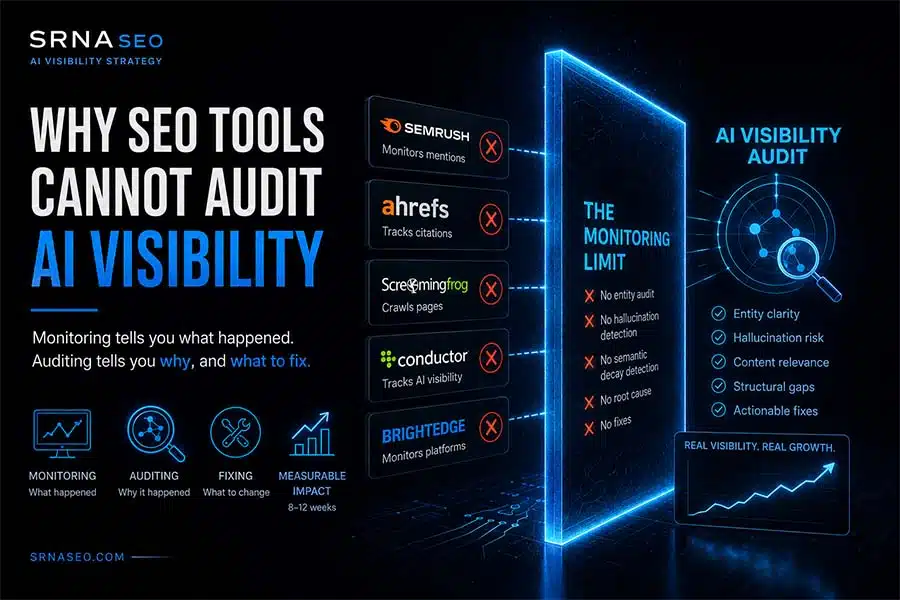
- Monitoring tells you what happened last week. Auditing tells you why, and what to fix. Almost nobody enterprise-side is doing the second thing yet.
- Fixing the entity and structural gaps that drive AI citation typically shows measurable movement in eight to twelve weeks, not overnight, and not through a dashboard subscription.
What “Auditing AI Visibility” Actually Means
Monitoring and auditing are not the same discipline, even though the SEO industry has quietly let them blur together. Monitoring answers “did this happen.” Auditing answers “why did this happen, and what structural thing do we change so it happens differently.” A speedometer monitors. A mechanic audits.
Every tool named in this article monitors. None of them audit. That is not a criticism buried in fine print, it is the honest boundary of what a mention-tracking API can do versus what a diagnostic process requires.
For a broader comparison of the tools available for auditing websites with AI, SEO, technical, and visibility signals, see our guide to the best AI website audit tools.
What This Is NOT
This is not an argument that Semrush, Ahrefs, Conductor, and BrightEdge are bad products, or that you should cancel your subscriptions. I use several of them with clients every week, and NovaX, the framework I built for AI visibility diagnosis, pulls raw citation data from some of these same sources as an input. This is an argument that a mentions dashboard was never designed to diagnose entity confusion, hallucinated claims, or decaying topical relevance, and treating it as if it were is where enterprise teams are quietly losing budget.
Where Each Tool Actually Stops
| Tool | What it does well | What it cannot audit |
|---|---|---|
| Semrush AI Visibility Toolkit | Tracks branded and non-branded prompts, sentiment, share of voice across ChatGPT, Gemini, and AI Overviews | Cannot verify whether what the AI says about you is true. A confident hallucination and an accurate mention score identically. |
| Ahrefs Brand Radar | Maps citation and mention volume across six AI platforms from a 400-million-prompt library | Cannot detect entity gaps. It string-matches your brand name; it does not know whether the model has correctly disambiguated who you are from a similarly named competitor. |
| Screaming Frog | Crawls, renders, and validates schema so content is technically extractable | Cannot detect AI search visibility at all. Extractability is a precondition for citation, not evidence of it. |
| Conductor | Bundles AI Overview and ChatGPT tracking into an existing content workflow | Cannot detect semantic decay, the slow drift where your once-authoritative page stops matching the topic model an LLM now weights, well before mentions visibly drop. |
| BrightEdge | Tracks citation patterns and entity alignment across six-plus generative platforms via AI Catalyst | Cannot detect AI search ranking in any stable sense, because generative retrieval has no fixed position list to rank against in the first place. |
The Uncomfortable Truth
Here is the sentence that gets pushback in board meetings: there is no such thing as an “AI ranking” the way there was a Google position 1 through 10. Retrieval is probabilistic, session-dependent, and re-generated per query. Every vendor slide that shows your “AI rank” is smoothing over that fact to sell you a familiar mental model. It is a comforting fiction, and comforting fictions are exactly what get enterprise budgets misallocated.
The Cost of Inaction
Sitting on monitoring data without a diagnostic layer underneath it is not a neutral choice, it is an active cost. Teams I have audited typically discover three to five entity conflicts and one or two hallucinated product claims circulating in AI answers before they ever go looking. Left alone, that misinformation compounds every time a model retrains on web content that itself was shaped by the earlier, uncorrected version. Left corrected, brands I have worked with have seen accurate-mention share climb 20 to 35 percent within a quarter, not because they bought a better dashboard, but because they fixed the entity graph the dashboard was reporting on.
If your team wants a structured starting point rather than another tool comparison, our AI Search Readiness Audit walks through exactly this, and the Entity Clarity Index is a useful first diagnostic to run before you touch a mentions dashboard at all. For teams that have already read a Semrush versus Ahrefs comparison and want the honest gap analysis instead, I broke down the NovaX approach against Semrush, Ahrefs, Conductor, and BrightEdge directly.
Where This Leaves You
Keep the monitoring tools. Cancel nothing today. But stop reading their dashboards as a diagnosis, because a rising mention count sitting on top of an unmanaged entity graph or undetected hallucination risk is not progress, it is exposure with a nicer chart. Real AI visibility measurement starts with the audit, and the dashboard becomes useful only after that.
If you are an SEO Manager or Head of Digital trying to explain this gap to your C-suite before next quarter’s budget conversation, that is precisely the conversation I have with enterprise teams every week. Book a diagnostic call and I will show you, on your own domain, what your current tools are not catching.
FAQ
No. They are the correct tool for monitoring share of voice and mention volume over time. The waste happens when a team treats that monitoring as a complete visibility strategy rather than the surface layer it is.
Yes, indirectly. It is essential for confirming a page is crawlable and correctly schema-marked, which is a precondition for AI citation. It simply cannot tell you whether citation actually happened.
It is the gradual mismatch between what your page says and what the current topic model expects a comprehensive answer to include. Your content did not get worse; the surrounding competitive and semantic landscape moved past it.
For a typical enterprise domain with an established content footprint, expect two to three weeks for the diagnostic phase, with corrective content and structural changes rolling out over the following quarter.
No, and any tool presenting one as a stable metric is simplifying for the sake of a familiar dashboard. Treat every AI visibility number as directional, sampled, and time-boxed, never as a fixed position.
Further discussion available in r/RetrievalOptimization.
