

In This Article
Key Takeaways
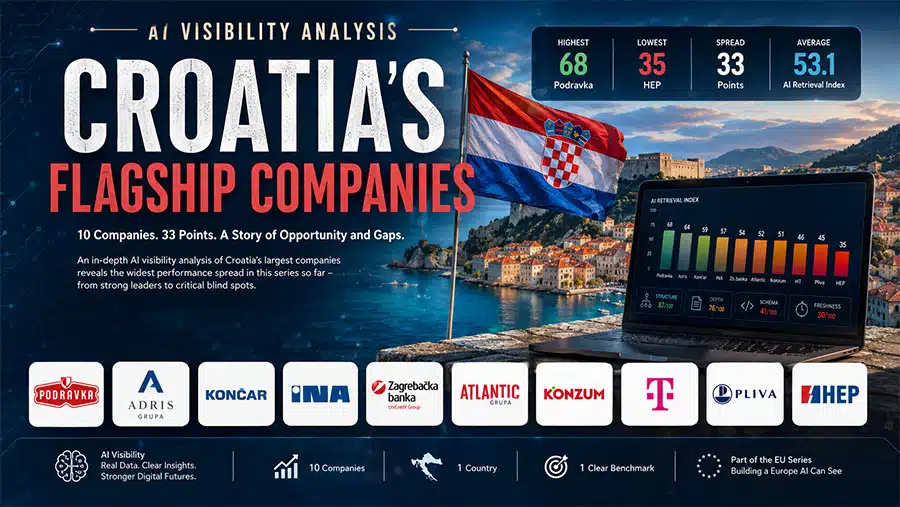
- No Croatian company in this dataset reached Grade B or above. Podravka leads at 68, short of the 70-point threshold this series defines as genuine AI readiness, but still the strongest leader-score recorded across this series’ three country-level reports.
- The 33-point spread between the highest score (Podravka, 68) and the lowest (HEP, 35) is the widest this series has recorded at country level, surpassing Belgium’s 31-point spread and far exceeding Austria’s 16-point spread.
- Structural Decay affected 7 of 10 companies, split evenly across missing H1 tags (HEP, INA, Konzum), fragmented intent from multiple H1 tags (Hrvatski Telekom, Pliva), and absent date signals (Zagrebačka banka, Atlantic Grupa).
- Freshness is the cleanest predictor of grade outcome documented in this series to date: every Grade C company scored above 60 on Freshness; every Grade D company scored a flat 0, with no exceptions in either direction.
- Schema averaged just 27.5, effectively tying Belgium for the weakest Schema average recorded anywhere in this series. HEP and Končar both scored 10, the joint-lowest Schema result in the dataset.
- Končar and Podravka are both parsed by AI systems as being about “Home” rather than their own company name, despite otherwise strong scores, a distinct failure mode this series hasn’t isolated this clearly before and one that echoes the wider Croatian pattern of generic “Naslovnica” homepage titles.
- HEP recorded the lowest overall score at 35 (Grade D), driven by a missing H1 tag, a Schema score of 10, and a Freshness score of 0, for a company operating under significant public-disclosure obligations.
- Končar’s homepage was found visibly broken and unresponsive at the time of this audit, a real-world renderability failure invisible to the structural score itself, underscoring that a strong AI Retrieval Index describes readiness, not guaranteed availability.
Building a Europe AI Can See (Research Series)
This research is part of the Building a Europe AI Can See series, which also includes top-company analyses of Austria, Belgium, Croatia, Czechia, Cyprus, Denmark, Estonia, Finland, France, Germany, Greece, Hungary, Ireland, Norway, Sweden and United Kingdom.
Also read Croatian National AI Profile research. The same AI Visibility Inspector and Ivica Srncevic Framework used across every prior report was applied here, unchanged.
A 33-Point Spread: Croatia’s Flagship Companies Have the Widest Gap This Series Has Recorded
Podravka. INA. Zagrebačka banka. Hrvatski Telekom. Končar. Adris Grupa. Atlantic Grupa. HEP. Konzum. Pliva. Ten companies that between them define the Croatian economy: its largest food and confectionery group, its national oil and gas company, its largest bank, its dominant telecommunications operator, its flagship electrical engineering and manufacturing group, one of its largest diversified holding companies, a regional consumer-goods leader, its national power utility, its largest grocery retailer, and a pharmaceutical manufacturer with a multi-decade export history now part of a global generics group. Between them they employ tens of thousands of people, generate billions of euros in annual revenue, and represent the industrial, energy, financial, and retail backbone of the newest full member of the eurozone.
This is the third installment in this series’ country-level strand, following the Austria analysis published earlier this month and the Belgium analysis published last week. The same AI Visibility Inspector and Ivica Srncevic Framework used across both of those reports, and across the ten industry-vertical installments that preceded them, was applied here.
Austria showed a country with a shared national ceiling, ten companies clustered inside a 16-point band. Belgium showed genuine separation, a 31-point spread between its best and worst performer. Croatia goes one step further. The gap between the top score and the bottom score in this dataset is 33 points, the widest this series has recorded at the country level to date, and it comes with its own distinct failure pattern: several companies undermined not by missing structure, but by pages that never say who they actually are.
Methodology
Each company’s primary corporate website was evaluated using the AI Visibility Inspector across four structural dimensions:
- Structure – how content is architecturally organized for machine parsing, including H1 clarity and navigational coherence
- Depth – the substantive quality and retrievability of content as AI systems process and extract it
- Schema – the presence of structured data markup that enables confident entity identification and citation
- Freshness – whether content age signals, specifically
dateModifiedJSON-LD, are present and verifiable to AI retrieval systems
The overall AI Retrieval Index score runs from 0 to 100. Scores below 50 indicate significant structural invisibility. Scores between 50 and 74 represent fair to moderate visibility with material gaps. Scores at 75 and above indicate good to strong AI readiness.
A Structural Decay warning is triggered when critical signals are absent or conflicting: a missing H1 tag preventing AI parsers from anchoring a primary topic, multiple competing H1 tags fragmenting intent, or absent date signals leaving content age unverifiable.
The Scores
| Company | Sector | AI Retrieval Score | Grade | Structure | Depth | Schema | Freshness |
|---|---|---|---|---|---|---|---|
| Podravka | Food & FMCG | 68 | C – Fair | 100 | 90 | 35 | 60 |
| Adris Grupa | Diversified Holding | 64 | C – Fair | 100 | 85 | 25 | 63 |
| Končar | Electrical Engineering / Manufacturing | 59 | C – Fair | 100 | 75 | 10 | 61 |
| INA | Energy / Oil & Gas | 57 | C – Fair | 55 | 65 | 35 | 69 |
| Zagrebačka banka | Banking | 54 | D – Poor | 96 | 85 | 25 | 0 |
| Atlantic Grupa | Consumer Goods / FMCG | 52 | D – Poor | 96 | 75 | 25 | 0 |
| Konzum | Retail (grocery) | 51 | D – Poor | 55 | 75 | 50 | 0 |
| Hrvatski Telekom | Telecommunications | 46 | D – Poor | 65 | 75 | 25 | 0 |
| Pliva | Pharmaceuticals | 45 | D – Poor | 70 | 60 | 35 | 0 |
| HEP | Energy / Utilities | 35 | D – Poor | 50 | 65 | 10 | 0 |
National average: 53.1 – Grade C/D border, AI Retrieval Index
Zero companies in Grade A. Zero in Grade B. Four in Grade C. Six in Grade D. Croatia’s best performer, Podravka at 68, would rank fourth in the Belgian comparison and third in the Austrian one. Croatia’s worst performer, HEP at 35, ties the lowest score recorded anywhere in this series’ country-level reports so far.
Five Findings the Croatian Corporate Sector Needs to See
Finding 1: The Widest Spread This Series Has Recorded at Country Level
The 33-point gap between Podravka (68) and HEP (35) edges past Belgium’s 31-point spread and dwarfs Austria’s 16-point spread. Two country-level reports into this series, a pattern is emerging: markets that show genuine separation between leaders and laggards, rather than a shared national ceiling, appear to be the norm rather than the exception once you move beyond a single small, tightly regulated economy like Austria’s. In Croatia, four companies, Podravka, Adris Grupa, Končar, and INA, cleared the 55-point Grade C threshold with real daylight beneath them. Six did not, and one of those six, HEP, the country’s national power utility, posted the lowest single score recorded in this report and one of the lowest recorded anywhere in the series to date.
Finding 2: Structural Decay Hit 7 of 10 – Across Three Distinct Failure Modes, Cleanly Split
Seven of the ten companies evaluated triggered a Structural Decay warning, a rate identical to Belgium’s and meaningfully better than Austria’s universal 100%. The failures split three ways, almost evenly:
Missing H1 tag (AI parsers cannot anchor a primary topic): HEP, INA, and Konzum, three companies spanning energy, oil and gas, and grocery retail.
Fragmented intent from multiple H1 tags: Hrvatski Telekom and Pliva, both flagged for two competing H1 tags on their homepages.
Absent date signals: Zagrebačka banka and Atlantic Grupa, both of which otherwise posted the strongest Structure scores in the entire dataset, 96 apiece, undone by the inability to verify content currency.
Three companies, Podravka, Adris Grupa, and Končar, triggered no Structural Decay warning at all. That is the same proportion Belgium achieved with Solvay, Umicore, and Proximus Group, and it confirms again what this series has now shown in two consecutive country-level reports: a clean structural baseline is achievable by roughly a third of any national flagship sample, which means it is a solvable problem, not an industry-wide ceiling.
Finding 3: A Company Can Fail Structurally and Still Reach Grade C – INA Is the Proof
INA is the most instructive case in this dataset. It carries a Structural Decay warning for a missing H1 tag, the same failure that drags HEP and Konzum into Grade D, yet INA still reaches 57 and Grade C. The reason is that INA pairs its structural gap with the highest Freshness score in the entire dataset, 69, and a Schema score of 35 that sits above the national average. A verifiable, well-dated, reasonably structured page can partially outrun a missing entity anchor. It cannot fully compensate for it, INA’s Structure score of 55 is still the joint-lowest in the dataset, but it demonstrates that Freshness and Schema are not merely secondary dimensions. They are load-bearing enough to move a company across a grade boundary even when the most basic structural signal, the H1 tag, is missing entirely.
Finding 4: Freshness Is Polarized, and It Is the Single Clearest Line Between Grade C and Grade D
The national Freshness average is 25.3, close to Belgium’s 21.9 and far above Austria’s near-total collapse of 1.6. But the number conceals a near-perfect split along grade lines. Every single Grade C company in this dataset, Podravka (60), Adris Grupa (63), Končar (61), and INA (69), carries a real, verifiable Freshness score above 60. Every single Grade D company, Zagrebačka banka, Atlantic Grupa, Konzum, Hrvatski Telekom, Pliva, and HEP, scored a flat zero.
That is not a coincidence buried in six other variables. It is the cleanest single-dimension predictor of grade outcome this series has documented at country level. Two companies, Zagrebačka banka and Atlantic Grupa, posted Structure scores of 96, nearly perfect, and still landed in Grade D purely because Freshness collapsed to zero alongside them. For a national bank operating under EU financial disclosure requirements, and a regional FMCG group whose product portfolio and pricing change on a defined retail cadence, the inability of AI systems to verify content currency is not a cosmetic gap. It is the specific, isolatable reason both companies are one dimension away from Grade C.
Finding 5: Schema Is the Deepest Hole in the Dataset, and Two Flagship Companies Tie the Series-Wide Floor
The average Schema score across the ten companies is 27.5, essentially tied with Belgium’s 27.6 for the weakest Schema average this series has recorded at any level, industry or country. HEP and Končar both scored 10, the lowest Schema score in this dataset and equal to the lowest Structure-adjacent Schema result recorded in the Belgian report (BNP Paribas Fortis).
The pairing is worth sitting with. HEP is Croatia’s national power utility, operating under regulatory and public-disclosure obligations comparable to those covering Verbund in Austria and Bekaert-scale industrial peers across Europe. Končar is the country’s flagship electrical engineering and manufacturing group, competing for infrastructure contracts against European peers that increasingly use structured data to win AI-mediated procurement research. Both post a Schema score of 10, meaning AI systems attempting to confidently identify either company’s products, subsidiaries, or market position have almost nothing machine-readable to draw from, regardless of how strong the rest of the page is. Končar’s Structure score is a perfect 100. It changes nothing about how confidently an AI system can identify what Končar’s products actually are.
What AI Actually Sees
The entity interpretation outputs make the practical stakes concrete, and Croatia surfaces a failure mode neither Austria nor Belgium showed clearly: pages that parse structurally clean but still fail to identify the company.
Končar and Podravka, despite posting two of the four highest scores in this dataset and a perfect Structure score apiece, are both parsed by AI systems as being about “Home”, not about Končar, not about Podravka. The H1 tag exists, so no Structural Decay warning fires, but the page’s declared primary topic is the generic label of the page type rather than the company’s own name. This is a distinct problem from a missing H1, and this series hasn’t documented it this cleanly before: it’s not that AI parsers have no anchor, it’s that the anchor they’re given is functionally meaningless for entity identification.
Adris Grupa shows what the alternative looks like. Its page is parsed as being about “Adris”, the company’s own name, giving AI systems a direct, unambiguous entity anchor to build on. The difference between “Home” and “Adris” is a handful of characters in a title tag or H1, and it is the difference between a page that helps an AI system identify the company and one that leaves it to guess.
This pattern lines up with something visible across the wider Croatian corporate web beyond this ten-company sample: a recurring habit of leaving homepage page titles as “Naslovnica”, the generic Croatian word for “front page” or “homepage,” rather than naming the company or its core offering. It costs nothing to fix and it is, functionally, the same mistake as the “Home” entity result documented above: a structurally present but semantically empty anchor.
HEP, Konzum, and INA, all missing or lacking a usable H1, return no confident primary topic at all. For HEP, the company that supplies electricity to the Croatian market, and for Konzum, the country’s largest grocery retailer, this means AI systems have no structural declaration of what these companies fundamentally are, and have to reconstruct identity from secondary text, the least reliable and least authoritative path to entity recognition in this framework.
A Note on Real-World Renderability: Končar’s Front-End Problem
One further finding falls outside the four scored dimensions but is worth flagging directly, because it illustrates a limitation of structural auditing that every company in this series should understand. At the time of this audit, Končar’s public homepage was visibly broken in-browser: the page rendered blurred and unresponsive, consistent with a stuck or failed JavaScript process, and on-page links did not function. None of that shows up in Končar’s AI Retrieval Index, which measures the underlying markup, structure, and metadata a parser encounters, not whether a human visitor’s browser can currently interact with the page.
The result is a genuinely useful cautionary case: Končar posts a Grade C score, a perfect Structure result, and no Structural Decay warning, while its homepage was, in practice, unusable for a visitor arriving that day. Structural readiness and real-world availability are two different failure surfaces, and a company can pass one comprehensively while failing the other in front of every visitor and every AI crawler attempting a live fetch. A high AI Retrieval Index score describes what a well-formed request would find. It does not guarantee that a request made at any given moment will find anything at all.
The Croatian Paradox
None of these ten companies are digital startups improvising their content strategy. Zagrebačka banka and Hrvatski Telekom operate as the Croatian arms of two of Europe’s largest financial and telecommunications groups, UniCredit and Deutsche Telekom, respectively, and inherit disclosure and communications standards from those parents. Pliva has exported pharmaceuticals globally for decades and now operates within Teva, a multinational generics group with its own structured-data standards elsewhere in its portfolio. HEP and INA operate under significant state ownership and correspondingly heavy public-disclosure obligations. Podravka, Adris Grupa, Atlantic Grupa, and Končar are, respectively, Croatia’s largest food group, one of its largest diversified holding companies, a regional FMCG leader, and its flagship industrial exporter.
None of that institutional weight reliably predicts the AI Retrieval Index result. The gap documented here is not a resource constraint in most of these cases, several of these companies sit inside multinational groups that have already solved structured data elsewhere in their organizations, it is a sequencing and localization gap. The Croatian-market-facing website has not yet received the same machine-facing treatment as the group’s other digital properties, and in the specific case of the “Naslovnica” title pattern and the “Home” entity result, the gap is small enough to close in an afternoon, not a quarter.
The commercial stakes are direct. When an investor asks an AI assistant to summarize INA’s current strategy, when a business customer asks an AI system to compare Croatian banks, when a job seeker asks what Končar or HEP actually manufacture and supply, or when a retail analyst asks an AI system to compare Konzum against its regional grocery peers, the answer is shaped by whichever source the system can retrieve, date, and confidently identify. Right now, in six of these ten cases, that confidence is compromised by the company’s own website, and in two more, Končar and Podravka, it is quietly undercut by a page that never gets around to naming the company at all.
Croatia’s flagship companies split into a familiar pattern with one local wrinkle. Podravka, Adris Grupa, and Končar prove the structural fix, a clean H1, verifiable dateModified signals, baseline Schema markup, is achievable without heroic investment. Six others haven’t made it yet. And two of the strongest performers, Končar and Podravka, are a reminder that structure alone isn’t the finish line: a page can be architecturally perfect and still tell an AI system almost nothing about who it actually belongs to.
Want to know where your own company stands?
If you’d like a free AI visibility check, similar to the ones behind this report, get in touch and I’ll run your site through the same framework and send you the results.
Research Date: July 2026 | Methodology: Ivica Srncevic Framework + AI Visibility Inspector. This research is independent, not sponsored by any organization or legal entity. All company names and logos are used for identification and analysis purposes only.
Read more about:
- The Largest Dataset in This Series and What It Proves
- Quantifying Structural Decay: The Silent Erasure of Web Assets in RAG Retrieval Pipelines
Calculate your potential exposure below
Inputs
Enter your own data where possible. Hover over labels or open “Methodology” for details on how each field is used.
From GA4, GSC, or your SEO platform. Use a 30–90 day average.
Session → lead / signup / purchase. Use decimal (e.g. 1.2 for 1.2%).
For B2B, use average deal value or LTV. Currency is symbolic here.
Used to show profit‑based cost of inaction. Leave at 100 to ignore.
Share of organic traffic from queries/pages likely to be influenced by AI answers and retrieval systems.
Based on observed traffic loss patterns in AI search and structural decay cases.
Expected organic growth if you do nothing special about AI visibility.
Plausible uplift over the chosen horizon based on case studies.
How these numbers are calculated (methodology)
Let:
- O₀ = monthly organic sessions
- CVRₒ = organic conversion rate (as a decimal)
- ARPC = average revenue per conversion
- GM = gross margin (as a decimal)
- E = AI exposure share (as a decimal)
- D = displacement rate (as a decimal)
- T = time horizon in months
Baseline monthly revenue:
- Revenue: \(R_0 = O_0 imes CVR_o imes ARPC\)
- Profit: \(R_{0,profit} = R_0 imes GM\)
Monthly revenue at risk (for a given D):
- \(R_{risk} = R_0 imes E imes D\)
- Profit version: \(R_{risk,profit} = R_{risk} imes GM\)
The tool computes R_risk for three scenarios:
- Conservative: D = 0.15
- Base: D = 0.30 (or your selected scenario)
- Aggressive: D = 0.50
Cost of Inaction over T months is approximated as:
- \(CoI(T) = R_{risk} imes T\)
- Shown as a range from conservative to aggressive.
The growth inputs (g₀, g₁) are currently used for narrative context and can be incorporated into a more advanced version that models opportunity cost explicitly.
