

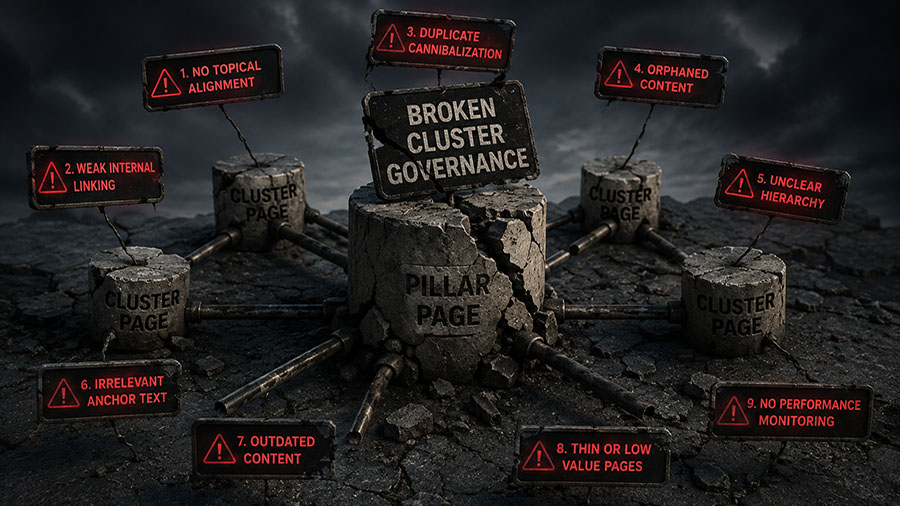
Definition
Broken cluster governance is the condition where a semantic content cluster, the interconnected system of pillar pages and supporting articles designed to signal topical authority, loses structural integrity, ownership clarity, or publishing discipline. The result is a system that looks like a content strategy on paper but functions as isolated noise in practice. Search engines and AI systems stop interpreting it as authoritative. Visibility erodes, quietly and consistently.
I have worked inside global enterprises long enough to know that broken cluster governance rarely announces itself. There is no dramatic ranking collapse, no overnight traffic drop that triggers a board-level incident. Instead, it accumulates in the background, a missing internal link here, a duplicate topic there, a pillar page that nobody has touched in fourteen months. By the time leadership notices the numbers, the structural damage has been building for quarters.
This article is for SEO Managers, Heads of Digital, and VPs who suspect their cluster architecture is not performing the way it should, but cannot yet name precisely why. I want to give you the diagnostic framework I use with enterprise clients, drawn from direct experience at organizations like Adecco Group and Atlas Copco, not from agency-side theory.
Why Cluster Governance Breaks in Enterprise Environments
Before identifying the signs, it helps to understand the mechanism. Semantic clusters require sustained coordination across content, development, and business units. In smaller organizations, this coordination happens naturally because fewer people touch the site. At enterprise scale, it must be intentional and structurally enforced.
What happens in practice is different. Content teams publish spoke articles without checking whether the pillar page exists or is linked. Product teams modify URL structures without SEO review. Multiple regional teams create near-identical content targeting the same topics. Internal linking standards exist in a document somewhere that nobody reads. The pillar page accumulates authority from backlinks, but that authority never flows to the cluster because the linking architecture has quietly decayed.
The cost is real. Organizations with structurally coherent clusters consistently outperform those without, in topical authority signals, in AI retrieval eligibility, and ultimately in organic revenue contribution. Estimates from practitioners working at scale suggest that well-governed clusters generate 30–50% more organic impressions than equivalent ungoverned content libraries targeting the same topics. The cost of not maintaining governance compounds quarterly. You do not just miss rankings, you train search engines and AI systems to treat your site as an unreliable source on the topics that matter most to your business.
Sign 1: Your Pillar Page Exists, But Nobody Owns It
The most common signal I encounter is a pillar page that was created during a strategy session eighteen months ago and has not been touched since. It ranks adequately for a broad head term, but it no longer reflects the cluster beneath it. New spoke articles have been published, but the pillar does not link to them. Topics have evolved, but the pillar has not.
Ownership is the foundation of governance. When I ask enterprise teams who owns the cluster’s pillar page, meaning who is responsible for its accuracy, its internal link architecture, and its quarterly refresh, the answer is usually a vague reference to “the content team” or silence. That ambiguity is the governance failure, not the content itself.
What to do: Assign named ownership to every pillar page. Define a refresh cadence, quarterly at minimum for competitive topics. Build a checklist that the owner completes each cycle: new spoke articles linked, outdated information updated, internal link anchors reviewed.
Estimated gain after implementation: Pillar pages with structured ownership and quarterly refresh cycles typically recover 15–25% of lost topical authority signals within two to three months, based on observable ranking behavior in clusters I have managed directly.
Sign 2: Spoke Articles Are Not Linking Back to the Pillar
This one surprises people because it seems mechanical. Surely the team knows to link spoke articles back to the pillar. In my experience, they frequently do not, or they link with generic anchor text that carries no topical signal.
A spoke article about “international SEO subdomain structure” that links to the pillar on “international SEO” with the anchor text “click here” has failed at the only linking job it has. Search engines use anchor text to understand semantic relationships between pages. Generic anchors break that relationship. Worse, spoke articles that link to no pillar at all are simply orphaned content; they contribute zero structural authority to the cluster and receive zero authority from it.
At enterprise scale, this problem multiplies. You may have forty spoke articles across a cluster, twenty of which have weak or missing pillar links. The cluster’s semantic network is fractured, and Google’s understanding of your topical authority degrades accordingly.
What to do: Audit all spoke articles in each cluster for pillar link presence and anchor text quality. Implement a publishing checklist that requires pillar link verification before any spoke article goes live. This is not bureaucracy; it is the minimum viable governance for cluster integrity.
Sign 3: Multiple Pages Are Competing for the Same Query
Internal keyword cannibalization within a cluster is one of the clearest signs that governance has broken down. When I see two or three spoke articles targeting substantially the same query, I know immediately that no one is managing the cluster’s topical map. Content was published based on individual briefs, not coordinated coverage.
Search engines do not reward internal competition. They choose one page, often not the one you intended, and suppress the others. Both pages underperform. The cluster’s authority signal becomes diffuse. In AI search environments, where retrieval depends on clear topical positioning, cannibalization creates ambiguity that causes the system to deprioritize your content entirely.
This pattern is especially common after content velocity increases. When teams move to two or three articles per week without a governed topic map, duplication accumulates faster than anyone notices. By the time you audit, you have a cluster that has cannibalized itself across a dozen query pairs.
What to do: Maintain a living topic map for every cluster, a document that assigns each subtopic and its target query to exactly one URL. No publication happens without the topic map being checked. If a new article brief overlaps with an existing spoke, the existing spoke gets updated rather than a new article being created.
The cost of not acting: Cannibalized clusters do not just plateau. They regress. As Google’s systems become more capable of detecting topical redundancy, the suppression effect becomes more aggressive. I have seen enterprise clients lose 40% of cluster impressions within six months of a significant cannibalization event, with no external cause.
Sign 4: The Cluster Has No Defined Boundary
A cluster without a defined boundary drifts. New content gets loosely associated with the cluster’s topic but serves fundamentally different audiences or intent stages. Over time, the cluster’s topical focus dilutes, and search engines lose confidence in what the cluster actually represents.
I see this frequently when business units contribute content to shared clusters. Marketing publishes a thought leadership piece that is tangentially related to the cluster’s core topic. Sales enablement adds a resource guide. Product launches a feature page. Each decision is reasonable in isolation. Together, they transform a tightly governed semantic cluster into a loosely related content library with no clear authority signal.
Defined boundaries mean documented scope: the cluster covers these topics, serves these intent stages, and targets these personas. Content that falls outside that scope belongs to a different cluster or does not belong in the cluster at all.
Sign 5: Internal Linking Runs One Direction Only
Healthy clusters link laterally, spokes link to related spokes, not just back to the pillar. This lateral linking creates what I describe as a semantic web within the cluster: multiple pathways for both users and crawlers to move through the topical architecture. It distributes authority across the cluster rather than concentrating it at the pillar.
When I audit enterprise clusters and find that every link runs vertically, spoke to pillar, pillar to spoke, but not horizontally between spokes, I know the linking architecture was built as a template exercise rather than as genuine topical relationship mapping. The cluster is structurally incomplete.
Lateral linking also reduces bounce rate and increases session depth. Users who arrive on a spoke article about “semantic cluster architecture” and find a natural link to a related spoke on “cluster governance” are more likely to stay in the cluster and signal engagement quality back to search engines. That engagement signal compounds the cluster’s authority over time.
What to do: Map the genuine topical relationships between your spoke articles. Where a reader of Spoke A would naturally benefit from reading Spoke B, create that link with a descriptive anchor. Aim for each spoke to link to at least two other spokes within the same cluster. If you are working on building this architecture, my article on semantic cluster architecture blueprint walks through how to structure these relationships systematically.
Sign 6: Publishing Cadence Has Stalled Inside a Cluster
Search engines interpret consistent publishing as a signal of active editorial investment. A cluster that received twelve articles in Q1 and nothing in Q2 and Q3 sends a clear signal: editorial attention has moved elsewhere. Freshness signals decay. Competitors who publish consistently into the same cluster accumulate incremental authority advantages that compound across quarters.
The stall happens for organizational reasons more than strategic ones. Teams complete a cluster build-out, declare success, and redirect resources to the next initiative. No one is assigned to monitor the cluster’s performance and identify gaps that warrant new content. The cluster is treated as finished rather than as a living structure.
Enterprise organizations with functioning cluster governance treat each cluster as a permanent maintenance commitment, not a project with a completion date. Quarterly reviews identify which subtopics have shifted in intent, which queries have increased in volume, and which spoke articles have decayed in performance. New content is commissioned based on those findings, not based on editorial availability.
Estimated gain: Clusters with active quarterly maintenance cadences outperform static clusters in the same topic space by 20–35% in impression share within twelve months, based on patterns I have observed directly in enterprise environments.
Sign 7: The Cluster Is Invisible to AI Search Systems
This is the sign that will matter most over the next three years. If your cluster is structurally ambiguous, has weak internal linking, overlapping topics, stale pillar content, or undefined scope, AI search systems will not retrieve it reliably. These systems synthesize information from sources they can interpret with confidence. Structural ambiguity reads as uncertainty, and uncertainty means exclusion.
I covered the mechanics of this in my article on AI search readiness. The short version is this: AI systems do not correct for structural gaps the way human readers can. They need the architecture to be unambiguous. A cluster with clear pillar authority, lateral spoke connections, consistent entity references, and a defined topical scope gives AI systems exactly what they need to retrieve and cite your content. A broken cluster gives them nothing to work with.
The diagnostic question is simple: when you search for the topics your cluster covers in AI tools like ChatGPT, Perplexity, or Google’s AI Overviews, does your content appear? If it does not, the structural signal your cluster is sending is not strong enough for retrieval eligibility. That is a governance problem, not a content quality problem.
Sign 8: No One Monitors Cluster-Level Performance
Most enterprise SEO teams report at the page level or the keyword level. They track which individual URLs are gaining or losing rank. What they rarely do is monitor cluster-level performance as a unit, tracking the collective impression share, click-through patterns, and authority distribution across an entire semantic cluster.
Without cluster-level monitoring, governance failures are invisible until they become crises. A pillar page might be declining in authority while individual spoke articles temporarily maintain rankings, masking the structural deterioration beneath. By the time the spoke articles also start declining, you have lost twelve months of recovery time.
Cluster-level monitoring means defining what performance looks like for the cluster as a whole: total impressions across all cluster URLs, authority distribution between pillar and spokes, internal link click-through rates, and AI retrieval frequency for the cluster’s core topics. These are the operational indicators that tell you whether governance is holding before the damage shows in topline metrics.
For a deeper look at measurement frameworks that work in AI search environments, my article on measuring visibility in the age of AI search covers the approach I recommend to enterprise clients.
Sign 9: Governance Exists as a Document, Not a Process
The most sophisticated governance failure I encounter in enterprise organizations is the one that looks functional from the outside. There is a governance document. It defines cluster ownership, publishing standards, internal linking requirements, and refresh cadences. It lives in Confluence or SharePoint, and almost nobody reads it.
Document-based governance is not governance. It is an aspiration. Real governance means the standards are embedded in the actual workflow, in publishing briefs, in CMS templates, in pre-launch checklists, and in sprint reviews. When a content manager creates a new spoke article brief, the cluster topic map is part of the brief template. When a developer modifies a URL structure, an SEO review checkpoint exists in the deployment process. When a quarter ends, cluster performance reviews are scheduled events, not optional audits.
The difference between document governance and embedded governance is the difference between a policy that depends on individual memory and a system that makes the right behavior the default behavior. At enterprise scale, only the second version survives organizational complexity.
What to do: Audit your current governance against this question: does following it require any individual to remember to do something, or does the process make it happen automatically? Every point where memory is required is a governance vulnerability. Systematically eliminate those vulnerabilities by embedding standards into tools and workflows. My article on SEO governance covers the structural framework I apply to enterprise clients making this transition.
The Cost of Not Acting
Broken cluster governance is not a theoretical risk. It is an active drag on organic performance that compounds with time. Clusters that receive no governance attention for twelve months typically see authority signals decline by 20–40% relative to competitors who maintain theirs. In AI search environments, the compounding effect is faster, each quarter of structural ambiguity makes retrieval eligibility harder to recover, because AI systems build classification models over time and reassign confidence scores accordingly.
The organizations that will win organic visibility over the next three years are not the ones with the most content. They are the ones with the most coherent content systems. Cluster governance is the mechanism that keeps those systems coherent. Without it, you are producing content that works against itself.
Key Takeaways
Broken cluster governance is one of the most common and most underdiagnosed causes of enterprise SEO underperformance. Here is what the diagnostic framework reveals:
The nine signs your cluster governance is broken are: no named ownership for pillar pages; spoke articles missing or using weak links back to the pillar; multiple pages competing for the same query; clusters with undefined topical boundaries; internal linking that runs vertically only, without lateral spoke connections; stalled publishing cadence inside active clusters; cluster content that is invisible to AI search retrieval; no cluster-level performance monitoring; and governance that exists as a document rather than an embedded process.
The gain from fixing these systematically is measurable, 20–50% improvement in cluster-level authority signals and impression share within two to four quarters, depending on the severity of existing damage. The cost of not fixing them is continued structural decay in an environment where AI search is making topical coherence a prerequisite for visibility, not just an advantage.
If you recognize three or more of these signs in your current cluster architecture, the structural work needs to start now. The recovery timeline is real, and every quarter of delay extends it.
Work With Me
I help enterprise SEO teams diagnose and rebuild the structural foundations that determine long-term organic performance, cluster governance, pillar architecture, AI readiness, and cross-functional implementation frameworks. If what you read here reflects what you are experiencing inside your organization, the conversation should start now.
Frequently Asked Questions
Cluster governance is the operating system that keeps a semantic content cluster functioning as a coherent unit. It defines who owns the pillar page, how spoke articles get commissioned and linked, what the cluster’s topical boundaries are, and how performance gets monitored. Without it, even well-intentioned content strategies degrade into disconnected pages that send weak, contradictory signals to search engines.
The nine signs in this article provide a practical diagnosis. The fastest check is to ask three questions: Who specifically owns each pillar page, and when did they last review it? Does every spoke article link back to its pillar with descriptive anchor text? Are any two spoke articles targeting substantially the same search query? If any of those questions produce uncertainty, governance is broken at the foundation.
Yes. In most enterprise environments, the cluster’s content assets are sound; the structural and process problems are what need addressing. The typical intervention sequence is: establish named ownership, audit and fix internal linking, resolve cannibalization, define topical boundaries, and embed governance into publishing workflows. This is repair, not reconstruction, and it generates measurable results within two to three quarters.
AI systems retrieve content from sources they can interpret with high confidence. A cluster with structural ambiguity, overlapping topics, weak internal linking, and stale pillar content presents as an uncertain source. These systems do not fill in structural gaps; they simply move to sources where the topical architecture is clear. Governing your clusters well is no longer just an SEO practice; it is an AI retrieval prerequisite.
Pillar page ownership is the highest-leverage starting point. Once a named owner is assigned and the pillar page is refreshed and linked to all active spokes, the cluster’s authority signal improves immediately. Internal linking audit and cannibalization resolution should follow in the same quarter. The compounding gains from those three actions outperform any tactical content investment you can make without fixing the structural foundation first.
Quarterly at a minimum for competitive topic areas. Monthly for clusters where the competitive landscape is moving quickly or where AI retrieval is a priority. The review should be a scheduled operational event, not an ad hoc audit triggered by a performance drop. By the time the drop is visible in topline metrics, the structural damage has already been accumulating for months.
Yes, though the complexity of the problems is naturally lower. The governance principles, ownership, topical boundaries, internal linking standards, and refresh cadence apply at any scale. The advantage of building governance discipline early is that you avoid the significantly more expensive cleanup required when a site scales without structure in place.
