
Table of contents
- The SEO Maturity Model: From Tactical Execution to Governance
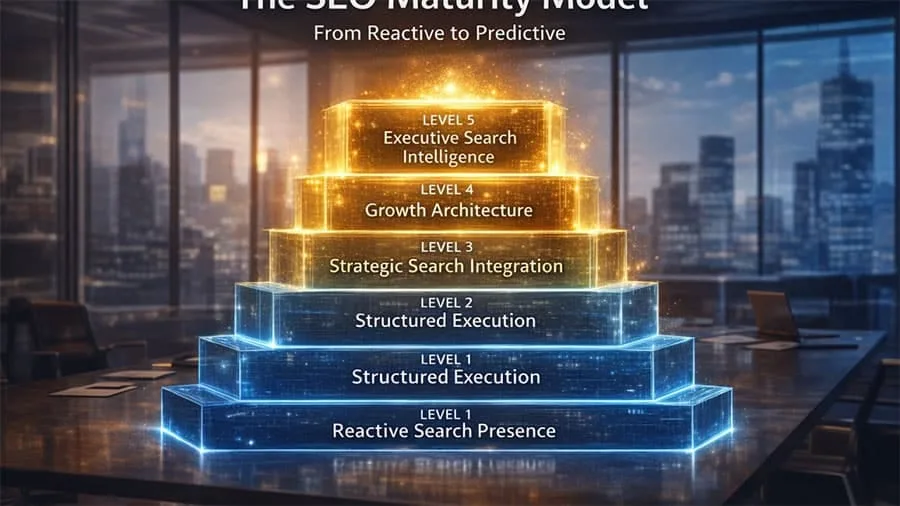
- The Five Levels of SEO Maturity
- Why the SEO Maturity Model Matters More in 2026
- The 5 Levels of the SEO Maturity Model
- The Self-Assessment Problem
- What Moving Up the Maturity Curve Actually Requires
- The Executive Question
- Work With Me
- Frequently Asked Questions
The SEO Maturity Model: From Tactical Execution to Governance
Most organizations ask the wrong question. They ask, “How good is our SEO?” – and then measure the answer with rankings, traffic numbers, or the size of the backlog they’re burning through. After 25 years in this industry, across startups, SMEs, and global enterprises like Adecco Group and Atlas Copco, I can tell you that the question never gets to the real issue.
The right question is: at what level of maturity is your organization actually operating?
The SEO maturity model is not a ranking system for your technical skills. It is a diagnostic framework for your organizational design. SEO performance reflects how deeply search logic is embedded into the structure of a business – and that structure evolves in stages that most leadership teams have never mapped. The gap between where organizations believe they sit and where they actually operate is one of the most consistent patterns I encounter when I walk into an enterprise engagement.
This article breaks down each level of the SEO maturity model in full, explains the organizational patterns that define each stage, and – critically – tells you what the difference between Level 2 and Level 4 actually costs you in competitive terms. It also tells you how to identify where you truly are, because the self-assessment almost always flatters the real answer.
The Five Levels of SEO Maturity
Level 1 – Reactive SEO
SEO happens occasionally and usually in response to problems such as traffic drops or ranking losses. There is no defined process and no ownership.
Level 2 – Tactical SEO
Teams start implementing SEO best practices, but work remains fragmented. Activities depend heavily on individual specialists rather than systems.
Level 3 – Operational SEO
SEO processes become repeatable. Content, technical improvements, and measurement follow defined workflows.
At this stage, organizations begin structuring their content systematically, often using frameworks like a semantic cluster blueprint to guide implementation.
Level 4 – Integrated Search Strategy
SEO is embedded in development, content planning, and digital strategy. Cross-team collaboration becomes routine.
Level 5 – Search as a Growth System
Search visibility becomes part of the organization’s operating model. SEO informs product decisions, market expansion, and long-term growth planning.
Why the SEO Maturity Model Matters More in 2026
The competitive context has shifted dramatically. AI-driven search surfaces, zero-click environments, and entity-based retrieval have raised the structural stakes for every organization that depends on organic visibility. The enterprises that weather these shifts are not the ones with the largest SEO teams or the most sophisticated tooling. They are the ones with the highest level of governance maturity – where search logic is embedded into decisions before those decisions are made, not patched in afterward.
Understanding the SEO maturity model is therefore no longer a practitioner concern. It is a leadership concern. If you are a Head of Digital, a VP of Marketing, or a C-suite executive, the maturity of your SEO organization determines the resilience of one of your most valuable growth channels. It determines whether organic visibility is a managed asset or a recurring crisis.
The 5 Levels of the SEO Maturity Model
Level 1 – Tactical Execution
At this level, SEO is perceived as a set of tasks. The work is real and it is often done diligently, but it operates inside a reactive loop: keyword research, on-page updates, backlog tickets for technical fixes, traffic dashboards, and fast responses to algorithm changes. The team is inside marketing and carries limited authority. When product or engineering makes decisions that affect search performance, SEO finds out after the fact.
The risk at Level 1 is structural, not motivational. The team is not failing because of effort – they are failing because the organization has no mechanism for SEO to prevent the problems that keep appearing. Every quarter produces new fires because the conditions that create fires remain unchanged. This is where the majority of companies operate, including many that believe they have moved beyond it.
The defining characteristic of Level 1 is volatility by design. Rankings fluctuate because the structural conditions that determine them are uncontrolled.
Level 2 – Structured Optimization
At Level 2, SEO begins to function as a technical discipline rather than a task list. Technical audits start influencing development cycles. Internal linking gets systematized. Crawl behavior and indexation are monitored proactively rather than discovered through drops in Search Console. Content clusters are planned in advance, and international configuration improves.
Crucially, SEO at this level starts to collaborate with product and engineering rather than just serving marketing. This is genuine progress. The risk, however, is that improvements remain project-based rather than systemic. A migration gets reviewed. A template gets audited. A crawl budget issue gets resolved. But these are events, not conditions. When the project ends, the governance reverts. The next migration starts the same review process again because the standards were never codified into the workflow.
Progress happens at Level 2, but it does not fully compound. Organizations often spend years here, cycling through optimization projects that improve performance without creating lasting structural change. If your organization identifies as Level 2, the honest question to ask is: when the project ends, does the standard survive?
Level 3 – Architectural Integration
Level 3 is where structural compounding begins. SEO moves from executing after decisions to contributing before them. Template development involves SEO input. Taxonomy decisions factor in search considerations. URL logic is governed. CMS capabilities align with discoverability requirements. When new site sections are planned, someone asks the search question before the build begins.
The organizational pattern here is meaningful: SEO gets consulted before expansion decisions. Not after. The distinction matters enormously at scale. I have seen international rollouts lose six to eighteen months of discoverability because the URL structure, hreflang configuration, and content architecture were designed without SEO involvement, then patched afterward. At Level 3, that conversation happens at the planning stage.
Search performance becomes more predictable at this level because the structural conditions that determine it are more controlled. But Level 3 still has a ceiling. Consultation is not an authority. SEO can be consulted and overruled. Standards can be set and then bypassed when timelines tighten. The organization has not yet embedded search logic as a governing principle – it has added SEO as a collaborator. That is better, but it is not the same thing.
If you want to understand how structural decisions at this level affect long-term visibility, the work I have done around semantic cluster architecture and internal authority distribution directly addresses the architectural choices that determine whether Level 3 progress holds or erodes.
Level 4 – Governance Layer
Very few organizations reach Level 4. Here, SEO transitions from a structural contributor to a governing system. The difference is not semantic – it is operational. At Level 4, SEO defines structural standards rather than recommending them. Template rules are codified. Crawl governance is proactive rather than reactive. Semantic consistency is enforced across the content ecosystem. International growth follows architectural principles that were established before the expansion began. Search-readiness is integrated into product roadmaps as a standard criterion, not an optional review.
Most importantly: SEO has authority, not just responsibility.
This is the distinction that most organizations underestimate. Responsibility without authority means the SEO team can identify the problem, document the risk, and write the recommendation – and then watch the decision go the other way because nobody with authority made the call. Level 4 resolves this. Governance means that certain classes of decisions require SEO sign-off before proceeding. Not a recommendation. A gate.
The competitive advantage at Level 4 is measurable. Structural debt decreases because new development follows standards rather than creating exceptions. Volatility impact from algorithm changes diminishes because the structural foundations are sound and documented. Organic growth becomes resilient rather than fragile.
This is also the level where SEO governance transitions from concept to infrastructure – and where the conversations I have with enterprise leadership teams begin to produce compounding returns rather than one-off project wins.
Level 5 – Predictive and AI-Ready Search Infrastructure
Level 5 is where SEO becomes a strategic intelligence layer. The organizations operating here are not optimizing for rankings. They are building discoverability infrastructure for a search environment that increasingly operates through AI retrieval, entity resolution, and semantic matching rather than keyword frequency and backlink counts.
At this level, content is modeled around entities rather than queries. Structured data is mature and comprehensive. The organization has deliberately aligned its content ecosystem with the retrieval patterns of AI-powered search surfaces. Predictive visibility analysis informs content investment decisions before traffic data confirms them. Cross-channel semantic consistency means that the entity signals the organization sends through its website, its documentation, its PR, and its product content all reinforce a coherent and machine-readable identity.
Critically, search data informs product development – not the other way around. The SEO function sits close to digital strategy leadership because it generates intelligence that shapes decisions well beyond the search channel.
Most organizations discuss Level 5 as a future ambition. Few have mapped what it structurally requires. I have written about AI search readiness and entity-based SEO in depth, because these are not theoretical constructs – they are the architectural decisions that determine whether your organization becomes visible or invisible in the next phase of search.
The Self-Assessment Problem
Here is the pattern I see consistently across enterprise engagements: most organizations believe they are at Level 3. Many are at Level 1. The gap between perception and reality is not a measurement problem – it is an organizational psychology problem. Teams describe their aspirations rather than their operational reality. Leaders describe the capabilities of their best practitioner rather than the systemic condition of the organization.
The diagnostic I use is straightforward. Ask these questions about your organization today:
- If your SEO lead left tomorrow, would structural standards persist without them?
- Do new site sections get built with discoverability as a design criterion, or does SEO review them after launch?
- Are semantic standards documented and enforced, or do they exist in someone’s head?
- Would AI retrieval systems recognize your content ecosystem as a coherent, authoritative entity?
If the answers reveal dependency on individuals rather than systems, you are below Level 4 regardless of how sophisticated your tooling appears. The difference between maturity levels is not the tools. It is the authority structure and the governance mechanisms that persist when people change and priorities shift.
What Moving Up the Maturity Curve Actually Requires
The organizations that successfully advance through the SEO maturity model share a common pattern: they reframe SEO as infrastructure rather than activity. The language shift matters. Infrastructure has governance. Infrastructure has standards. Infrastructure requires sign-off before changes are made to it. Activity does not.
Moving from Level 2 to Level 3 requires structural access – getting SEO into the room before architectural decisions are finalized. Moving from Level 3 to Level 4 requires authority – translating that access into documented standards and enforced review gates. Moving from Level 4 to Level 5 requires intelligence integration – using search data to inform product and content strategy proactively rather than reporting on what already happened.
Each transition requires executive sponsorship. Without it, SEO remains below governance maturity regardless of the team’s capability. I have seen exceptional SEO professionals trapped at Level 1 operational conditions because the organizational design around them provided no mechanism for their work to compound.
If you are working to make this case internally, the framing around predictable organic growth and structural decay in enterprise SEO provides the executive-level argument for why governance investment produces returns that task-level optimization cannot.
The Executive Question
If SEO disappeared from your organization tomorrow – not the team, but the function – consider what would remain. Would the URL structure of the next platform migration reflect search principles? Would the international expansion planning include discoverability architecture? Would the content briefs going to writers enforce semantic consistency? Would the AI systems processing your site content understand what your organization is and what it knows?
If the honest answer is no, your organization is still operating below governance maturity. And below governance maturity, organic visibility is a cost you manage rather than an asset you compound.
The SEO maturity model is ultimately a question about organizational design. Execution creates activity. Governance creates durability. In a search environment defined by structural intelligence, where AI systems surface content based on entity clarity, semantic coherence, and structural authority, durability is the only sustainable competitive advantage.
Work With Me
If this diagnosis surfaces a gap between where your organization believes it operates and where it actually does, that gap has a cost – measured in structural debt, missed organic compounding, and vulnerability to search environment shifts that governance maturity absorbs.
I work with enterprise organizations at the leadership level to assess maturity, define governance architecture, and build the structural foundations that make organic visibility resilient. Are you ready to move your organization up the maturity curve?
Frequently Asked Questions
The SEO maturity model is a framework for assessing how deeply search logic is embedded into an organization’s structure and decision-making processes. It measures not how many SEO tasks are being executed, but whether SEO has the authority, governance mechanisms, and structural integration to produce compounding organic growth. The model described in this article defines five levels – from tactical execution through to predictive, AI-ready search infrastructure.
The most reliable diagnostic is not a technical audit – it is an authority audit. Ask whether SEO is consulted before architectural decisions are made, whether structural standards are documented and enforced rather than held in individuals’ heads, and whether organic visibility would remain stable if your SEO lead left tomorrow. Organizations that answer no to these questions are operating below Level 3 regardless of their tooling sophistication.
The self-assessment problem is structural. Teams describe the capabilities of their best practitioners and the quality of their optimization work, rather than the systemic conditions that govern how SEO authority operates across the organization. An enterprise can have a highly skilled SEO manager and still operate at Level 1 conditions if that manager lacks authority over the decisions that determine search performance.
Level 3 means SEO is consulted before major decisions. Level 4 means SEO has codified authority – structural standards are documented and enforced, review gates are built into development workflows, and crawl governance is proactive. The critical distinction is that consultation can be overruled; governance cannot be bypassed without a documented exception. This difference is what separates organizations that experience structural decay from those that compound structural strength over time.
AI-powered search surfaces – including AI Overviews, ChatGPT, Perplexity, and similar systems – retrieve content based on entity clarity, semantic coherence, and structural authority rather than keyword frequency alone. Organizations at Level 5 maturity have deliberately built their content ecosystem to be machine-readable, entity-coherent, and structurally authoritative. Lower-maturity organizations that have not invested in structured data, entity modeling, and semantic consistency face increasing visibility erosion in AI-mediated discovery environments, often without detecting it through traditional analytics.
Yes, though the path looks different than it does at enterprise scale. Smaller organizations have fewer stakeholders to align and can move governance standards through the organization faster. The structural principles are identical – what changes is the complexity of the implementation. The governance mechanisms that define Level 4 are not dependent on team size; they depend on whether standards are documented, authority is defined, and review processes are built into workflows.
The first step is an honest organizational assessment – not a technical audit. Map where SEO currently sits in decision-making processes, identify the specific decisions that affect search performance where SEO has no authority or late-stage access, and document the structural debt those gaps have created. That assessment gives you the evidence to make the governance case to leadership and defines the specific authority mechanisms that need to change. Without that clarity, maturity improvement initiatives tend to improve the tooling without changing the organizational conditions that limit compounding.
Ivica Srncevic – 25 years in SEO, including enterprise roles at Adecco Group and Atlas Copco. Independent adviser to SEO Managers, Heads of Digital, VPs, and C-suite at enterprise organizations.