

Table of contents
- Predictable Organic Growth
- Reporting Is Rear-View Driving
- Why Most SEO Forecasts Still Fail
- The Shift: From Rankings to Demand Modeling
- Scenario-Based Forecasting: The Executive-Grade Model
- Capacity Is a Forecasting Variable, Not a Footnote
- AI as a Forecasting Multiplier – With Appropriate Limits
- What Executive-Level Forecasting Actually Delivers
- The Credibility Shift That Forecasting Creates
- The Bottom Line
- Predictable organic growth FAQ
Predictable Organic Growth
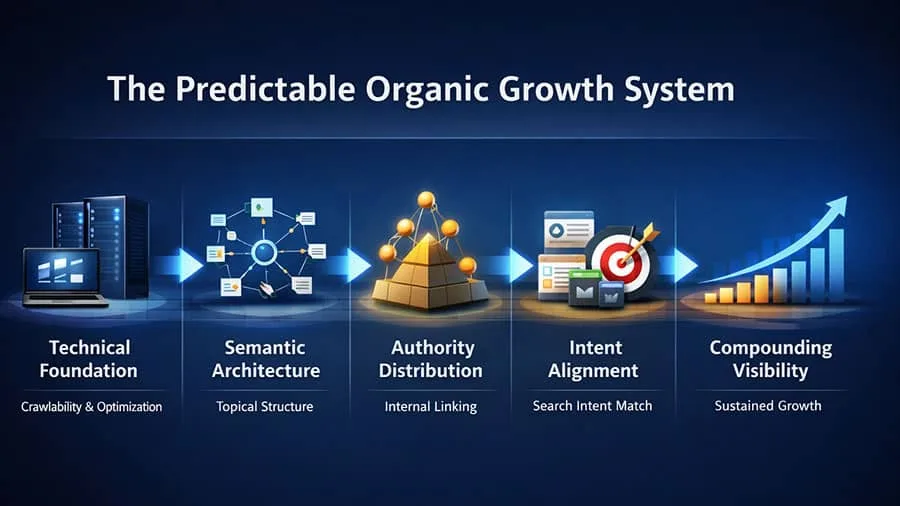
Predictable organic growth is not the result of content volume
or tactical SEO activity. It emerges when four structural conditions align:
• Technical discoverability
• Intent-aligned content
• Topical authority
• Measurement feedback loops
Most SEO reporting answers one question exceptionally well: What happened last month? Traffic went up. Rankings held. CTR declined slightly. Year-over-year, we are broadly on track. The slides look clean, the data is accurate, and the room is politely unimpressed. Because executives do not build next year’s budget on what already happened. They build it on what will happen – and if SEO cannot speak that language, it quietly loses credibility in the rooms that matter most.
Predictable organic growth is not a reporting outcome. It is a forecasting discipline. And moving from one to the other is the single most important shift SEO teams can make in 2026.
Reporting Is Rear-View Driving
I have sat through hundreds of SEO reviews across organizations at multiple scales – from fast-growing SMEs to global enterprises managing multi-market digital estates. The pattern repeats itself almost universally. The metrics presented are real, the trends are accurately tracked, and the analysis is technically sound. Yet the conversation rarely reaches the strategic level, because the entire frame is retrospective.
Organic sessions, keyword positions, CTR, visibility metrics, and technical fixes completed – these are all valuable data points. However, none of them answer the questions executives actually bring into planning cycles. What organic revenue should we expect next quarter? What is our realistic growth ceiling within this category? What happens to the pipeline if we increase investment by 30%? What is the compounding risk if we do nothing for six months? When SEO cannot answer those questions with structured, defensible projections, it remains a reporting function, not a strategic one. Forecasting is precisely what changes that dynamic.
Why Most SEO Forecasts Still Fail
When organizations attempt forecasting, the models tend to share the same structural weaknesses. Ranking-based forecasts rely on average CTR assumptions that can break down quickly when the SERP landscape is crowded with ads, featured snippets, or other elements that shift click behavior. Layer on top of that the static search volume assumptions and linear growth projections that ignore competitive movement, and the result is a forecast that looks confident on paper but collapses under scrutiny.
Zero-click searches are now appearing in roughly 15% of queries and growing, which means a number-one ranking no longer delivers the traffic volumes that older CTR models assumed. Add the reality of frequent algorithm volatility – Google pushed five major core updates in the past year alone – and rank-based forecasting becomes structurally fragile as a planning instrument.
The deeper issue is that most forecasting models treat demand as fixed. They project what existing rankings might deliver, rather than modeling what total addressable demand actually exists and what share of it is realistically capturable. That is a fundamental distinction, and it is where the shift toward demand-based forecasting becomes essential. You can read more about how misreading data leads to exactly these planning failures in my earlier piece on how enterprise teams misread data.
The Shift: From Rankings to Demand Modeling
Predictable organic growth begins with a different set of questions. Instead of asking how many keywords we can rank for, the model should ask what commercial demand exists in our category and what share we can realistically capture given current authority, execution capacity, and competitive positioning.
This reframes SEO from an optimization activity into market modelling – and that reframe is what earns it a place in strategic planning conversations. The five pillars of a demand-based forecasting model are total addressable search demand, intent segmentation across the purchase journey, conversion potential by cluster, competitive capture rate at current and projected authority levels, and implementation capacity as a governing constraint on speed. Each of these inputs feeds the model. Leave one out, and the forecast either overpromises or underestimates, both of which damage credibility.
For organizations with structured content architecture, this type of modelling integrates naturally with semantic cluster governance – because clusters built around intent give you the cleaner demand signal that makes forecasting both more accurate and more defensible.
Scenario-Based Forecasting: The Executive-Grade Model
One of the most credible structural choices in executive-level SEO planning is the scenario model, because it replaces single-point predictions – essentially brittle – with a range of outcomes tied to specific investment and execution decisions. Modern SEO forecasting uses scenarios, documented assumptions, and ranges rather than promises, which set realistic expectations, build trust with leadership, and provide a framework to adapt when the search landscape shifts.
A conservative scenario is anchored in incremental improvements to existing content and authority, with current implementation cadence maintained. A strategic investment scenario assumes architectural upgrades, cluster expansion, structured data enhancement, and sufficient development bandwidth to execute. An aggressive expansion scenario incorporates new markets, additional product categories, and meaningful entity footprint growth that extends reach beyond the current domain authority profile. This three-scenario model transforms SEO from a cost center into an investment model. It gives leadership something they can actually pressure-test: a choice set with clearly defined assumptions, not a single number that either lands or doesn’t.
Capacity Is a Forecasting Variable, Not a Footnote
One of the most consistently overlooked constraints in enterprise SEO forecasting is implementation capacity – and ignoring it is one of the most common reasons forecasts miss. Forecasting SEO is fundamentally about resourcing: documenting how many articles can be published monthly, the development hours available for technical fixes, and link-building capacity. Growth potential may genuinely exist in the demand landscape, but development bandwidth, content production limits, accumulated technical debt, and governance maturity all define the speed of execution.
I have seen organizations with strong demand opportunities and well-structured forecasts consistently underdeliver because capacity constraints were excluded from the model. The forecast becomes optimistic fiction rather than operational intelligence. Predictable organic growth requires explicit alignment between demand opportunity and operational capacity – and when that alignment is missing, the model breaks before execution even begins. My earlier article on SEO governance addresses this constraint directly, because capacity and governance are inseparable in practice.
AI as a Forecasting Multiplier – With Appropriate Limits
AI tools are genuinely changing what is possible in forecasting, primarily through pattern detection across large intent clusters and predictive trend identification that would take human analysts significantly longer to surface. Advanced teams use these capabilities to model emerging demand before it peaks, rather than reacting to trends after they are already established. Traditional performance forecasting must now be augmented with AI-aware signals – including visibility in generative responses, AI Overviews, and LLM citations – because these increasingly shape user behavior and influence demand without generating a click.
That said, AI does not replace forecasting strategy. It enhances modeling precision when the underlying architecture is sound. Without clean entity structure, structured data integrity, and a defensible semantic framework, AI tools surface noise as readily as signal. The foundation still matters – and for organizations assessing where they stand, AI search readiness is the right place to begin that audit.
What Executive-Level Forecasting Actually Delivers
A mature SEO forecasting model answers questions that traditional reporting cannot touch. Expected organic revenue next quarter, with a documented confidence range. Pipeline value contribution segmented by intent cluster. Growth delta from specific initiatives – so leadership can evaluate individual investments rather than the channel in aggregate. Risk exposure if identified technical issues persist without remediation. Expansion potential by market is particularly relevant for organizations managing an international SEO structure across multiple regions.
Before embarking on costly projects like complex technical fixes or high-volume content creation, forecasts allow decision-makers to determine whether potential gain outweighs the effort and expense – reducing the risk of misallocated investment. That is not reporting. That is strategic intelligence, and it is the level at which SEO earns genuine organizational influence.
The Credibility Shift That Forecasting Creates
There is a tangible difference in how SEO is received in planning conversations depending on the frame it arrives in. When a team walks in with “traffic increased 12% last quarter,” they are heard, acknowledged, and moved past. When a team walks in with “based on current demand modeling across our three primary intent clusters, we project €2.4 million in incremental organic revenue over the next two quarters if cluster architecture work is prioritized in Q2” – the conversation changes entirely. Forecasting shifts the conversation from “trust me” to “here’s the math,” which means speaking the language executives already use for every other business decision.
That shift changes perception, budget access, and cross-functional cooperation simultaneously. It moves SEO from a channel that reports outcomes to a discipline that models futures – and that is a fundamentally different organizational position. For teams still in the process of establishing that credibility, the foundational argument is well worth revisiting in terms of why most SEO teams are solving the wrong problem.
The Bottom Line
Historical reporting proves effort. Forecasting proves control. If SEO wants a seat in strategic planning – not just a slide in a marketing review – it must demonstrate the ability to model futures, not just measure the past. Executives do not invest in channels. They invest in models that scale, and forecasting is the mechanism that makes SEO look like one.
The transition from reporting to forecasting is not a technical upgrade. It is a strategic repositioning of what SEO means inside the organization. And the organizations that make that shift earliest will hold a structural advantage that compounds over time.
Predictable organic growth FAQ
Predictable organic growth is the ability to model future organic revenue and traffic outcomes with a defensible degree of confidence, based on demand data, competitive positioning, conversion potential, and execution capacity – rather than simply reporting on past performance. It is the shift from SEO as a historical scorecard to SEO as a forward-looking business model. Organizations that achieve it can answer executive questions about pipeline contribution, growth scenarios, and investment return before the quarter begins, not after it ends.
Reporting tells you what happened. Forecasting tells you what will happen – and under what conditions. In executive planning cycles, the second question is the one that drives budget decisions, headcount approvals, and strategic prioritization. When SEO teams present only historical data, they are answering a question no one is actively making decisions on. Forecasting repositions SEO as a demand modeling discipline, which is the frame that earns it influence in boardrooms and planning sessions rather than just marketing reviews.
An enterprise SEO forecast starts with total addressable search demand segmented by intent – informational, navigational, and commercial. From there, you layer in realistic capture rates based on current domain authority and competitive gap analysis, apply conversion rate assumptions by cluster, and model three scenarios: conservative, strategic investment, and aggressive expansion. Critically, you must factor in implementation capacity – development bandwidth, content production limits, and governance maturity – as a hard constraint on how fast the growth curve can actually move. Without that constraint in the model, the forecast becomes aspirational rather than operational.
Rank-based forecasting starts with current keyword positions and projects traffic by applying average CTR curves to search volume estimates. It is simple to build and consistently unreliable at scale, because it assumes static SERP structures, stable click behavior, and linear ranking improvements – none of which hold in competitive enterprise environments. Demand-based forecasting starts with the total commercial search demand that exists in a category and models what share of it is realistically capturable given authority, architecture, and execution pace. It is more complex to build and significantly more defensible in executive conversations.
AI changes forecasting in two material ways. First, it accelerates pattern detection across large intent clusters, surfacing emerging demand signals before they peak in traditional keyword tools. Second, it introduces a new visibility layer that most legacy forecasting models ignore entirely – AI Overviews, LLM citations, and generative search responses now influence user behavior and pipeline contribution without generating a click. A complete enterprise forecast in 2026 must account for both traditional organic traffic and AI-layer visibility, because optimizing for one without the other produces an incomplete picture of actual commercial impact. My article on AI search readiness covers the foundational requirements in detail.
The most common failure point is not methodology – it is missing inputs. Forecasts that exclude implementation capacity constraints, treat search volume as static demand, ignore SERP feature volatility, or use generic CTR benchmarks rather than category-specific data will consistently overpromise. A second structural failure is building a single-point forecast rather than a scenario range. Single numbers collapse credibility the moment market conditions shift. A scenario-based model with documented assumptions survives volatility because it frames growth as a range tied to decisions, not a prediction tied to hope.
Executive audiences respond to forecasts framed in business outcomes, not SEO metrics. That means presenting expected organic revenue contribution by quarter, pipeline value attributed to specific intent clusters, growth delta from proposed initiatives versus a baseline scenario, and risk exposure if identified technical issues are left unaddressed. The format should mirror how finance presents investment cases – with scenario ranges, assumption documentation, and clear linkage between SEO activity and commercial outcome. Traffic numbers and keyword rankings belong in the appendix, not the executive summary.
Implementation capacity is the single most underestimated variable in enterprise SEO forecasting, and ignoring it is the most reliable way to produce a forecast that misses. Growth potential in the demand landscape is one dimension. The speed at which an organization can actually execute against that potential – through content production, development throughput, and governance processes – is an entirely separate and often more constraining dimension. A forecast that models demand opportunity without modeling execution capacity is not a business forecast. It is an optimistic document. The two must be explicitly aligned for the model to hold.
Yes – but the forecast model must be calibrated accordingly. A lower domain authority changes the competitive capture rate assumptions and extends the timeline for ranking in high-volume clusters, but it does not eliminate the ability to forecast. In fact, lower-authority domains often benefit most from a demand-based model, because it identifies high-intent, lower-competition clusters where capture is achievable within realistic authority constraints. The discipline of forecasting is the same regardless of domain maturity. The inputs and timelines differ. For teams building from a growing content base, semantic cluster architecture provides the structural foundation that makes forecasting progressively more accurate as authority compounds.
A well-structured enterprise SEO forecast should be reviewed quarterly and updated whenever a material change occurs – a significant algorithm update, a major competitive shift, a substantial change in implementation capacity, or a new market or product category entering scope. The underlying model should remain consistent so that trends are comparable across periods, but the inputs – demand signals, competitive capture rates, conversion assumptions – should reflect current conditions. An annual forecast with no mid-year revision is as unreliable as a quarterly report with no year-over-year context. Forecasting is a living model, not a one-time exercise.
Forecasting without governance is planning without execution infrastructure. A forecast models what growth is possible and under what conditions. Governance defines whether the organization has the processes, ownership structures, and decision-making clarity to actually deliver it. In my experience across enterprise organizations, the gap between forecast potential and realized growth almost always traces back to a governance failure – not a demand failure. If the forecast projects cluster execution across six markets in two quarters but no one owns the cross-functional workflow to make that happen, the model is accurate, and the result is not. SEO governance is what converts a forecast from a planning document into a delivery framework.
The readiness signal is not technical – it is organizational. When SEO teams have clean data pipelines from Search Console and analytics, a defined content architecture organized by intent cluster, visibility into implementation capacity across at least one planning cycle, and basic conversion attribution connecting organic traffic to the pipeline, the inputs for forecasting exist. The barrier at that point is usually confidence and internal positioning, not data. If your current reporting already tracks performance by cluster, monitors competitive movement, and attributes organic contribution to revenue even approximately, you have enough foundation to build a first-generation forecast. Starting imperfectly is significantly better than waiting for perfect data that will never fully arrive.