

Table of contents
- A Multilingual Cannibalization Case Study
- The Setup: 80 Markets, One English Template, Zero Local Intelligence
- What Multilingual SEO Cannibalization Actually Looked Like
- The English-Speaking Market Illusion
- Japan and Thailand: Where Auto-Translation Fails Completely
- Is This Happening in Your Markets Right Now?
- Why the System Kept Running Anyway
- The Cost Nobody Was Counting
- What the Fix Required
- What This Means for Your Organization
- You’ve Read the Problem. Now Let’s Look at Your Specific Situation.
- A Multilingual Cannibalization Case Study FAQ
A Multilingual Cannibalization Case Study
Multilingual SEO cannibalization is one of the most expensive silent problems in enterprise digital marketing. It doesn’t announce itself with a penalty notice or a traffic cliff. It erodes slowly, market by market, keyword by keyword – and by the time someone in leadership notices, the damage runs deep across dozens of country sites.
I’ve written before about international website cannibalization as a structural problem. This is the real case behind it.
The Setup: 80 Markets, One English Template, Zero Local Intelligence
During one of my enterprise roles, I worked inside a global organization operating across more than 80 markets. The digital team had built what looked, on paper, like an efficient system: a centralized content team produced English-language pages, and a translation pipeline automatically published those pages across every regional site. Fast. Scalable. Auditable. A logistical success story.
In SEO terms, it was a slow disaster.
The translation team’s brief was linguistic accuracy, not market performance. Nobody in that workflow owned keyword research for Japanese. Nobody validated search intent for the Thai market. Nobody questioned whether the product terminology that resonated with buyers in the United States carried the same weight – or even the same meaning – in Germany, Brazil, or South Korea. The assumption was simple and dangerously wrong: translate the words, and the market will follow.
What Multilingual SEO Cannibalization Actually Looked Like
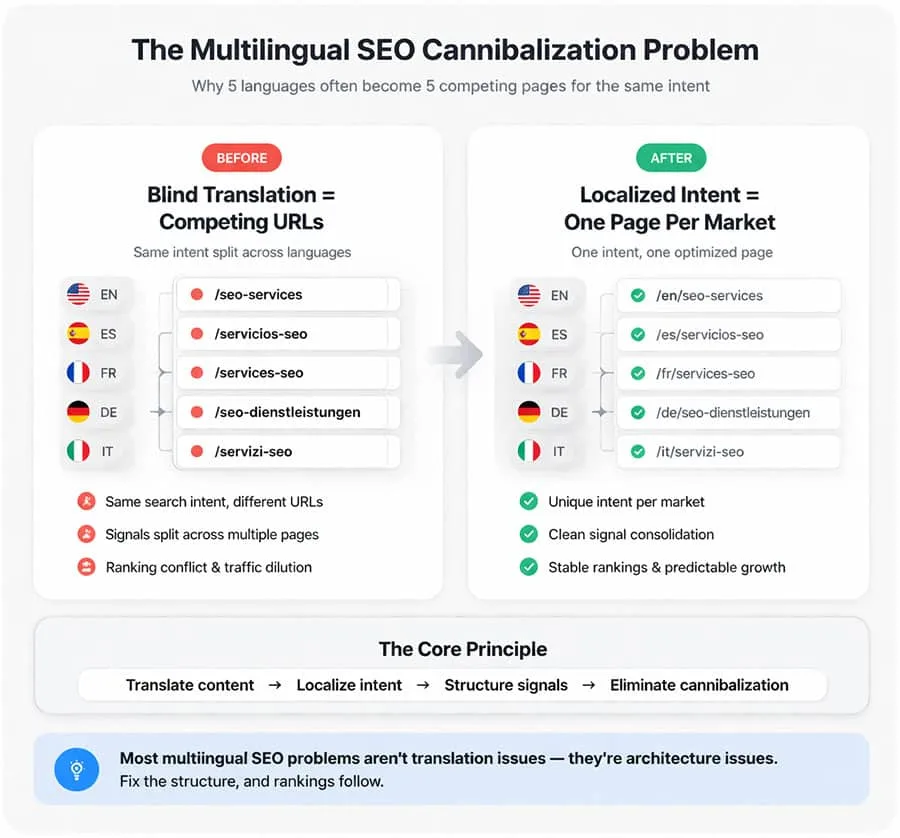
The first problem that surfaced was the one most SEO teams recognize: page-on-page cannibalization across English-speaking markets. The UK site, the US site, the Australian site, and the Canadian site were all publishing near-identical content, each targeting essentially the same English-language queries. Google had to choose which version to rank in each market – and it often chose the wrong one.
When content across regional subfolders is identical or very similar, combined with an incomplete hreflang setup, the wrong version ends up ranking for queries in the wrong country. That is exactly what happened. Australian users were served the UK page. UK users occasionally saw the US version. The hreflang annotations existed, but they were incomplete – research has found that 42% of global sites only implement hreflang on the home page and key category pages, leaving product pages entirely to Google’s interpretation.
The consequence was not just a rankings fluctuation. It was a conversion problem. A buyer in Sydney landing on a page with UK pricing, UK product codes, and UK contact information does not convert. They leave. The SEO team reported traffic. The business reported weak regional revenue. Nobody connected the dots until we ran a market-by-market analysis.
The English-Speaking Market Illusion
There is a persistent assumption in enterprise content teams that English is English. A single set of English pages should serve all English-speaking markets. It is a reasonable-sounding hypothesis that falls apart the moment you look at actual search behavior.
The search query patterns between US and UK buyers for industrial equipment – to use a category familiar to many global B2B organizations – differ significantly. Terminology differs. Purchase-intent signals differ. Even the way questions are structured in a search engine differs. Even within the same language, significant cultural differences impact content engagement, and the same logic applies to search behavior. A user in the UK searching for “compressed air solutions” and a user in the US searching for the same concept may use entirely different keyword constructs. When both markets share one page, neither market is served well.
Beyond terminology, local competitive dynamics are completely invisible to a centralized content team. The page that dominates a query in the US may sit at position 15 in Australia because a strong local competitor owns that space with localized, authoritative content. Publishing a translation does not close that gap. It ignores it entirely.
Japan and Thailand: Where Auto-Translation Fails Completely
The English market misalignments were fixable with hreflang corrections and targeted content differentiation. The Asian market failures were a different category of problem entirely.
A machine-translated page in Japanese may use direct constructions that feel aggressive in a culture where indirectness signals credibility. The grammar is correct. The meaning is preserved. But the page fails to persuade because it does not match the reader’s expectations for how a trustworthy business communicates.
That description is precise. In the Japanese market, our auto-translated pages were technically accurate and culturally tone-deaf. Japanese business communication follows conventions of indirection, formality, and relationship-first framing that machine translation does not model. The pages read, to a native speaker, like a foreigner shouting product benefits in grammatically correct but socially incorrect Japanese. Buyers noticed. They bounced. And because the pages ranked – at least initially – on the strength of domain authority, the rankings masked the conversion failure for months.
Thailand presented a different version of the same failure. If your SEO content sounds off or machine-translated, your brand will struggle to rank and resonate – especially in high-context cultures like Japan or Korea. The Thai pages had a more fundamental problem: automated translation tools at the time could not handle the tonal complexity of Thai script with sufficient accuracy. Some pages were not just culturally misaligned – they were linguistically incoherent. End readers encountered text that did not make sense as written Thai. The pages were indexed, crawled, and served to Thai users who had no reason to trust a brand that could not communicate in their language at a basic level.
The business impact was not a soft SEO metric. It was zero traction in two significant markets, wasted publishing infrastructure across both, and a reputational signal to local competitors that the organization was not seriously committed to those markets.
Is This Happening in Your Markets Right Now?
Most enterprise teams don’t discover international cannibalization until it has already cost them 12 to 18 months of organic growth in markets they should be winning. By the time it shows up in a board report, the damage is done.
If your organization publishes content across multiple markets – and you’re not certain your regional pages are working for you rather than against each other – it’s worth a conversation before it becomes a crisis.
Why the System Kept Running Anyway
This is the part that enterprise SEOs will recognize with uncomfortable familiarity. The system kept producing pages because the people running it were measured on output, not outcomes. The translation vendor delivered volume. The content operations team hit their publishing targets. The regional site managers received pages and published them. Nobody’s KPI included Japanese organic conversion rate or Thai page engagement depth.
Most companies treat translation like an afterthought – they create content, finalize campaigns, then scramble to get everything translated before launch deadlines. Without API-based connectivity between content management systems and translation platforms, companies face constant challenges maintaining multilingual consistency.
The deeper issue was structural isolation. SEO lived in one silo. Translation lived in another. Local market teams – where they existed at all – had no formal authority to flag content quality before publication. The workflow was linear and fast, optimized entirely for speed with no feedback loop for market performance.
Visibility now depends on decisions that rarely show up in a localization brief – how phrasing is shaped, how trust is earned, and whether the content makes sense to the systems that process it. If localization teams don’t take it on, it won’t get done.
This isn’t just a translation issue – it’s a structural failure in how the system is designed. When multiple pages across languages target the same intent without clear differentiation, you’re not expanding reach – you’re fragmenting it. This is exactly where most international setups break: they scale content across markets, but never scale the underlying logic. If you look at it through the lens of semantic cluster governance, the problem becomes obvious – the system simply isn’t built to support intent separation.
The Cost Nobody Was Counting
Every organization running this model carries a hidden cost that does not appear in the content production budget. It appears in the numbers that executives eventually ask about: why is our organic traffic in Germany declining? Why are our Japanese conversion rates so low? Why does our competitor dominate Southeast Asia when we have pages in every market?
When different language versions compete, ranking authority becomes fragmented rather than consolidated, resulting in weaker positions across all languages instead of strong rankings in each target market. The pages that were supposed to multiply reach were instead dividing authority. Every auto-translated page that cannibalized another split the link equity that should have accumulated in a single authoritative document.
Beyond the cannibalization mechanics, there was a user trust problem with direct commercial consequences. Research across 8,709 consumers in 29 countries found that 76% of online shoppers prefer to buy products with information in their native language, and 40% will never purchase from a website in another language. When the “native language” version reads like a machine output, those numbers likely skew worse. We were not competing against local competitors. We were competing against the reader’s trust threshold – and losing.
What the Fix Required
Stopping the damage required changes at three levels, none of which were purely technical.
Governance first. The workflow requires a new gate: no page can be published in a market without sign-off from someone accountable for that market’s performance. That accountability structure often doesn’t exist. Creating it meant changing how the translation project was funded and measured – a conversation that belonged at the VP or Director level, not in the SEO team.
Market-specific keyword research. Going beyond simple translation requires in-depth keyword research in the target languages – understanding search intent, local terminology, and variations in keyword usage. Tools and native speakers are both necessary. For the markets where you have the most to gain, try to commission native-language keyword research from scratch. The results consistently show significant divergence from what the direct translations are targeting.
A hybrid localization model. The right approach is a hybrid workflow that leverages AI for speed and consistency, while utilizing human linguists for final review, cultural nuance, and transcreation. Full human translation at scale is not economically viable for 80 markets. But auto-translation without human review is not viable either – as the Japanese and Thai cases demonstrated clearly. The sustainable model uses automated translation as a first draft, followed by in-market review for cultural and commercial alignment.
Hreflang remediation as a foundation, not a fix. Correcting the hreflang implementation was necessary and non-negotiable. But it was not sufficient. Hreflang tells Google which page to serve. It does not fix the page’s relevance to the market once it arrives. Hreflang was a precision instrument in a rules-based world – it told Google which page to serve in which market. But AI search engines generate responses rather than serving pages, and hreflang becomes advisory, not authoritative. In the current search environment, the quality and local alignment of the content itself carry more weight than the tag pointing to it.
Fixing this wasn’t about rewriting content or improving translations – it required redefining how intent is mapped and distributed across markets. Instead of duplicating pages per language, the structure had to reflect how users actually search in each region. That’s where most teams struggle, because this isn’t a content task — it’s an intent and retrieval problem. This is exactly why SEO acts as the foundation layer of AI retrieval, not something that sits on top of it.
What This Means for Your Organization
If your organization publishes multilingual content at scale – whether across language versions of a single site or across country-specific domains – the question is not whether this problem affects you. The question is how severe it is and which markets are bleeding most.
The diagnosis is straightforward. Pull your Google Search Console data by country. Filter by market. Look for pages from the wrong region appearing in the wrong country’s results. Look for multiple URLs competing for the same query. Look for high impression, low click-through performance in markets where your pages should be winning. That pattern – visible ranking, poor engagement, weak conversion – is the signature of exactly this problem.
The fix is not a technical project. It is a strategic decision about how your organization values market-specific performance against the efficiency of centralized content production. Every enterprise I have worked inside has made this trade-off in favor of efficiency. Most have paid for it in market share they never fully recovered.
The organizations that get international SEO right treat localization as a market entry decision, not a content operations task. They assign ownership at the market level. They measure performance at the market level. And they resource the function with the same seriousness they would apply to any other go-to-market investment.
That shift in framing – from translation workflow to market strategy – is where the real return on international SEO begins.
Most organizations don’t realize they have this problem because performance doesn’t collapse – it just plateaus. Traffic spreads thin across competing pages, signals get diluted, and growth stalls without a clear cause. Without a clear international SEO strategy, this becomes a recurring pattern rather than a one-time issue.
You’ve Read the Problem. Now Let’s Look at Your Specific Situation.
International cannibalization doesn’t resolve itself. Every week your regional pages compete against each other is a week your competitors are consolidating the authority you’re leaving on the table – market by market, query by query.
I work with SEO Managers, Heads of Digital, and enterprise leadership teams to diagnose exactly where this is happening, quantify the impact, and build a remediation plan that fits the operational reality of a large organization. Not a generic audit. Not a template report. A clear picture of what is broken, why it matters commercially, and what to fix first.
If that sounds like a conversation worth having, send me a message and we’ll take it from there.
A Multilingual Cannibalization Case Study FAQ
International website cannibalization happens when multiple pages across your regional or language versions compete for the same search queries. In an enterprise context operating across dozens of markets, this is rarely a one-off technical issue – it is a systemic failure that fragments authority, confuses search engines about which page to rank, and quietly erodes organic performance market by market. The reason it matters at the board level is straightforward: every cannibalizing page is a market where you are competing against yourself instead of your actual competitors.
Absolutely, and this is one of the most underestimated problems in enterprise SEO. When content across regional subfolders is identical or near-identical, combined with an incomplete hreflang setup, the wrong version ends up ranking in the wrong country. An Australian buyer landing on a UK page with UK pricing, UK contact information, and UK product codes does not convert. The SEO team reports traffic. The business reports weak regional revenue. The two numbers rarely get connected until someone runs a proper market-level audit.
Hreflang is the technical signal that tells search engines which page to serve to which audience based on language and region. Done right, it ensures the correct page version surfaces for the right audience – done wrong, it causes Google to show the wrong country or language version, or ignore your tags altogether. However, hreflang is a routing signal, not a quality signal. It tells Google which page to deliver. It does not make that page relevant, competitive, or culturally appropriate for the market once it arrives. Fixing hreflang is necessary. It is not sufficient.
The two most damaging errors at enterprise scale are missing return links and incorrect ISO language codes. Every hreflang tag must be reciprocated – if your English page points to your Spanish page, the Spanish page must point back. Missing return tags are among the most frequent causes of hreflang failure. The second error is using incorrect region codes – for example, writing en-UK instead of the correct en-GB. That single character difference means the tag is unlikely to be understood by search engines at all. At enterprise scale, both errors multiply rapidly across thousands of pages.
These two tags serve different purposes and must never be confused. If you place a canonical tag on your US page pointing to your UK page, you are effectively telling Google the US page is a duplicate, which can result in it being de-indexed entirely, destroying your visibility in the American market. Hreflang is the correct tool for regional variants. Canonical tags belong on true duplicates – for example, print versions or parameter-generated URLs – where you want one version to represent the content. Using the wrong tag in the wrong context is one of the fastest ways to lose market visibility at scale.
Yes – and it creates two distinct problems simultaneously. The first is structural: auto-translated pages targeting the same queries across markets fragment authority the same way any duplicate or near-duplicate content does. The second is more damaging commercially: the pages that do rank fail to convert because they do not reflect local search intent, local terminology, or local trust signals. In high-context markets like Japan, a grammatically correct but culturally tone-deaf page reads as untrustworthy to native speakers. In some Asian markets, automated translation tools have historically produced text that is linguistically incoherent to end readers. The pages get indexed. They do not build the business.
For every market that represents a meaningful commercial opportunity – yes. The assumption that translating high-performing keywords from your primary market will unlock success in other markets is one of the most expensive errors in international SEO. Search behavior, terminology, and purchase-intent signals differ materially between markets even when the underlying language is the same. International SEO strategies fail not because of poor planning but because of poor execution – businesses pour resources into technical foundations without the tactical precision that reflects real search behavior, local authority signals, and cultural expectations. For lower-priority markets, a tiered approach – full keyword research for tier-one markets, template-based optimization for tier-two, basic localization for tier-three – is a defensible and scalable position.
The x-default tag designates a fallback page for users whose language or region does not match any of your configured variants. It prevents search engines from making arbitrary choices when a user falls outside your targeted markets. Always include an x-default hreflang tag to define a fallback version for unmatched users. In practice, this typically points to a language-selection page or your global homepage. For organizations that have hreflang configured only for primary markets, the x-default tag ensures that the international architecture has a coherent fallback rather than leaving Google to guess.
The diagnostic starts in Google Search Console. Filter your performance data by country and look for patterns where pages from the wrong region appear in the wrong market’s results. Look for multiple URLs competing for the same query in the same market. Pay particular attention to markets where you have high impressions but low click-through rate – that pattern is often a signal that Google is surfacing a page that users recognize as the wrong version and do not click. Tools like Semrush’s Position Tracking cannibalization report and Screaming Frog for hreflang chain verification will surface the structural issues that GSC alone will not show you.
International SEO prioritizes consistency across shared languages. Multilingual SEO focuses on nuance. Both demand solid technical SEO to avoid cannibalization and confusion. A practical distinction: international SEO asks “which page should rank in which country?” – and the answer involves domain structure, hreflang, and geo-targeting. Multilingual SEO asks “does this page actually resonate with someone who speaks this language in this market?” – and the answer involves keyword research, cultural alignment, and content quality. Enterprise organizations operating across dozens of markets need both disciplines working in coordination. Running one without the other is where most of the expensive mistakes originate.
Each structure carries different trade-offs for cannibalization risk, authority distribution, and operational complexity. Country-code top-level domains (ccTLDs) send the strongest geographic signal to search engines but distribute authority across separate domains, meaning each country site effectively starts from zero in terms of link equity. Subdirectories concentrate authority on a single domain and allow hreflang implementation at scale, which is why most enterprise SEO teams recommend them for large multilingual operations. Subdomain implementations fall between the two – some authority sharing occurs, but subdomains are treated more independently, requiring careful technical setup to maximize authority flow. The right choice depends on your organizational structure, content governance model, and the commercial priority of each market.
Because English is not a monolithic search behavior. A buyer in Australia, the United Kingdom, Canada, and the United States may be using the same language but searching with different terminology, different purchase-intent signals, and different competitive contexts. The page that dominates a query in the US may sit at position 15 in Australia because a local competitor owns that space with localized, authoritative content that your centralized English page does not address. Beyond search behavior, local relevance signals – pricing, contact information, regional product availability, local case studies – affect conversion independently of rankings. Serving one English page across all English-speaking markets is an operational shortcut that consistently underperforms market-specific content.
The structural answer is accountability at the market level. Most organizations that experience chronic international cannibalization have a content governance model that optimizes for production speed rather than market performance. The translation workflow has an owner. The market’s organic performance does not. Fixing that requires assigning someone – whether a local SEO manager, a regional digital lead, or a market-specific agency – who is measured on country-level performance and has authority to block publication of content that does not meet local quality standards. Without that accountability gate, centralized production teams will continue optimizing for output, and cannibalization will continue accumulating market by market.
In some respects, yes. Traditional search engines could be guided toward the correct regional version through hreflang and geographic signals. AI search systems generate responses rather than serving pages, and they draw from content quality and relevance at the document level. As search engines build confidence in your international structure, they allocate crawl budget more efficiently across language versions – but without clear signals, crawlers may spend resources repeatedly checking whether pages are duplicates or distinct content. In AI retrieval, a page that reads as a low-quality translation or a near-duplicate of another version is simply less likely to be cited. The technical signals that helped in traditional search carry less weight. The quality and local relevance of the content itself carry more.
Start with a triage, not a rebuild. Identify which markets drive meaningful revenue or have clear growth potential – those are your tier-one priorities. For those markets, commission native-language keyword research and a content quality review before any other technical remediation. Alongside that, audit the hreflang implementation across those markets and correct the most common errors: missing return links, incorrect ISO codes, and canonical conflicts. For the remaining markets, a hybrid model – automated translation as a first draft, in-market human review before publication – prevents the problem from compounding further. Trying to fix 50 markets simultaneously is a project that will stall before it delivers results. Fixing five markets properly is a project that delivers demonstrable ROI and builds the internal case for broader investment.
When AI systems – ChatGPT, Perplexity, Gemini, and others – retrieve content to cite in responses, they assess document quality, specificity, and authority signals. A market with five near-identical auto-translated pages covering the same topic sends a signal of low information value across all five. None of them is distinctive enough to be the preferred citation source. By contrast, a single well-localized, market-specific page that reflects genuine local expertise and search behavior is far more likely to be cited as an authoritative source for that market’s queries. International cannibalization does not just suppress Google rankings – it dilutes the AI citation footprint that is increasingly becoming the primary discovery channel for enterprise buyers at the research stage of the purchase journey.
Noindex is the right decision when a regional page serves no genuine search function – for example, campaign landing pages that exist for paid media or email, or pages for markets where you have no real commercial presence. It is not the right decision as a substitute for localization. Noindex stops a page from cannibalizing your SEO pages – but deleting or merging pages, with redirects to the remaining page, is often the cleaner long-term solution for truly redundant content. The decision framework is straightforward: if the market has commercial value and the page has search intent behind it, localize it properly. If the page exists for operational reasons that have nothing to do with organic search, noindex or redirect it. Using noindex as a workaround for poor localization quality is a governance failure, not an SEO strategy.