
Table of contents
- Zero-Click Is Not a Traffic Problem. It Is a Visibility Shift.
- The Four Dimensions of Zero-Click Visibility
- Why Zero-Click Visibility Matters More Than Most Teams Realise
- Case Study: AI Surfaces an Unknown Site Above Established Brands – Before Google Indexed It
- The Strategic Shift: Visibility First, Traffic Second
- What Enterprise Organizations Must Do to Win Zero-Click
- Where This Fits in the Broader System
- FAQ
Visibility no longer begins and ends with a click.
A zero-click surface – a place where your brand, answer, or insight appears without requiring the user to navigate to your page – has become the primary battleground for attention and authority in AI-driven search environments.
Whether it is a generative snippet, an AI answer card, a knowledge panel, or a platform recommendation layer, zero-click surfaces represent controlled exposure in environments where users do not need to leave the interface to get answers. And yet, that exposure still shapes perception, consideration, and ultimately conversion.
For enterprise organizations still measuring search success by click volume, this is a structural blind spot – and it is costing them influence they cannot see in their dashboards.
This shift is part of a broader transformation in how visibility itself must be measured in the age of AI search.
The same dashboards that miss zero-click influence also mask deeper data interpretation problems. See how enterprise teams misread data and why it costs them growth.
Zero-Click Is Not a Traffic Problem. It Is a Visibility Shift.
The old model was simple: impressions lead to clicks, clicks lead to sessions, sessions lead to conversions. That chain still exists – but it is no longer the only chain that matters.
In the current landscape, users see you without clicking. AI systems reference you without generating a visit. Brand authority gets transmitted through mention and surface presence, not navigation. That means presence – not page traffic – has become the real currency of search.
This is not a future scenario. It is already happening at scale across enterprise search environments. Generative engines are extracting, summarising, and presenting brand and topic entities in AI answer cards. Users are forming opinions and making decisions based on what they see in those surfaces – before they ever visit a page, if they visit at all.
Traditional SEO drove traffic flow. Zero-click surfaces drive visibility gravity – the accumulated weight of being the source that systems consistently choose to surface.
The Four Dimensions of Zero-Click Visibility
Zero-click is not a single phenomenon. It operates across four distinct surface types, each with different mechanics and different implications for how enterprise teams should think about content and structure.
1. AI Answer Cards
Generative engines extract content and surface answers directly – often without linking to the source. This is influence without navigation. The brand or entity that gets cited in an AI answer card shapes the user’s mental model of the topic, regardless of whether they ever visit the page.
2. Knowledge Panels and Entity Blocks
When a search system has sufficient confidence in your entity – who you are, what you do, how you relate to other concepts – it displays you directly in a knowledge panel. This builds trust before traffic ever arrives. It also signals to the system that your entity is stable, well-defined, and worth surfacing proactively.
This is why entity-based SEO is not optional for organizations serious about AI-era visibility. Entity clarity is the prerequisite for knowledge panel presence.
3. Platform Discovery Feeds
AI feeds, assistant results, and social recommendation layers increasingly surface entity profiles and content summaries without requiring a click. These environments reach audiences earlier in the decision journey than traditional SEO ever did – and they operate largely outside the metrics frameworks most enterprise teams use.
4. Featured Snippets in Traditional SERPs
Featured answers in traditional search results give users the answer on the page, reducing clicks without reducing the prominence – or the influence – of the answer source. Being the cited source in a featured snippet still builds authority, even when no click follows.
Why Zero-Click Visibility Matters More Than Most Teams Realise
If an organization measures only clicks, it is ignoring the signal layer that actually drives status in a networked discovery ecosystem.
Zero-click visibility delivers four things that page traffic alone cannot:
Authority presence. Users see the brand before they visit – or instead of visiting. That first impression is formed in the search interface, not on your site.
Top-of-mind awareness. When your entity is consistently surfaced in answer environments, it becomes mentally anchored for users in your category – even those who never click through.
Influence layering. AI answers shape decisions mid-journey. A user researching enterprise software, industrial equipment, or professional services may encounter your brand multiple times in AI surfaces before ever initiating direct contact.
Faster momentum. Recognition through AI surfaces can build before traditional ranking stabilises – particularly for new content on lower-DA domains. I have seen this directly, and the clearest proof of it came from a project I run myself.
This visibility dynamic also explains why organic click volume is an increasingly unreliable primary KPI. The full argument is in the death of organic clicks as a KPI in AI search.
Case Study: AI Surfaces an Unknown Site Above Established Brands – Before Google Indexed It
The most direct proof of zero-click visibility I have seen first-hand came from Thai HUB, a project I run.
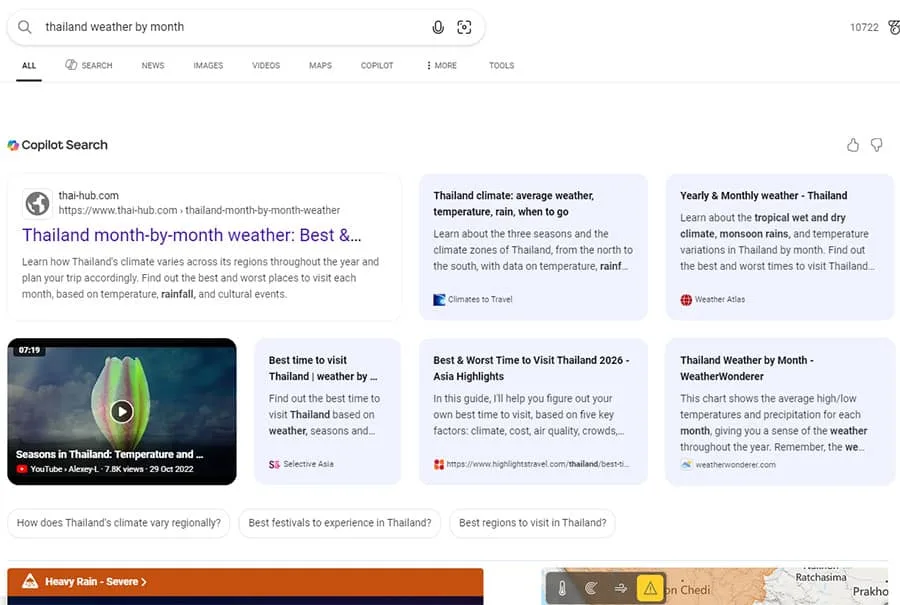
Early in the site’s lifecycle – before Google had fully indexed its pages, and with no backlink profile to speak of – AI discovery systems were already recognising and surfacing Thai HUB entities in AI search responses for non-branded terms. Not niche, obscure queries. Terms where well-known, established brands were the expected answer.
Users encountered Thai HUB in AI answer cards and discovery snippets before traditional rankings had formed at all. The site was appearing above brands with years of domain authority, simply because the entity signals were clear, the content was semantically coherent, and the topical relationships were explicitly architected. AI systems could interpret the entity with confidence – and they acted on that confidence immediately.
By the time Google’s indexing and ranking signals caught up, the brand already had established presence in the AI discovery layer. That early recognition accelerated the trust and engagement signals that reinforced ranking performance over time.
This is what zero-click visibility looks like when it works as a foundation – not a consolation prize for missing clicks, but as the leading edge of a visibility system that traditional metrics cannot yet see.
It also demonstrates something important for enterprise SEO leaders: AI search does not wait for Google’s permission. If your entity signals are clear and your content is semantically structured, AI systems will surface you – regardless of where you sit in traditional rankings. For new market entrants or brands expanding into new topic areas, this changes the strategic calculus entirely.
The Strategic Shift: Visibility First, Traffic Second
The mindset shift I consistently work to instil in enterprise SEO teams is this: stop asking did I get the click and start asking am I being referenced intentionally.
If the answer is yes – even without clicks – your visibility foundation is stronger than most teams recognise. Clicks remain useful signals. Recognition is the actual goal.
This is the difference between reactive SEO execution and proactive influence architecture. One optimises for what happened. The other engineers what gets seen.
What Enterprise Organizations Must Do to Win Zero-Click
Winning zero-click surfaces is not about gaming snippets or chasing features. It is about structural clarity – building the kind of entity signal that systems choose to surface because it is the clearest, most reliable answer available.
Build clear entity signals. Search systems must recognise who you are before they can show you. That means consistent branding, structured data, and entity mentions across trusted external sources. The mechanics are covered in entity-based SEO.
Optimise for short, direct, declarative answers. Generative systems extract meaning efficiently. They do not parse long narratives the way human readers do. Clear, structured responses in your content make it easier for systems to lift and surface accurate answers.
Align content with answer intent. Structure content to answer the question cleanly and completely – not to drive a click. When answers are clear, platforms use them. That usage is visibility, regardless of whether a click follows.
Build presence across strategic layers. Your modern frontlines are platforms, feeds, AI assistants, and syndicated sources. You will be seen before you are visited. That is the correct sequence now – and content strategy should reflect it.
The structural foundation for all of this is a coherent Visibility Strategy & System Design — and the readiness for AI surfaces specifically is what the AI Search Readiness Blueprint addresses.
Where This Fits in the Broader System
Zero-click visibility is not a standalone tactic. It emerges when search systems trust and understand your entity with high confidence – and that confidence is engineered, not accidental.
It is built through a structured Visibility Strategy & System Design, reinforced by AI Search Readiness, and grounded in the Semantic Cluster Blueprint that gives systems the topical coherence they need to surface your entity consistently.
If your organization is investing in content and not seeing the visibility returns you expect, the gap is likely structural – not executional. The AI Search Readiness Audit is designed to diagnose exactly that.
FAQ
Zero-click visibility refers to how often your brand or content appears directly in search results without requiring a user to click. Instead of measuring success by traffic, it focuses on being present where answers are already delivered.
A zero-click search happens when the user finds the answer directly on the search results page and doesn’t visit any website. The search engine or AI system satisfies the query instantly.
Search engines are evolving into answer engines. With features like AI-generated responses and rich results, users can get what they need immediately, reducing the need to click through to websites.
No – it means SEO is changing. Instead of only driving traffic, SEO is now about visibility, presence, and influence within search environments where users may never leave the results page.
Zero-click visibility comes from elements like featured answers, AI-generated summaries, knowledge panels, and other enhanced search features that display information directly on the results page.
Even without clicks, consistent visibility builds recognition, trust, and authority. Users may not visit immediately, but repeated exposure increases the likelihood of future engagement and branded searches.
SEO should shift from focusing only on rankings and clicks to optimizing for presence across all search features. This includes structuring content for direct answers and making it easily extractable by search engines and AI systems.
AI search accelerates zero-click behavior by generating complete answers directly in the interface. This makes visibility within AI-generated responses a key part of modern SEO strategy.
Content should be clear, structured, and directly answer questions. The goal is to make it easy for search engines and AI to extract and present your information within search results.
Yes, but it’s no longer the only metric that matters. Visibility, authority, and brand recall are becoming equally important indicators of SEO success.
→ Request an AI Search Readiness Audit For enterprise SEO managers and heads of digital who need to understand where their visibility stands in AI search surfaces – and what structural changes will move the needle.