
Table of contents
- What Personalized Search Layers Actually Mean
- How Personalization Changes What Visibility Means
- The Two-User Problem: Why Identical Queries Produce Different Visibility Outcomes
- Three Strategic Implications for Enterprise Organizations
- What This Means for How You Build Content
- FAQ
- Where This Fits in the Broader System
Search visibility used to be a fixed state. Rank here, appear there. The hierarchy was universal – the same query produced the same results for every user, and the work of SEO was to position a page as high as possible within that universal hierarchy.
That model is no longer the operating reality.
Modern discovery systems do not optimize for the most relevant answer for the largest number of people. They optimize for the best answer for this person, in this context, at this moment. Personalized search layers do not just respond to the words in a query – they react to identity, behaviour, history, preference, and situational context simultaneously. The result is a visibility landscape where two users submitting identical queries may see meaningfully different answers – and where your position in one user’s discovery environment says nothing reliable about your position in another’s.
For enterprise organizations that have built their visibility strategies around universal ranking metrics, this is a structural shift that most measurement frameworks are not yet equipped to capture.
What Personalized Search Layers Actually Mean
The mechanics of traditional search were relatively straightforward: a user types a query, the system matches it against an index, pages are ranked by relevance and authority, and the same ranked list is returned to everyone.
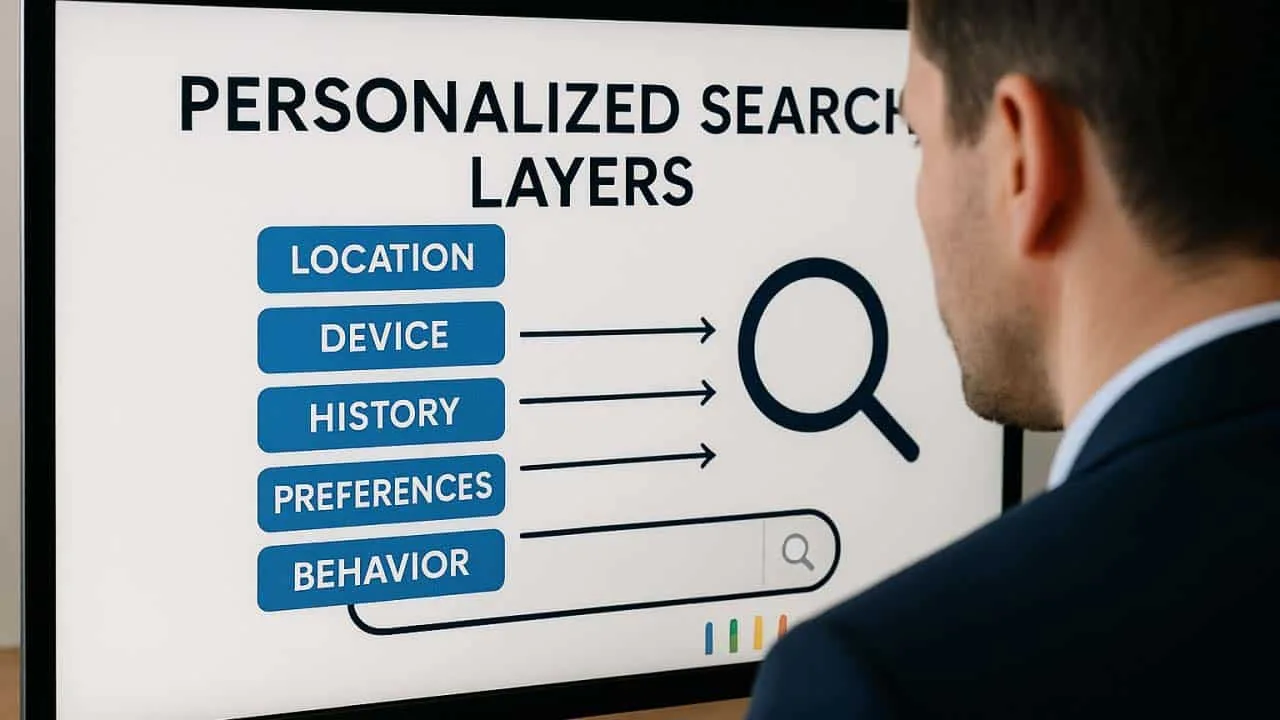
Personalized search layers introduce a different model. User context combined with behavioural signals and entity intent feeds into a system that infers what this specific user is actually trying to accomplish – and delivers a response calibrated to that inference, not to a generic interpretation of the query text.
The signals that drive this inference include behavioural history from current and past sessions, contextual data such as location, device type, and time of day, semantic patterns derived from the topics a user has previously explored, entity relationships based on what the user has interacted with before, and preference inference drawn from both explicit choices and implicit engagement patterns.
Together, these signals create a profile layer that modifies retrieval weighting in real time. Personalization is not an add-on applied after results are generated. It is a core mechanism of how relevance is resolved – and it operates whether or not a user is logged in, because systems can infer context from session-level signals without persistent identity data.
How Personalization Changes What Visibility Means
Traditional ranking assumed a fixed hierarchy of answer quality. Personalized layers assume a dynamic hierarchy of relevance – one that shifts based on who is asking and under what circumstances.
The practical implications for enterprise visibility are significant. Average rank position becomes a less meaningful metric when the rank you hold for one user cohort differs materially from the rank you hold for another. Your content may surface for a specific user context before it achieves page one ranking universally – because the system has determined, based on that user’s signals, that your entity is the most contextually relevant answer available.
This also means that visibility gaps are not always what they appear to be. An organization that appears to rank well on average may be significantly underperforming in high-value user contexts. Conversely, an organization with modest average rankings may be achieving strong visibility precisely within the user segments that matter most commercially. Neither of those realities is visible in a standard rank tracking report.
This connects directly to the broader problem of how enterprise teams interpret performance data – and why surface-level metrics so often mask structural realities. See how enterprise teams misread data and why it costs them growth.
The Two-User Problem: Why Identical Queries Produce Different Visibility Outcomes
Consider two procurement professionals at different organizations, both searching for the same enterprise software category at the same moment.
The first has a history of engaging with technical documentation, specification comparisons, and implementation guides. They are on a desktop device during business hours. Their session pattern suggests evaluation-stage intent – they are deep in a decision process and looking for detail.
The second has been browsing supplier directories and case study content. They are on a mobile device in the evening. Their session pattern suggests early-stage research – they are building a longlist and assessing credibility at a high level.
Traditional search treats both queries identically. Personalized discovery systems do not. The first user may see technical guides and detailed product comparisons prioritised. The second may see high-level overviews and social proof content surfaced first. An AI assistant synthesising a response may construct entirely different answers for each, drawing on different facets of available content based on inferred intent.
Your visibility in that environment is not determined by a single ranking position. It is determined by how well your entity and content architecture aligns with the full range of intent contexts your target users bring to their queries – across the entire decision journey, not just at the moment of peak commercial intent.
Three Strategic Implications for Enterprise Organizations
Dynamic entity exposure. Your entity’s visibility increases or decreases based on user affinity signals – not just keyword relevance. This means the relationship between your content and specific user cohorts matters as much as the relationship between your content and specific query terms. Organisations that build content depth across the full intent spectrum of their audience will compound their contextual visibility advantage over time.
Personalised answer prioritisation. Generative responses are tuned to inferred user preference patterns. Content that answers a question correctly is necessary but not sufficient – it also needs to resonate with the situational context in which the question is being asked. This requires understanding not just what your audience wants to know, but the circumstances under which they are likely to be asking.
Contextual resonance as a measurement dimension. Clicks, rankings, and impressions remain relevant signals, but they are incomplete in a personalised search environment. The measurement framework needs to extend to include entity presence within specific context clusters, AI answer citation frequency across different user cohorts, and engagement patterns within personalised discovery surfaces. This is a more complex measurement challenge than traditional SEO required – but it is the only framework that reflects how visibility actually works now.
What This Means for How You Build Content
The strategic response to personalised search is not to try to optimise for every possible user context simultaneously. That is neither feasible nor necessary. It is to ensure that your entity is clearly defined, your content is semantically coherent across the full depth of your topic authority, and your structural signals give discovery systems enough confidence to surface you appropriately across a range of contexts – without you having to engineer each one individually.
This is precisely why entity-based SEO is foundational. A clearly recognised entity with strong semantic relationships is one that personalised systems can place confidently within a wide range of user contexts. An entity that is ambiguous or structurally inconsistent will be placed inconsistently – or not at all – regardless of how well individual pages are optimised for specific queries.
It is also why zero-click visibility and personalised search are increasingly convergent phenomena. The surfaces where personalised answers appear – AI answer cards, generative responses, discovery feeds – are overwhelmingly zero-click environments. Visibility in those surfaces requires the same structural foundations: entity clarity, semantic depth, and coherent topical architecture.
FAQ
Is personalised search just cookies and browsing history?
No. Modern personalised search layers infer patterns from cross-session semantic intent and contextual signals – far beyond simple browsing history. The inference operates at the level of user purpose and situational context, not just past page visits.
Does personalisation only work for logged-in users?
No. Systems infer context from session-level signals and behavioural patterns without requiring a persistent login identity. Personalisation operates at varying degrees of precision depending on available signals, but it does not require authentication to function.
Does personalisation reduce search fairness?
It changes what fairness means in a search context. A universal ranked list treats every user identically, regardless of their actual needs. Personalised retrieval attempts to serve each user more precisely, which produces different results for different people, but arguably more relevant ones.
How should enterprise organizations measure visibility in a personalized search environment?
By tracking entity presence across context clusters, AI answers citation frequency, and engagement within personalised discovery surfaces – alongside traditional metrics. The goal is to understand how visibility varies across user contexts, not just what it looks like on average.
Does this make traditional SEO irrelevant?
No. The entity authority and semantic structure that traditional SEO builds are the foundation that personalised retrieval operates on. Without that foundation, there is nothing for personalisation to amplify. The two are complementary, not competing.
Where This Fits in the Broader System
Personalised search amplifies structural strengths and structural weaknesses equally. An organization with strong entity clarity and semantic depth will find that personalisation extends its visibility across more contexts and user situations. An organization with gaps in its entity structure or content architecture will find that personalisation makes those gaps more consequential, not less.
A properly implemented Visibility Strategy & System Design ensures that semantic clarity, authority signals, and contextual relevance align with the retrieval systems that personalisation operates within. That architecture is built through the Semantic Cluster Blueprint and stress-tested through AI Search Readiness – giving discovery systems the confidence to surface your organization accurately across the full range of personalised contexts your audience brings to their queries.
If you are not certain how your current content architecture performs across different user intent contexts, the AI Search Readiness Audit is the right place to start.
→ Request an AI Search Readiness Audit For enterprise SEO managers and heads of digital who want to understand how their entity and content architecture performs across personalised search contexts – and where the gaps are.