
Table of contents
Search used to be a text box. A user typed a phrase, a system matched it to pages, and visibility was determined by how well your content aligned with that phrase.
That model is breaking down – not gradually, but structurally.
Today’s discovery systems interpret meaning from multiple simultaneous input channels: text, images, voice, contextual signals, session history, location. Users do not just ask anymore. They show, speak, point, and communicate intention across modes. And AI-powered discovery systems have become sophisticated enough to synthesise those signals into a coherent understanding of what a user actually needs.
Multi-modal search is not a feature update. It is a fundamental shift in the language of human-machine communication – and for enterprise organizations built around text-first SEO strategies, it represents a significant structural gap in how they think about visibility.
What Multi-Modal Search Actually Means
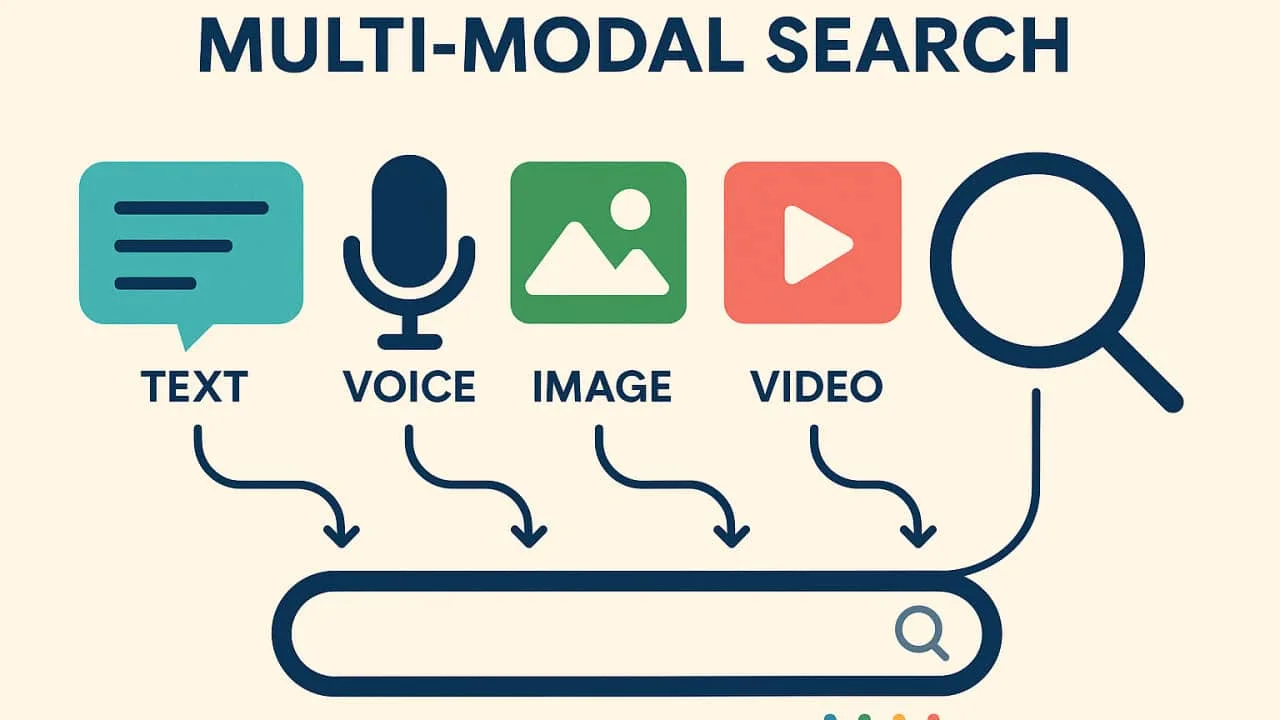
Multi-modal search refers to systems that understand and synthesise more than one type of input simultaneously. The input channels now in play include:
Text – traditional typed queries, still dominant but no longer exclusive.
Images – object recognition, scene analysis, and visual context that carries meaning independently of any accompanying text. A photograph of a component, a product, or a physical environment is now a query in its own right.
Voice and sound – spoken intent interpreted through natural language processing, often combined with other contextual signals to infer meaning that a typed query would not capture.
Gestures and visual markers – screenshots, annotated images, and visual reference points that users increasingly use to communicate what they are looking for.
Contextual data – location, time of day, device type, session history, and behavioural signals that help systems infer the why behind a query, not just the what.
The system no longer waits for typed instructions. It interprets meaning from multiple channels and constructs an answer that is holistic to the user’s actual intent – not just the surface-level words they happened to use.
This is the shift from asking for information to communicating intention. And it changes what it means for your brand to be visible.
Why This Matters for Enterprise Visibility
Multi-modal search does not replace the visibility foundations that came before it – it extends them into new dimensions.
Entity-based SEO establishes machine recognition of who you are as a concept. Zero-click visibility determines where and how you are surfaced without a navigation event. Multi-modal search determines whether you are interpretable across the full range of signals users now use to express intent.
If your entity is only recognisable through text – if your content, metadata, and structured signals are optimised exclusively for typed queries – you are visible in one language in an environment that now speaks several. That is an increasingly costly structural limitation, particularly for enterprise organizations operating across complex product catalogues, multiple markets, and diverse user behaviours.
The structural question of whether your organization is genuinely ready for AI-driven discovery – across all modalities – is what the AI Search Readiness Blueprint is designed to assess.
How Multi-Modal Signals Interact with Discovery Systems
Image Inputs Are Now Intent Signals
A photograph of a tool, a component, a product, or a physical environment is no longer just an image – it is a query. It does not need to be translated into text. It carries meaning directly.
Discovery systems analyse shape, material, context, and metadata, then map what they find back to related semantic entities. A user photographing an industrial component and receiving supplier recommendations without typing a single word is not a future scenario – it is current behaviour across mobile search and AI assistant interfaces.
For enterprise organizations with complex product catalogues – particularly in industrial, manufacturing, or technical sectors — this represents both a significant opportunity and a significant risk. If your product entities are not structured for visual recognition, you are invisible to a growing segment of discovery behaviour.
Voice Queries Are Contextual Commands
Users increasingly do not type their queries – they speak them. And spoken queries carry different intent signals than typed ones. They tend to be longer, more conversational, more contextual, and more often combined with other input signals.
“What is this part?” combined with a photograph is a compound signal that a text-only optimisation strategy cannot address. “Where can I find a supplier near me?” is a voice query whose answer depends on location context that has nothing to do with keyword matching.
Voice in combination with image context, location data, and session history produces a compound signal that AI systems interpret holistically. Optimising for any single one of those inputs in isolation misses how they actually function together.
Contextual Session Signals Augment Meaning
Time of day, browsing history, device signals, and prior session behaviour all contribute to how discovery systems interpret a query. These layers help AI systems infer why a user asked what they asked – which determines which entity gets surfaced as the answer.
This is also why personalized search is becoming an increasingly important dimension of enterprise visibility strategy. Contextual signals do not just affect ranking – they affect which entities the system considers relevant enough to evaluate in the first place.
Case Study: Multi-Modal Recognition Before Traditional Indexing
The clearest evidence I have seen of multi-modal discovery working independently of traditional search signals came from Thai HUB, a project I run.
Early in the site’s lifecycle – before Google had fully indexed its pages and before any meaningful backlink profile existed – AI discovery systems were already recognising and surfacing Thai HUB entities in response to non-branded queries. This happened because discovery systems were absorbing semantics from multiple signal types simultaneously: structured product entities, contextual relationships across categories, meta-linked descriptors, and signals from early user interactions.
In a multi-modal environment, an image of a Thai product can carry a query entirely on its own – and get surfaced in discovery layers regardless of whether any text is present. The system interprets meaning across modes, maps it to the most clearly defined relevant entity, and surfaces that entity – irrespective of where it sits in traditional rankings.
Thai HUB was appearing above well-established brands for specific non-branded terms not because it had outranked them in Google’s traditional index, but because its entity signals were clear enough for AI systems to act on immediately. That is multi-modal discovery operating as a genuine competitive advantage – available to any organization that structures its entity presence correctly, regardless of domain age or backlink volume.
Three Shifts Every Enterprise Organization Must Make
1. Design Content for Meaning Interpretation, Not Just Text Matching
Content must be structured to support interpretation across input types – not just text. That means images with rich contextual metadata, clear visual framing of products and concepts, structured data that describes entities in ways systems can parse across modes, and terminology that is consistent and unambiguous regardless of how a user expresses their intent.
Parsed meaning now consistently outperforms keyword matching. The organizations that adapt their content architecture to reflect this will compound their visibility advantage over those that do not.
2. Define Entity Presence Across Modal Inputs
Your brand’s semantic footprint needs to be recognisable even when users never type your name. A photograph, a voice query, or a contextual signal bundle should still map back to your entity with confidence.
This requires the same structural discipline as entity-based SEO – but extended deliberately across visual and contextual signal layers, not just text. It is the difference between an entity that exists in one dimension and one that is structurally present across the full surface area of modern discovery.
3. Evaluate Discovery Signals, Not Just Search Traffic
Visibility in a multi-modal environment is measured through appearance in generative responses, AI feed references, visual query answers, and context-aware discovery layers – not just clicks and sessions.
If your reporting framework only captures what happens after a click, you are measuring the outcome of a process you cannot see. The leading indicators of multi-modal visibility require a different measurement approach – one that tracks entity presence and citation frequency across discovery surfaces, not just traffic volume. This connects directly to why organic clicks are no longer a reliable primary KPI in AI-driven search environments.
Where This Fits in the Broader System
Multi-modal search requires discovery systems to connect entities across formats, contexts, and signal types. That capability depends on a clearly defined Visibility Strategy & System Design and strong semantic architecture built through the Semantic Cluster Blueprint.
When those foundations are in place, multi-modal discovery becomes an amplifier – extending entity recognition into new channels that reach users earlier, across more contexts, and with less dependence on traditional ranking signals. When they are not in place, adding multi-modal optimisation in isolation produces diminishing returns.
The AI Search Readiness Audit assesses where your organization currently stands across all of these dimensions – including multi-modal readiness – and identifies the highest-priority structural gaps to address first.
FAQ
Multi-modal search is the ability of search engines and AI systems to understand and process different types of input – such as text, images, voice, or video – within a single search experience.
Traditional search relies mostly on text queries, while multi-modal search combines multiple input types and contexts. Instead of just matching keywords, it interprets meaning across formats and signals at the same time.
Search behavior is no longer limited to typing. Users now combine voice, images, and text across devices, and AI systems are built to understand this blended input. This shifts how content is discovered and evaluated.
Modern AI systems convert different content types – text, visuals, and audio – into a shared understanding. This allows them to connect meaning across formats and deliver more accurate and context-aware results.
A user might upload an image, ask a question about it, and refine the query with text or voice. The system processes all inputs together to generate a more precise answer.
SEO is no longer limited to written content. Search engines evaluate pages based on how well text, visuals, and overall structure work together to communicate meaning and relevance.
Yes. Visual elements are no longer just supporting content – they are part of how search engines interpret meaning. Relevant and well-integrated visuals can strengthen how your content is understood.
Context – such as location, device, or user behavior – can be combined with different input types to refine results. This makes search more dynamic and personalized.
Content should be clear, well-structured, and supported by relevant visuals or formats. The goal is to make information easy to interpret across different input types, not just text.
Yes. Multi-modal capabilities are a core part of modern AI search. These systems can “see,” “read,” and “interpret” different types of content together, making them more effective at answering complex queries.
→ Request an AI Search Readiness Audit For enterprise SEO managers and heads of digital who want to understand how their entity presence holds up across text, image, voice, and contextual discovery — and what to fix first.