

International website cannibalization occurs when multiple language or regional versions of the same site compete for the same search intent without enough structural or semantic differentiation, diluting authority and reducing rankings.
If international expansion has already started affecting your rankings, diagnosing structural cannibalization early is critical.
International website cannibalization is one of the most consistent, most expensive, and least understood problems I’ve seen inside global enterprises. I’ve watched it play out at organizations with hundreds of millions in revenue, experienced digital teams, and genuine global ambition – and in almost every case, the same pattern repeats. A company decides to expand internationally. The marketing team is excited. Leadership is aligned. The mandate goes to the web team: get us into these markets. Six months later, organic visibility hasn’t multiplied. It’s redistributed – and in some markets, it’s gone entirely.
The instinct is to blame the algorithm, the competition, or the new market’s maturity. After 25 years in enterprise SEO – from start-ups through to Adecco Group and Atlas Copco – I’ve learned that the real cause is almost always internal. The organization didn’t expand. It duplicated.
When you translate a page without localizing it, you haven’t entered a new market. You’ve created a new competitor for yourself.
What International Website Cannibalization Actually Looks Like
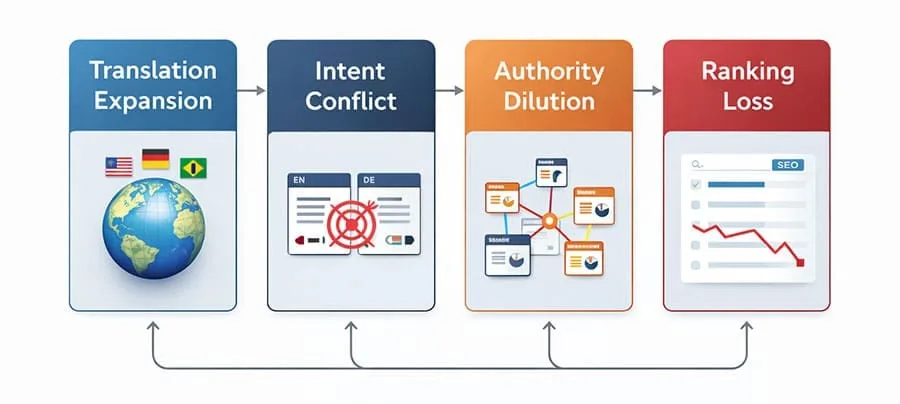
Let me describe what I’ve seen – not in theory, but in practice.
A large organization has a well-performing English-language website. They decide to enter three new markets: Germany, Spain, and Brazil. The brief goes to a translation agency or an internal team, and within a few weeks, translated versions of the key pages are live. The technical team adds hreflang tags – sometimes correctly, sometimes not – and the job is considered done.
Then, over the following quarters, something strange starts happening. The original English pages begin to lose rankings. The German pages aren’t ranking for German queries either – they’re competing with the English pages for the same concepts. The Brazilian Portuguese pages have engagement rates that look terrible. No one understands why.
This is international website cannibalization. It happens when multiple versions of your content compete for the same search intent without enough differentiation – structural, topical, or linguistic – to allow search engines to allocate authority clearly.
I covered the technical architecture side of this in my article on international SEO and GEO optimization. What I didn’t cover there – and what I want to address directly here – is the organizational behavior that causes the problem in the first place.
The Translation-First Fallacy
The most common mistake I see is treating international expansion as a content operation rather than a market strategy. The assumption is that if the words are in the right language, the page will perform. This is wrong for several interconnected reasons.
Search intent is not universal
The same product or service is searched for differently in different markets. The vocabulary differs. The stage of the buying journey where users turn to search differs. The level of sophistication and familiarity with the category differs. A translated page inherits the intent model of its source market. That model may be entirely misaligned with the target market’s reality.
I’ve seen this in B2B particularly. At Atlas Copco, the way industrial buyers in Sweden research compressor solutions is structurally different from how buyers in Brazil approach the same decision. One market is looking for technical specifications early in the process. Another is looking for use cases and trust signals. A translated page that doesn’t account for this doesn’t just underperform – it actively signals misalignment to search engines, which read engagement patterns.
Tone and cultural context affect trust signals
Search engines have become increasingly sophisticated at reading the relationship between content and user behavior. When translated content fails to convert, fails to generate engagement, and produces high bounce rates, that behavioral data feeds back into ranking decisions. A page that users leave immediately because it sounds foreign – even if it’s technically in their language – is a page that earns no authority.
This is not a soft concern. I’ve worked in organizations where translated pages were generating significant crawl budget consumption, ranking for nothing, and actively diluting the topical authority of the primary domain. The cost was real.
The English-language problem nobody talks about
Here’s the version of this problem that surprises most people: it also happens within English-language markets.
A UK-based organization expands to the US and Australia. The pages are already in English, so no translation is needed. The team assumes the content works globally. It doesn’t. American searchers use different vocabulary. Australian buyers have different regulatory contexts and different trust factors. The UK-origin content often ranks poorly in those markets – not because it’s wrong, but because it’s not calibrated to the signals those markets actually produce.
Meanwhile, the original UK pages start losing ground too, because their authority is being diluted across unqualified international variants. I’ve seen this create a situation where a company with strong UK visibility essentially spent two years undoing that work by expanding without a localization strategy.
Expansion without architectural clarity doesn’t grow your visibility. It redistributes it – and often shrinks the total.
Why This Keeps Happening Inside Large Organizations
I’m not pointing fingers at the people involved. The problem is structural.
Enterprise organizations routinely misread the data that would alert them to this problem. Traffic reports show the aggregate. Market-level visibility is buried in segments that nobody checks until something goes visibly wrong. By then, the cannibalizing pages have been live for months, have been linked to from other properties, and have started to influence the authority signals of the whole domain.
The digital team is typically measured on output – pages published, markets launched, languages covered. The SEO team is downstream of this decision and often doesn’t have the influence to pause an expansion roadmap. The translation agency delivers technically accurate content and considers its brief fulfilled. No one in this chain is wrong, exactly. But the system produces a bad outcome reliably.
This is part of a broader pattern I’ve written about: enterprise SEO teams solving the wrong problem. The focus is on execution speed when the real leverage is in architectural decisions made before a single page is published.
The Five Warning Signs I Look For
When I’m brought in to diagnose a large-scale visibility problem, these are the patterns that tell me cannibalization is the issue:
- Ranking volatility in the primary market coinciding with international launch dates. The timing is not coincidental.
- International pages with near-zero organic traffic but high crawl frequency. Search engines are evaluating them, finding insufficient differentiation, and deprioritizing them.
- Multiple language variants ranking for identical queries – not complementary queries, but the same ones. This is a signal conflict.
- Engagement metrics that diverge sharply between the original and translated versions, even when the content is conceptually identical.
- Hreflang implementation that is technically present but strategically wrong – pointing to equivalent pages when the intent behind those pages is actually different.
If you’re seeing any of these and haven’t run a structured indexation and crawl diagnostic, that’s the place to start.
What Structural Separation Actually Means
The solution is not to add more hreflang tags. It’s to treat each market as a distinct entity with its own intent model, its own topical depth requirements, and its own authority-building strategy.
This means several things in practice.
Market-specific keyword research – not translation of existing keywords
Every target market needs its own keyword analysis, conducted in the target language by someone who understands how that market searches. This isn’t a translation task. It’s a research task. The findings will often look different from the source market’s keyword map, sometimes radically so.
Localized user intent mapping
For each key page, ask: what is the user in this market actually trying to accomplish when they arrive here? What stage of the decision process are they in? What would make them trust this page? What would make them leave? These questions need local answers, not translated ones.
Content differentiation at the structural level
This is where entity-based SEO becomes relevant. Search engines understand the semantic relationship between content pieces. If your German page and your English page are structured around identical entity relationships with no local differentiation – different examples, different use cases, different contextual references – they will be treated as near-duplicates regardless of language.
Authority architecture that separates markets clearly
Whether you’re using ccTLDs, subdomains, or subdirectories, the internal linking structure, the content hierarchy, and the entity associations need to make it unambiguous to search engines that these are distinct properties serving distinct audiences. This is the visibility strategy and system design work that almost always gets skipped because it’s slower and less visible than launching pages.
What I Tell Leadership When I Walk Into This Situation
The conversation I have at executive level is usually uncomfortable, because the honest message is: the expansion you did twelve months ago has been working against your core market for twelve months. The good news is that it’s recoverable. The bad news is that it doesn’t recover by adding more content.
It recovers by making architectural decisions about which markets are worth investing in properly, which pages need to be consolidated or redirected, and which markets need to be rebuilt from the ground up with a localization strategy rather than a translation brief.
This is not a project for the translation agency. It’s a strategic realignment that involves SEO, brand, product, and leadership. It takes longer than a content sprint. But the alternative – continuing to run competing versions of your own content – is not a stable state. The cannibalization compounds over time.
I’ve seen organizations recover from this. The recovery always starts with the same thing: an honest diagnostic of where structural decay has taken hold, followed by a prioritized remediation plan that doesn’t try to fix everything at once but addresses the highest-impact conflicts first.
The markets worth entering are worth entering properly. Half-entry is not a resource-saving strategy. It’s a visibility-destroying one.
The Hidden Cost of International Cannibalization
What makes international cannibalization particularly dangerous is that the damage is rarely isolated to rankings alone. When multiple near-duplicate market pages compete for the same intent, search engines are forced to repeatedly crawl and evaluate content that offers little structural differentiation. This quietly consumes crawl budget that could otherwise reinforce stronger pages. At the same time, authority signals begin to fragment: backlinks, internal links, and behavioral signals are distributed across competing versions instead of consolidating around a clear canonical resource. Over time this creates a form of index bloat, where the search index contains multiple weak variants rather than a smaller set of authoritative pages. The result is predictable but often invisible until visibility drops: link equity is diluted, ranking potential weakens, and the domain’s overall signal quality deteriorates as search engines struggle to determine which version actually deserves authority.
Before You Launch Into the Next Market
If you’re planning international expansion, or you’re in the middle of one, here’s the set of questions I’d want answered before a single page goes live:
- Have we done independent keyword research in the target language, or have we translated our existing keyword map?
- Do we understand how user intent in this market differs from our primary market, or are we assuming parity?
- Is the content differentiated enough at the structural level that a search engine would treat these as distinct resources?
- Does our hreflang implementation reflect the actual relationship between these pages, or does it assume equivalence where equivalence doesn’t exist?
- Do we have a plan for building authority in this market separately, or are we expecting the primary domain’s authority to transfer automatically?
- Who owns the decision to pause an expansion if early signals show cannibalization?
That last question is the one that gets least attention. In most enterprises, the expansion roadmap is locked once it’s approved. The SEO team doesn’t have a clear escalation path if the data shows the launch is causing damage. Fixing this is partly a governance problem, not just a technical one.
A semantic cluster blueprint for each target market, developed before content production begins, goes a long way toward preventing these problems from emerging in the first place.
The Opportunity Cost Is Real
I want to close with something that often gets lost in the technical discussion: the markets you enter badly are not just underperforming – they’re actively preventing you from performing well in the markets you’re already in.
Every cannibalizing page that search engines are crawling and evaluating is consuming budget, attention, and authority that could be reinforcing your primary presence. Every market you enter without proper differentiation is a drain on the domain’s overall signal quality.
International expansion is one of the highest-leverage opportunities in enterprise digital strategy. I’ve seen it done well – at Portugal Homes, international visibility was a direct driver of revenue growth. Done properly, it compounds. Done poorly, it subtracts. The difference is almost always in how seriously the organization treats technical SEO risk management during the expansion phase, not after it.
The organizations that get this right treat international SEO as a market entry discipline. The ones that get it wrong treat it as a translation task. After 25 years of watching both, I can tell you the outcomes are consistently, measurably different.
If international cannibalization is a problem you’re dealing with inside your organization, I offer structured advisory engagements for enterprise SEO teams and leadership. Start with the Strategic Search Visibility Advisory page to understand how I work.